High-dose chemotherapy with stem cell transplant showed higher 2-year progression-free survival than lower-dose chemotherapy
Myeloablative vs nonmyeloablative consolidation for primary central nervous system lymphoma: results of Alliance 51101
Randomized phase 2 clinical trialBenefit found
Is myeloablative or nonmyeloablative consolidation better for primary central nervous system lymphoma?
Who
108
Patients aged 18 to 75 years with primary central nervous system lymphoma · United States
Compared
Myeloablative consolidation: 73% 2-year progression-free survival
Nonmyeloablative consolidation: 51% 2-year progression-free survival
Main outcome
Progression-free survival
Bottom line: Myeloablative consolidation with autologous stem cell rescue showed higher 2-year progression-free survival than nonmyeloablative consolidation.
Limitation: Landmark analysis showed no significant difference in progression-free survival among those completing consolidation therapy.
Blood Adv · 2024-04-10Download image
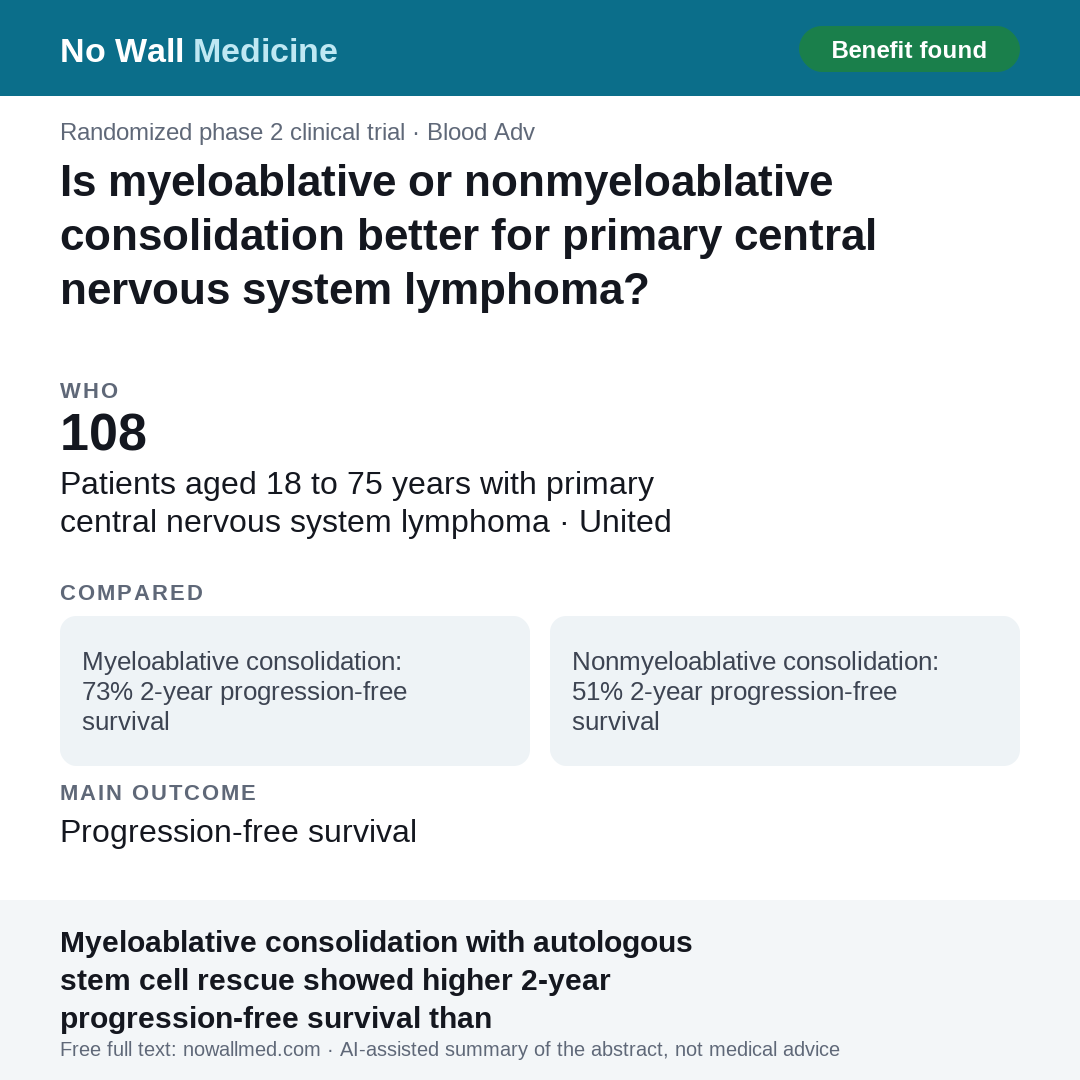
Clinical question: Is myeloablative or nonmyeloablative consolidation better for primary central nervous system lymphoma?
Why it matters: The optimal strategy for consolidation therapy in primary central nervous system lymphoma is not defined, especially when avoiding whole-brain radiotherapy to prevent neurotoxicity.
Key points
- Researchers studied 108 patients with primary central nervous system lymphoma who were randomized to receive either myeloablative consolidation with autologous stem cell transplantation or nonmyeloablative consolidation.
- The estimated 2-year progression-free survival, which is the time during which the disease does not worsen, was 73% for the myeloablative group versus 51% for the nonmyeloablative group.
- In a secondary analysis of patients who completed consolidation, the 2-year progression-free survival was 86% for the myeloablative arm and 71% for the nonmyeloablative arm, which was not a significant difference.
Headline and key points written with AI from the paper’s abstract, with every number checked against it. Read the paper before relying on them.
Abstract
Although it is evident that standard-dose whole-brain radiotherapy as consolidation is associated with significant neurotoxicity, the optimal consolidative strategy for primary central nervous system lymphoma (PCNSL) is not defined. We performed a randomized phase 2 clinical trial via the US Alliance cancer cooperative group to compare myeloablative consolidation supported by autologous stem cell transplantation with nonmyeloablative consolidation after induction therapy for PCNSL. To our knowledge, this is the first randomized trial to be initiated that eliminates whole-brain radiotherapy as a consolidative approach in newly diagnosed PCNSL. Patients aged 18 to 75 years were randomly assigned in a 1:1 manner to induction therapy (methotrexate, temozolomide, rituximab, and cytarabine) followed by consolidation with either thiotepa plus carmustine and autologous stem cell rescue vs induction followed by nonmyeloablative, infusional etoposide plus cytarabine. The primary end point was progression-free survival (PFS). A total of 113 patients were randomized, and 108 (54 in each arm) were evaluable. More patients in the nonmyeloablative arm experienced progressive disease or death during induction (28% vs 11%; P = .05). Thirty-six patients received autologous stem cell transplant, and 34 received nonmyeloablative consolidation. The estimated 2-year PFS was higher in the myeloablative vs nonmyeloablative arm (73% vs 51%; P = .02). However, a planned secondary analysis, landmarked at start of the consolidation, revealed that the estimated 2-year PFS in those who completed consolidation therapy was not significantly different between the arms (86% vs 71%; P = .21). Both consolidative strategies yielded encouraging efficacy and similar toxicity profiles. This trial was registered at www.clininicals.gov as #NCT01511562.
Abstract reproduced under the article’s CC BY NC ND licence.
Topics
Cite this article
Batchelor TT, Giri S, Ruppert AS, Geyer SM, Smith SE, Mohile N. Myeloablative vs nonmyeloablative consolidation for primary central nervous system lymphoma: results of Alliance 51101. Blood Adv. 2024. doi:10.1182/bloodadvances.2023011657
Spotted a mistake? Suggest a correction
Top studies every Monday
The week’s key trials and guidelines in your specialties, plus any topics you follow. By email, free.
Get the weekly digest