Low-level red-light therapy slowed myopia progression in Chinese children over six months
Myopia Control Effect of Repeated Low-Level Red-Light Therapy in Chinese Children: A Randomized, Double-Blind, Controlled Clinical Trial
Randomized, double-blind, controlled clinical trialBenefit found
Does repeated low-level red-light therapy control myopia progression in Chinese children?
Who
111
Chinese children aged 7 to 12 years with myopia
Compared
Repeated low-level red-light therapy: 0.06 ± 0.30 D
Sham device control: -0.11 ± 0.33 D
Main outcome
Changes in cycloplegic spherical equivalent refraction and axial length
Result: SER coefficient 0.167 D (95% CI 0.050-0.283 D)
Bottom line: Repeated low-level red-light therapy significantly reduced myopia progression and axial elongation in myopic children over 6 months.
Ophthalmology · 2022-08-29Download image
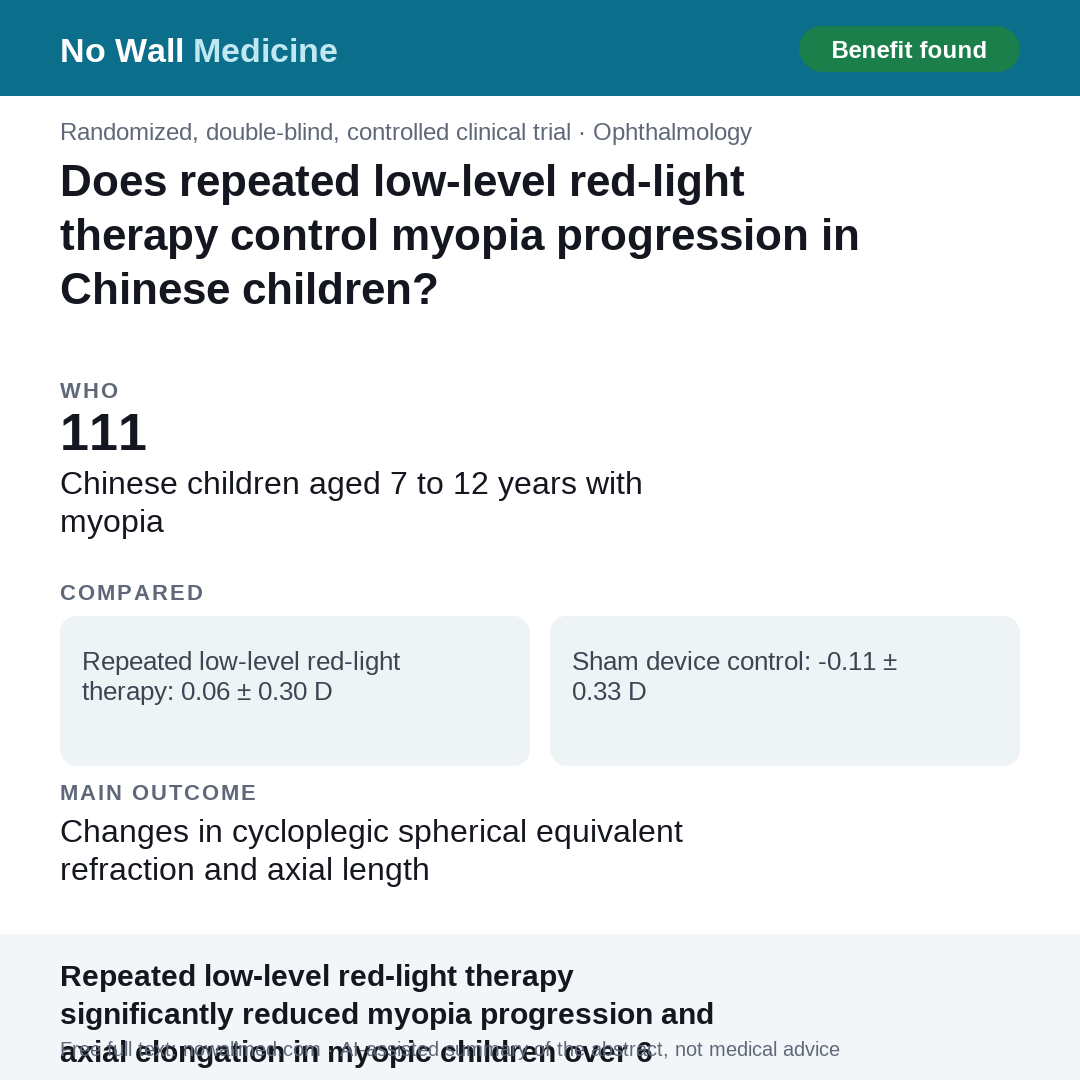
Clinical question: Does repeated low-level red-light therapy control myopia progression in Chinese children?
Why it matters: Previous studies on repeated low-level red-light therapy for myopia control were limited by open-label designs.
Key points
- Researchers studied 111 Chinese children aged 7 to 12 years, comparing repeated low-level red-light therapy to a sham device with 10% power.
- The red-light group had a mean spherical equivalent refraction change of 0.06 ± 0.30 D compared to -0.11 ± 0.33 D in the sham group.
- The red-light group showed less axial length increase, which is the physical lengthening of the eye, with a mean increase of 0.02 ± 0.11 mm versus 0.13 ± 0.10 mm.
Headline and key points written with AI from the paper’s abstract, with every number checked against it. Read the paper before relying on them.
Was this summary helpful?
Subject terms
Cite this article
Dong J, Zhu Z, Xu H, He M. Myopia Control Effect of Repeated Low-Level Red-Light Therapy in Chinese Children: A Randomized, Double-Blind, Controlled Clinical Trial. Ophthalmology. 2022. doi:10.1016/j.ophtha.2022.08.024
Spotted a mistake? Suggest a correction
Top studies every Monday
The week’s key trials and guidelines in your specialties, plus any topics you follow. By email, free.
Get the weekly digest