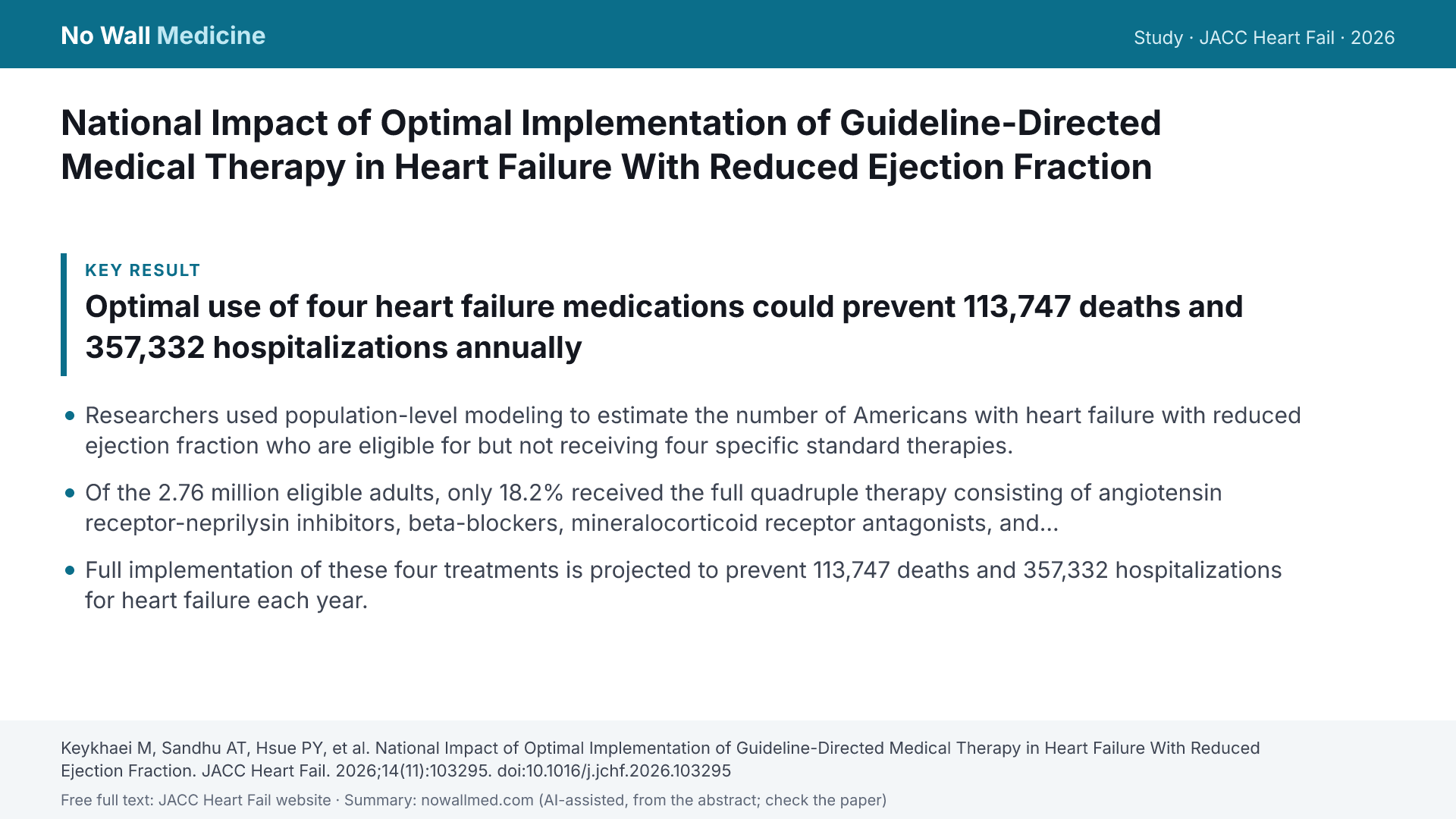
Optimal use of four heart failure medications could prevent 113,747 deaths and 357,332 hospitalizations annually
National Impact of Optimal Implementation of Guideline-Directed Medical Therapy in Heart Failure With Reduced Ejection Fraction
Why it matters: Clinical implementation of the four standard medications for heart failure with reduced ejection fraction remains incomplete despite evidence that they reduce mortality and hospitalizations.
Key points
- Researchers used population-level modeling to estimate the number of Americans with heart failure with reduced ejection fraction who are eligible for but not receiving four specific standard therapies.
- Of the 2.76 million eligible adults, only 18.2% received the full quadruple therapy consisting of angiotensin receptor-neprilysin inhibitors, beta-blockers, mineralocorticoid receptor antagonists, and sodium-glucose cotransporter 2 inhibitors.
- Full implementation of these four treatments is projected to prevent 113,747 deaths and 357,332 hospitalizations for heart failure each year.
Study type: Observational study: it can show a link, but not prove that one thing causes another.
Headline and key points written with AI from the paper’s abstract, with every number checked against it. Read the paper before relying on them.
Was this summary helpful?
Subject terms
Headline, design, result, key points, caveat and citation as plain text.
Cite this article
Keykhaei M, Sandhu AT, Hsue PY, et al. National Impact of Optimal Implementation of Guideline-Directed Medical Therapy in Heart Failure With Reduced Ejection Fraction. JACC Heart Fail. 2026;14(11):103295. doi:10.1016/j.jchf.2026.103295
Spotted a mistake? Suggest a correction