Adding vericiguat to standard heart failure medications was associated with lower mortality rates
Pharmacologic Treatment of Heart Failure With Reduced Ejection Fraction: An Updated Systematic Review and Network Meta-Analysis
Network meta-analysis of 89 randomized controlled trialsBenefit found
Which pharmacotherapy regimens are most effective for heart failure with reduced ejection fraction?
Who
103,754
Patients with heart failure with reduced ejection fraction
Compared
quintuple therapy: HR: 0.35 (95% CI: 0.27-0.45)
quadruple therapy: HR: 0.39 (95% CI: 0.32-0.49)
Main outcome
all-cause mortality
Result: HR: 0.35 (95% CI: 0.27-0.45) for quintuple therapy
Bottom line: Quintuple therapy may provide incremental survival gains over quadruple therapy for patients with heart failure with reduced ejection fraction.
Limitation: results are exploratory as they are derived from a secondary endpoint of a single trial
JACC · 2025-08-30Download image
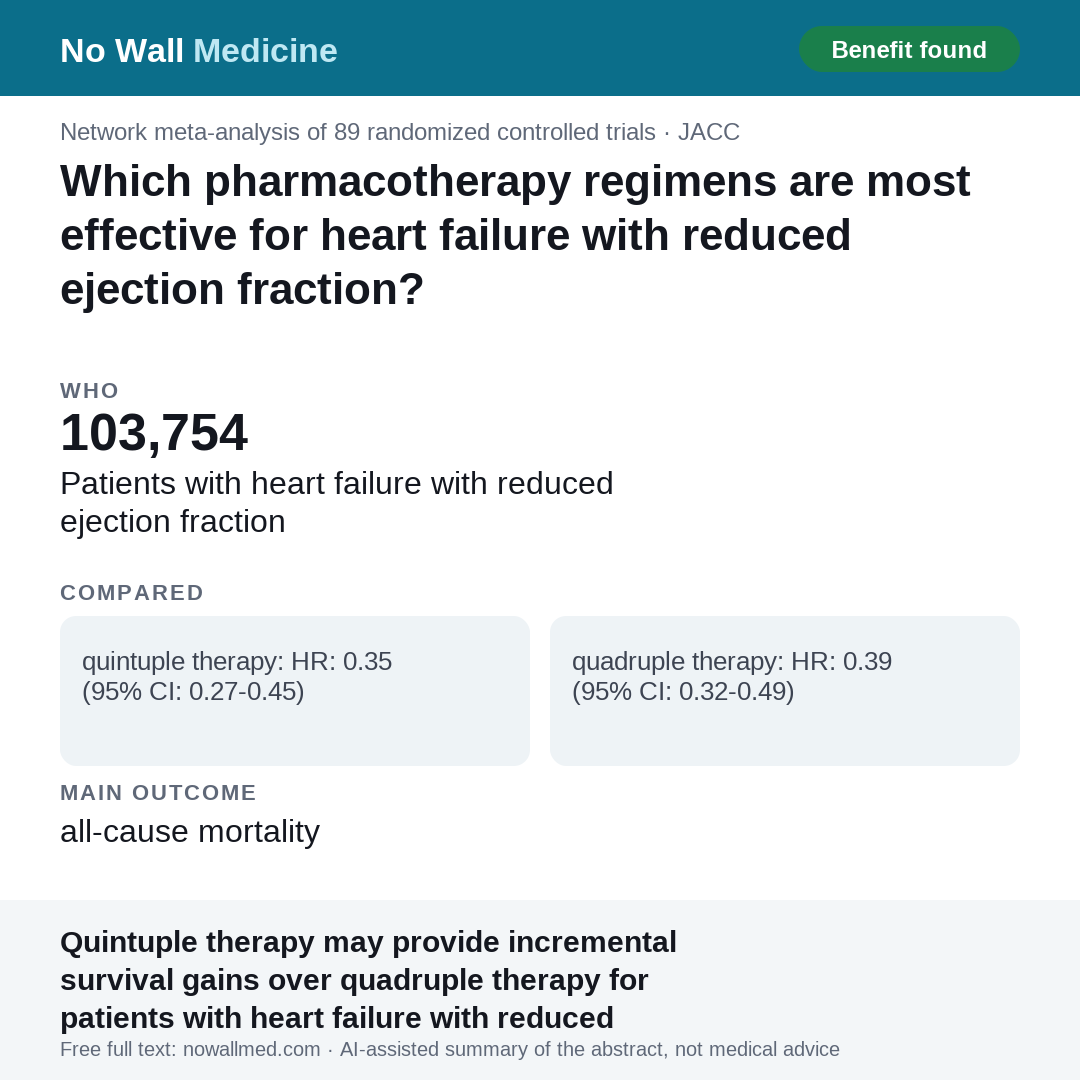
Clinical question: Which pharmacotherapy regimens are most effective for heart failure with reduced ejection fraction?
Key points
- Researchers analyzed 103,754 patients from 89 randomized controlled trials to compare different drug regimens for heart failure with reduced ejection fraction.
- Quintuple therapy including vericiguat had a hazard ratio of 0.35 for all-cause mortality, while quadruple therapy had a hazard ratio of 0.39.
- For a representative 70-year-old patient, quintuple therapy provided 6.0 additional life-years compared to 5.3 life-years for quadruple therapy.
Headline and key points written with AI from the paper’s abstract, with every number checked against it. Read the paper before relying on them.
Was this summary helpful?
Subject terms
Cite this article
van Essen BJ, Ceelen DCH, Ouwerkerk W, Teng TK, Tharshana GN, Hew FM. Pharmacologic Treatment of Heart Failure With Reduced Ejection Fraction: An Updated Systematic Review and Network Meta-Analysis. JACC. 2025. doi:10.1016/j.jacc.2025.08.054
Spotted a mistake? Suggest a correction
Top studies every Monday
The week’s key trials and guidelines in your specialties, plus any topics you follow. By email, free.
Get the weekly digest