Natural language processing of clinical notes shows potential for detecting cognitive impairment in electronic health records
Natural language processing of electronic health records for early detection of cognitive decline: a systematic review
Systematic reviewBenefit found
Can natural language processing detect cognitive impairment in electronic health record clinical notes?
Who
1,064,530
Patients in electronic health record clinical notes
Compared
Rule-based algorithms
Traditional machine learning
Deep learning: area under the receiver operating characteristic curves up to 0.997
Main outcome
Detection of cognitive impairment
Bottom line: Natural language processing shows robust performance in identifying cognitive decline from electronic health record clinical notes.
Limitation: Incomplete data capture, inconsistent documentation practices, and limited external validation.
NPJ Digit Med · 2025-03-01 · Save PNG
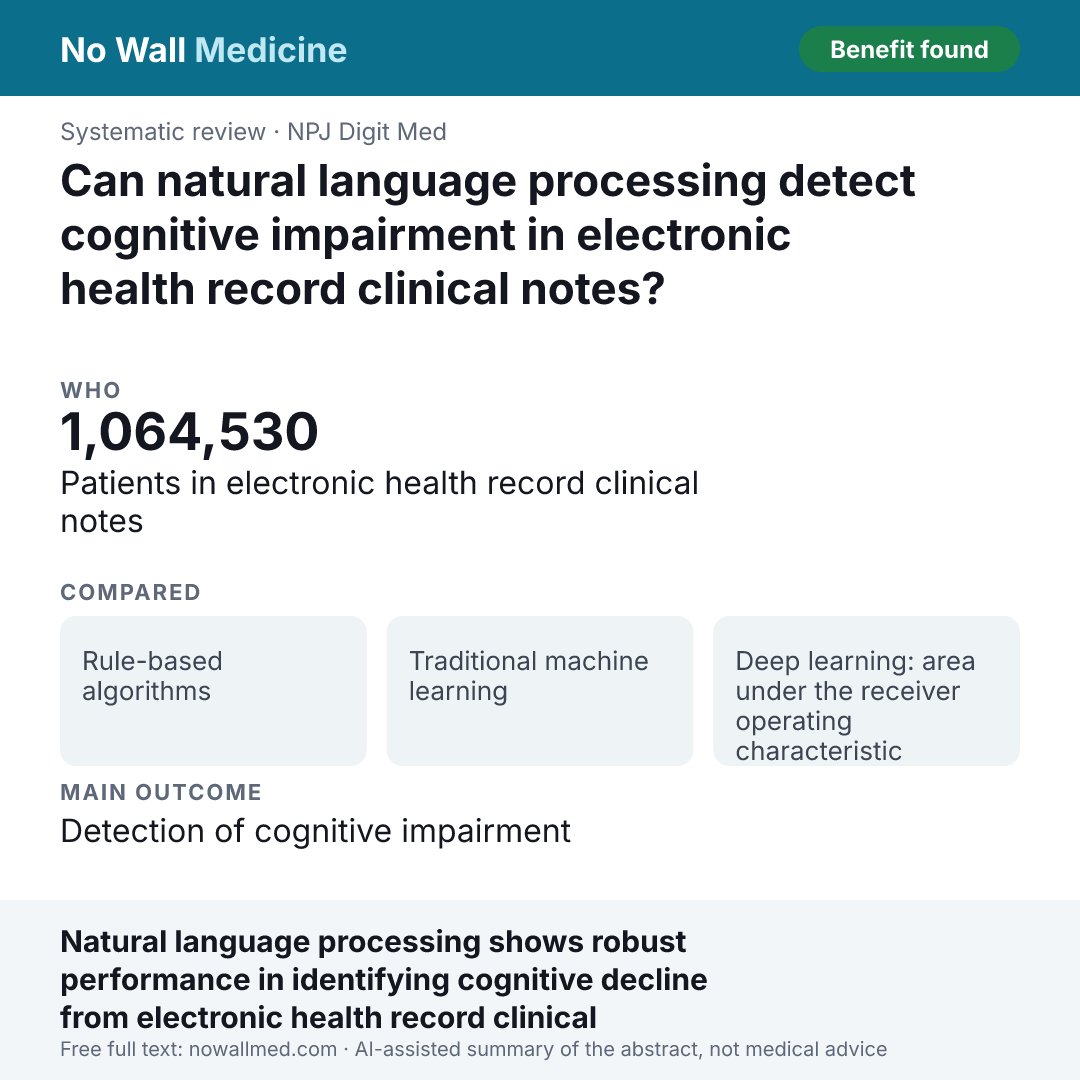
Clinical question: Can natural language processing detect cognitive impairment in electronic health record clinical notes?
Key points
- Researchers reviewed 18 studies involving 1,064,530 patients to evaluate how computer algorithms process text in medical records to find cognitive decline.
- The models showed a median sensitivity of 0.88 (IQR 0.74-0.91) and a median specificity of 0.96 (IQR 0.81-0.99).
- Deep learning architectures, which use complex computer models inspired by the human brain, reached an area under the receiver operating characteristic curve of up to 0.997.
Limitation the authors note: Major challenges include incomplete data capture, inconsistent documentation practices, and limited external validation.
Headline and key points written with AI from the paper’s abstract, with every number checked against it. Read the paper before relying on them.
Was this summary helpful?
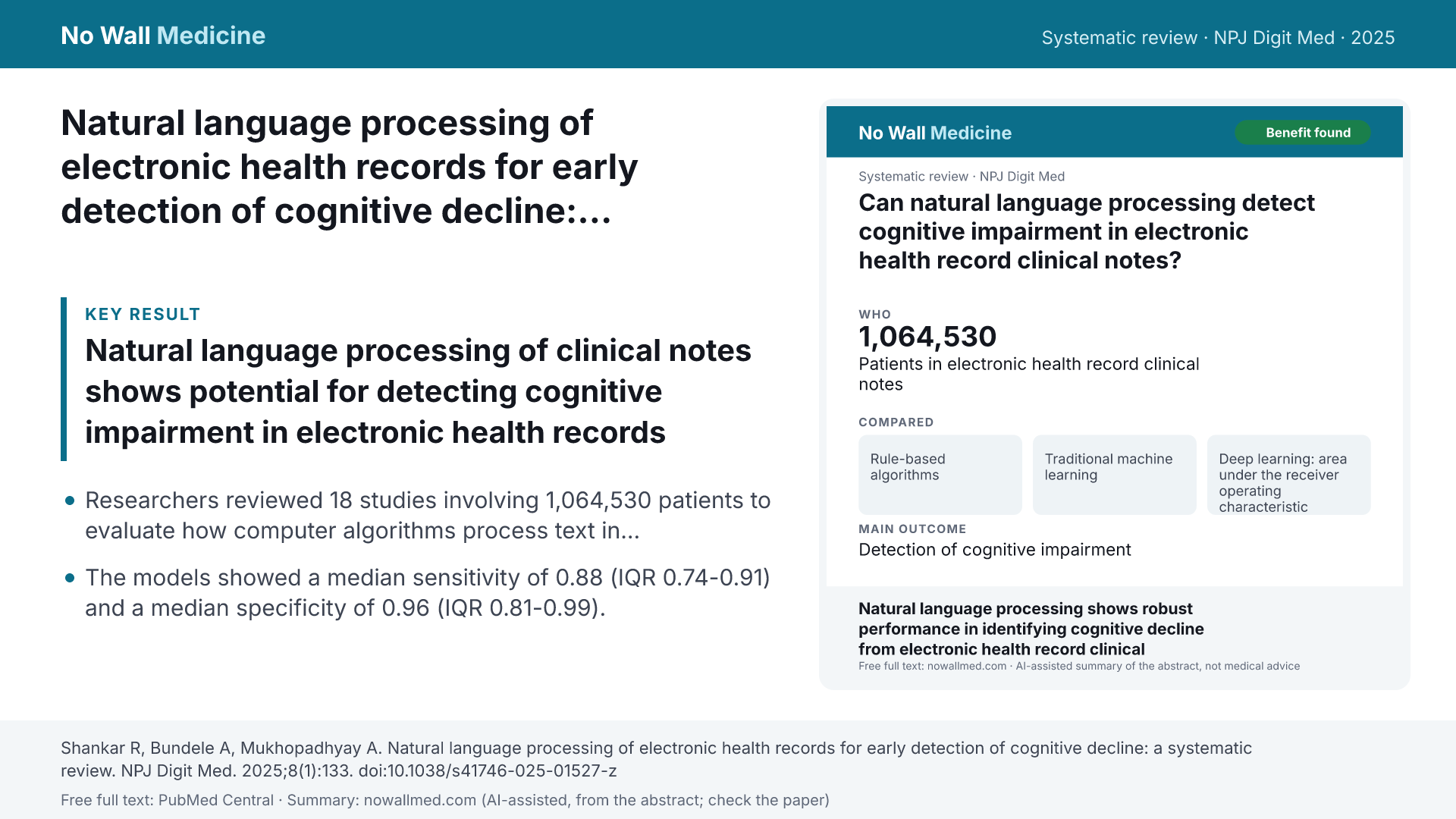
Headline, design, result, key points, caveat and citation as plain text.
Cite this article
Shankar R, Bundele A, Mukhopadhyay A. Natural language processing of electronic health records for early detection of cognitive decline: a systematic review. NPJ Digit Med. 2025;8(1):133. doi:10.1038/s41746-025-01527-z
Spotted a mistake? Suggest a correction