Clinicians used patient cues and uncertainty to navigate end of life conversations in hematology
Navigating Prognostic Dialogue During Serious Illness Conversations
Qualitative studyUnclear result
How do patients navigate prognostic dialogue
Who
50
Patients with hematologic malignant neoplasms and caregivers · Danish hematology departments
Compared
Patients
Caregivers
Main outcome
Prognostic dialogue navigation
Bottom line: Clinicians' attentiveness enabled prognostic dialogue
JAMA Netw Open · 2026-04-01Download image
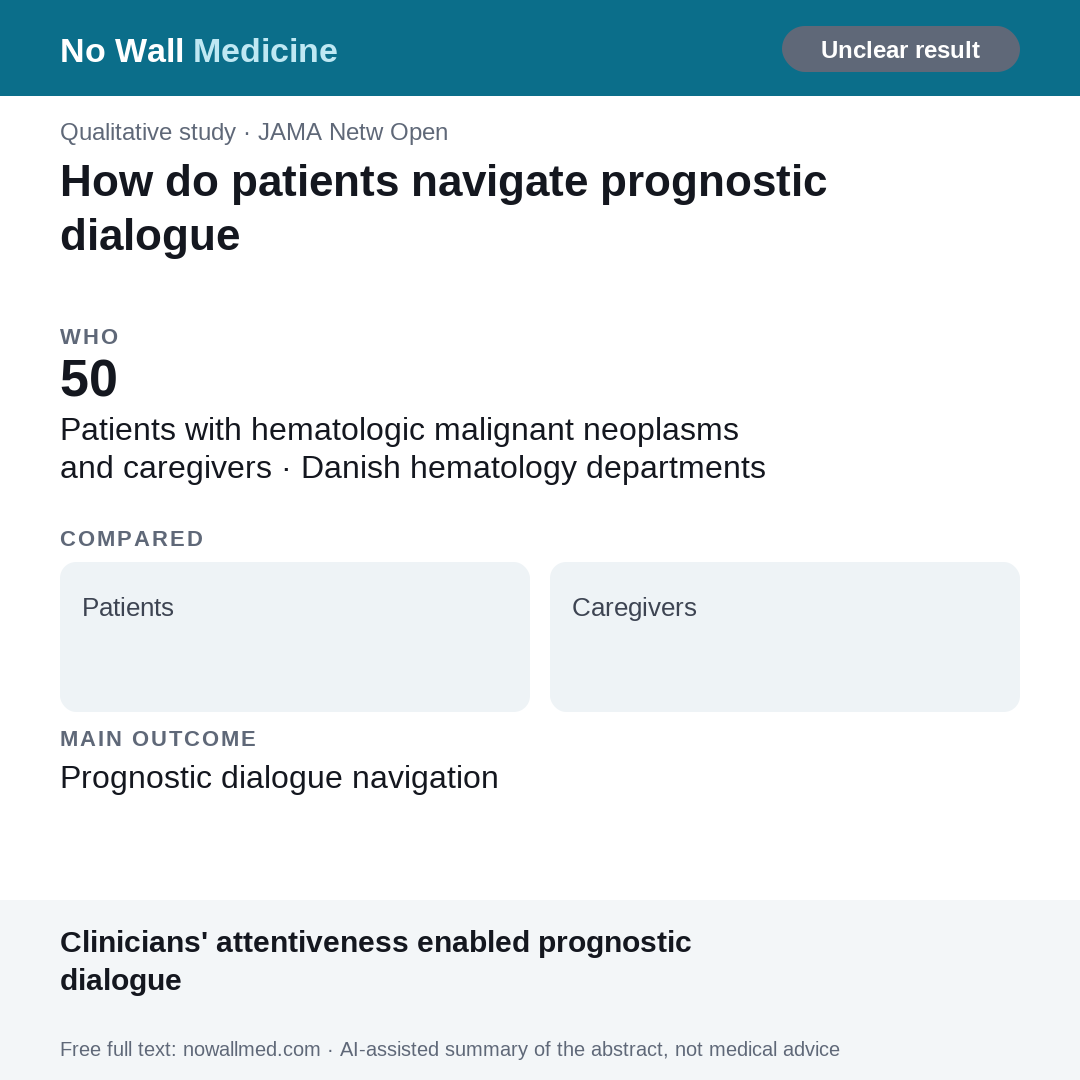
Why it matters: In hematology, uncertainty about prognosis and expectations for new therapies can delay important conversations about end of life preparation.
Key points
- Researchers analyzed 25 patient-caregiver pairs and 16 physician-nurse teams involved in serious illness conversations for blood cancers.
- Clinicians adjusted the depth and timing of prognostic information by following the verbal and emotional cues of patients and caregivers.
- Prognostic uncertainty was used as a resource to acknowledge both realistic concerns and hopes during these discussions.
Headline and key points written with AI from the paper’s abstract, with every number checked against it. Read the paper before relying on them.
Topics
Spotted a mistake? Suggest a correction