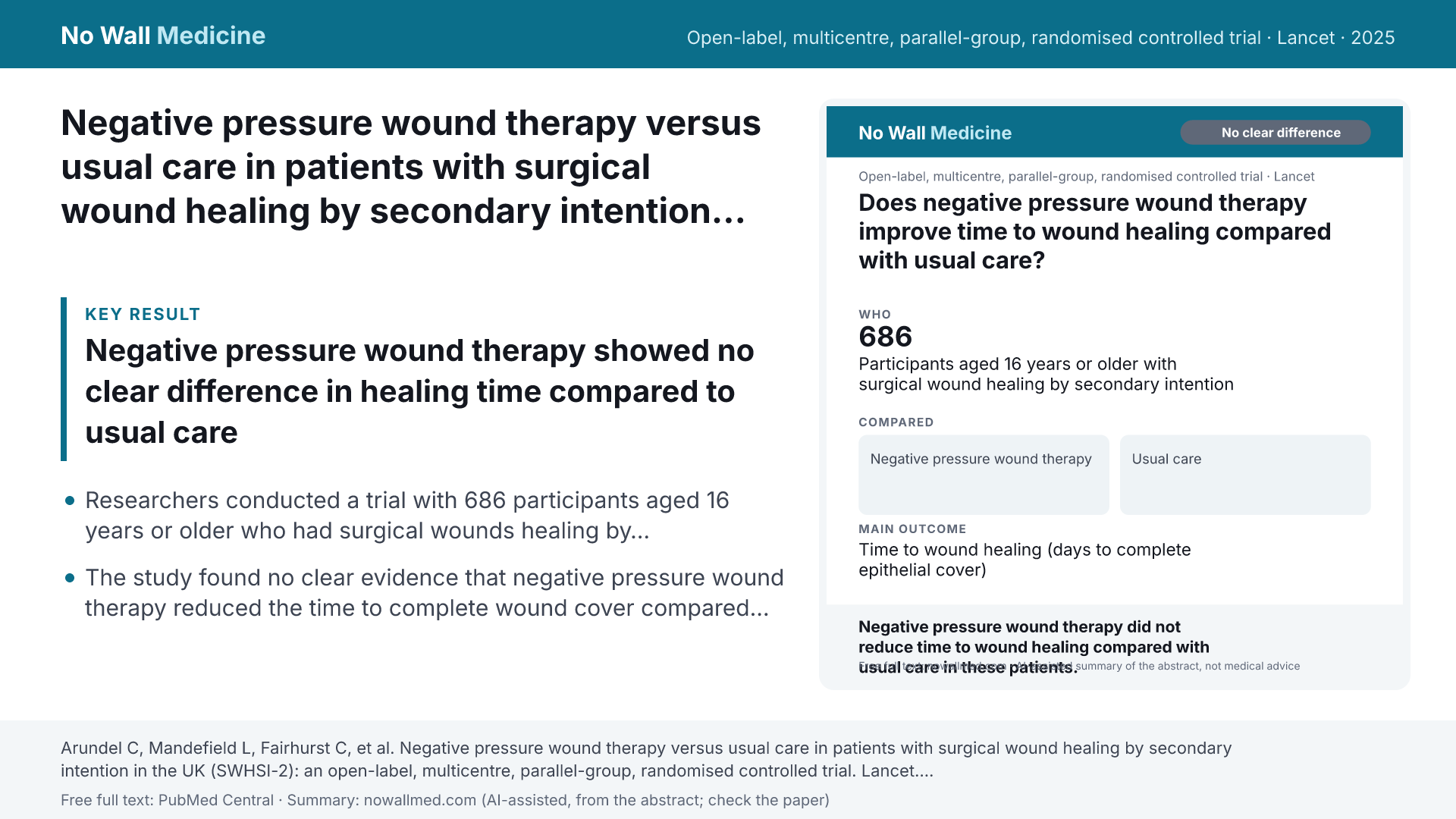
Negative pressure wound therapy showed no clear difference in healing time compared to usual care
Negative pressure wound therapy versus usual care in patients with surgical wound healing by secondary intention in the UK (SWHSI-2): an open-label, multicentre, parallel-group, randomised controlled trial
Open-label, multicentre, parallel-group, randomised controlled trialNo clear difference
Does negative pressure wound therapy improve time to wound healing compared with usual care?
Who
686
Participants aged 16 years or older with surgical wound healing by secondary intention · 29 United Kingdom National Health Service Trusts
Compared
Negative pressure wound therapy
Usual care
Main outcome
Time to wound healing (days to complete epithelial cover)
Result: hazard ratio 1·08 (95% CI 0·88-1·32)
Bottom line: Negative pressure wound therapy did not reduce time to wound healing compared with usual care in these patients.
Funded by: National Institute for Health Research Health Technology Assessment Programme
Lancet · 2025-04-15Download image
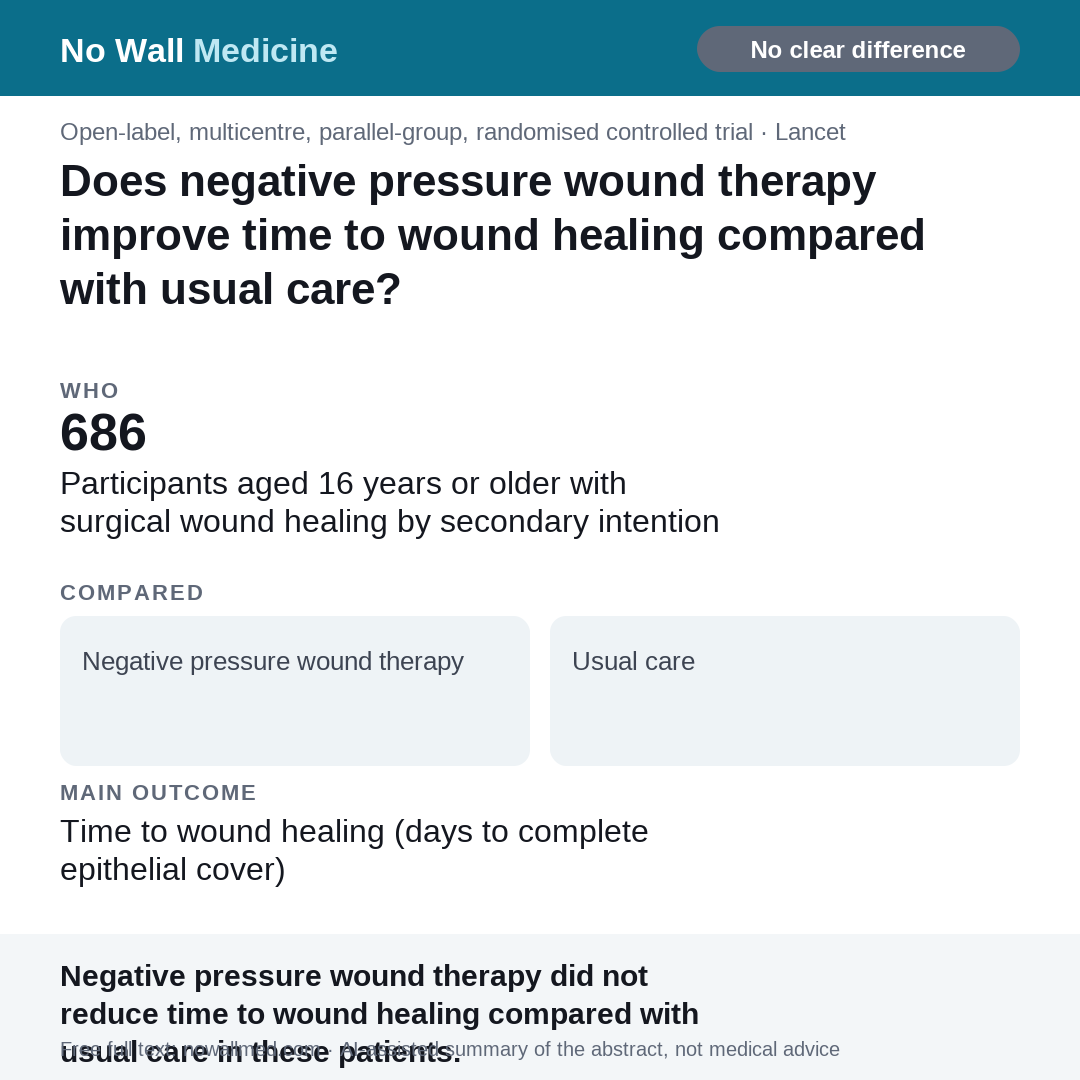
Clinical question: Does negative pressure wound therapy improve time to wound healing compared with usual care?
Why it matters: There has been an absence of comparative evidence regarding the effectiveness of negative pressure wound therapy for patients with surgical wounds healing by secondary intention.
Key points
- Researchers conducted a trial with 686 participants aged 16 years or older who had surgical wounds healing by secondary intention.
- The study found no clear evidence that negative pressure wound therapy reduced the time to complete wound cover compared to usual care (hazard ratio 1.08, p=0.47).
- Negative pressure wound therapy was found not to be cost-effective compared with usual care.
Headline and key points written with AI from the paper’s abstract, with every number checked against it. Read the paper before relying on them.
Was this summary helpful?
Abstract
Background
Surgical wound healing by secondary intention (SWHSI) presents a substantial management and financial challenge. Negative pressure wound therapy (NPWT) has increasingly been used as a treatment despite an absence of comparative evidence of effectiveness. We evaluated the effectiveness of NPWT compared with usual care for improving time to wound healing in patients with an SWHSI. Methods
We did a pragmatic, open-label, multicentre, parallel-group, randomised controlled trial in 29 UK National Health Service Trusts. Participants aged 16 years or older with an SWHSI appropriate for both study treatments (NPWT or usual care) were randomly assigned (1:1) by a centralised web-based system. Randomisation was stratified by wound location, wound area, and study centre. Participants were followed up for 12 months. Participants and clinical and research teams could not be masked to treatment. Assessors masked to treatment reviewed wound photography to verify the outcome. The primary outcome was time to wound healing (days from randomisation to complete epithelial cover), analysed via intention to treat using Kaplan-Meier survival curves and a proportional hazards Cox regression model. The trial was registered with ISRCTN, ISRCTN26277546. Findings
Between May 15, 2019, and Jan 13, 2023, 686 participants with an SWHSI were randomly assigned to receive NPWT (n=349) or usual care (n=337). All participants were included in the primary analysis. Most participants were diabetic (n=549, 80·0%) and had a single SWHSI (n=622, 90·7%), located on the foot or leg (n=620, 90·4%), arising after vascular surgery (n=619, 90·2%). There was no clear evidence that NPWT reduced the time to wound healing compared with usual care (hazard ratio 1·08 [95% CI 0·88-1·32], p=0·47). There were 448 adverse events, of which 14 were serious (nine participants in the NPWT group and five participants in the usual care group); 124 were deemed potentially related to treatment. NPWT was found not to be cost-effective compared with usual care. Interpretation
In patients with a lower limb SWHSI, including those with complications of diabetes, there is no clear evidence that NPWT reduced the time to wound healing compared with standard dressings. These findings do not support the use of NPWT to augment SWHSI healing. Funding
National Institute for Health Research Health Technology Assessment Programme.
Abstract reproduced under the article’s CC BY licence.
Subject terms
Cite this article
Arundel C, Mandefield L, Fairhurst C, et al. Negative pressure wound therapy versus usual care in patients with surgical wound healing by secondary intention in the UK (SWHSI-2): an open-label, multicentre, parallel-group, randomised controlled trial. Lancet. 2025. doi:10.1016/S0140-6736(25)00143-6
Spotted a mistake? Suggest a correction