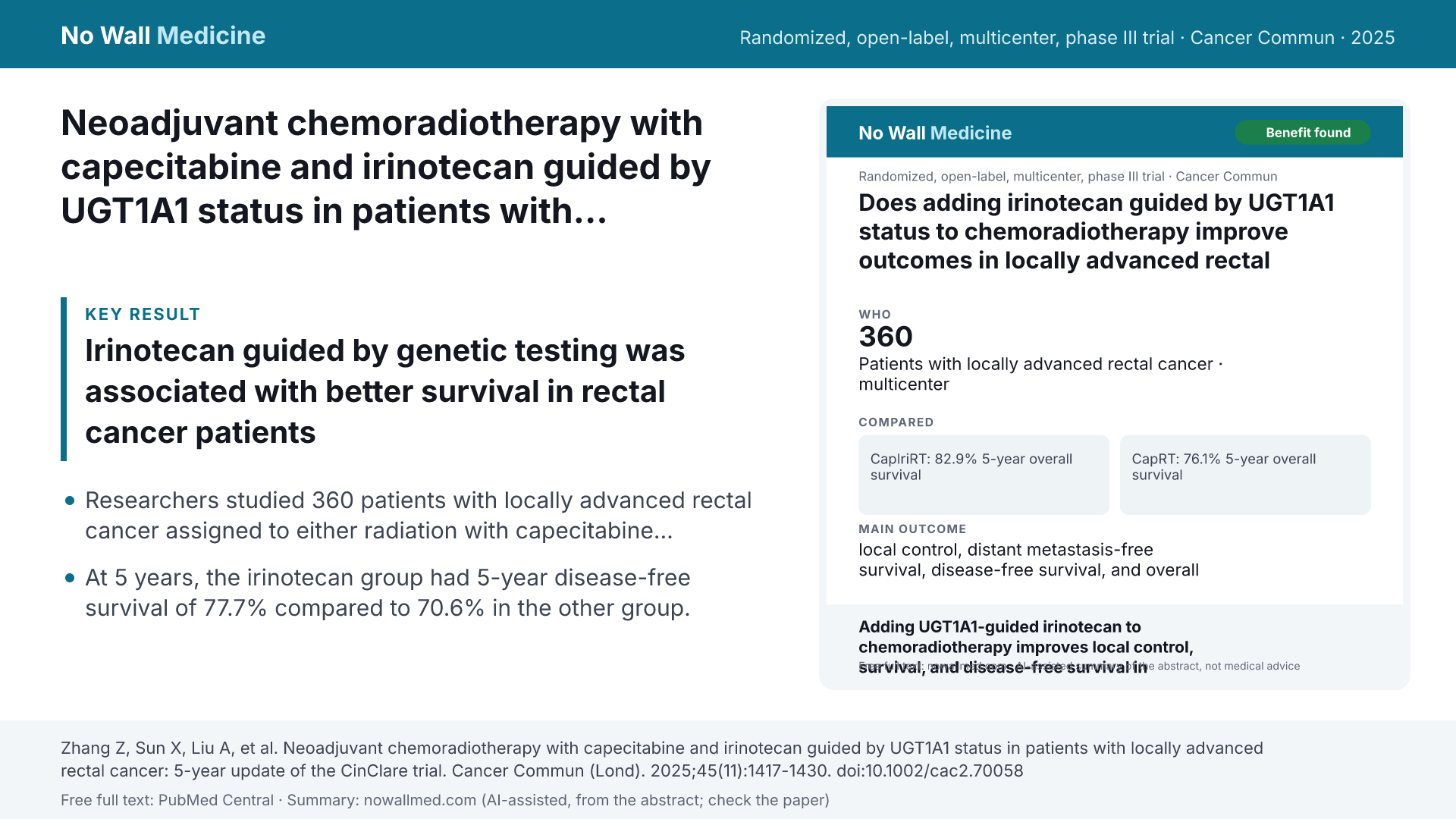
Irinotecan guided by genetic testing was associated with better survival in rectal cancer patients
Neoadjuvant chemoradiotherapy with capecitabine and irinotecan guided by UGT1A1 status in patients with locally advanced rectal cancer: 5-year update of the CinClare trial
Randomized, open-label, multicenter, phase III trialBenefit found
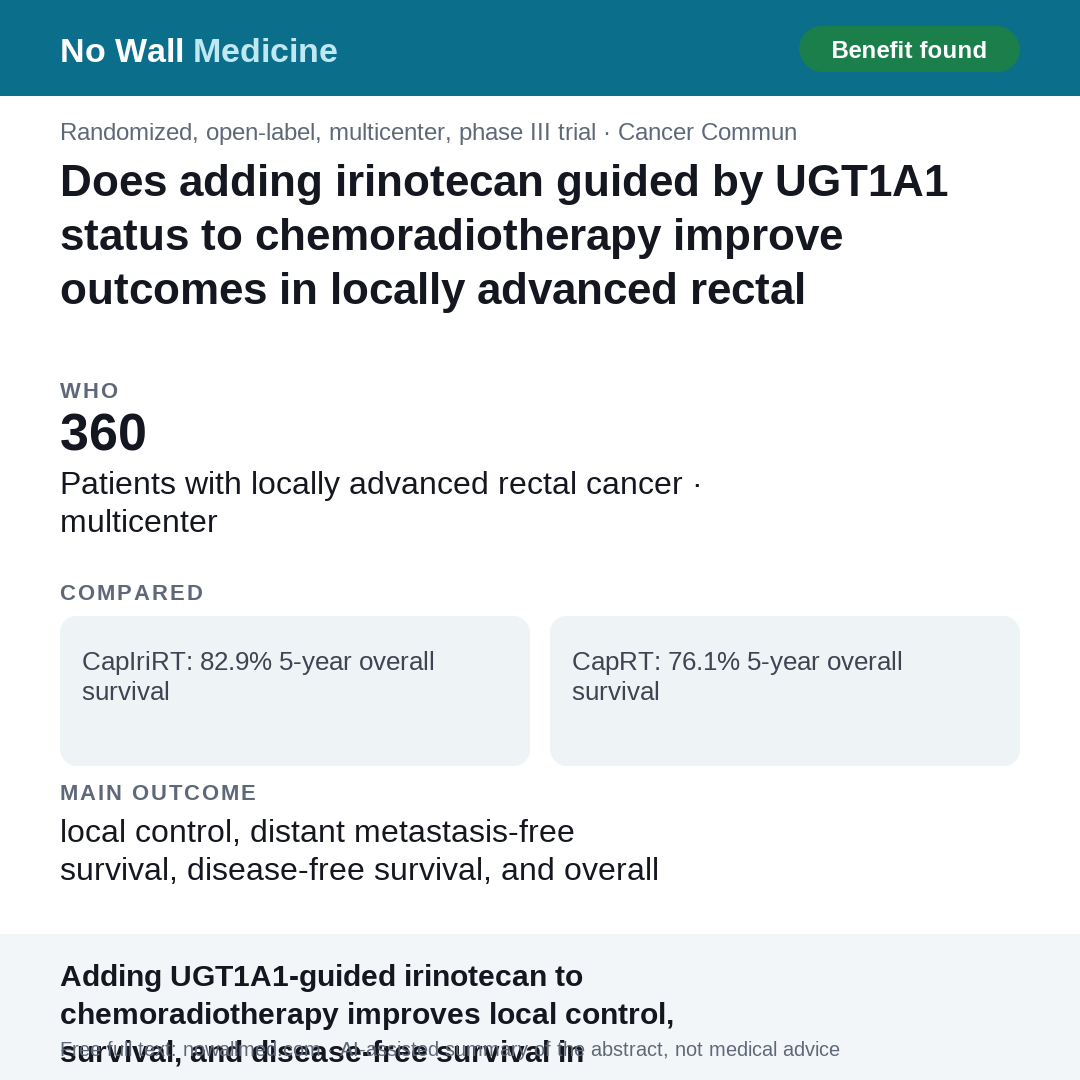
Does adding irinotecan guided by UGT1A1 status to chemoradiotherapy improve outcomes in locally advanced rectal cancer?
Who
360
Patients with locally advanced rectal cancer · multicenter
Compared
CapIriRT: 82.9% 5-year overall survival
CapRT: 76.1% 5-year overall survival
Main outcome
local control, distant metastasis-free survival, disease-free survival, and overall survival
Bottom line: Adding UGT1A1-guided irinotecan to chemoradiotherapy improves local control, survival, and disease-free survival in locally advanced rectal cancer.
Cancer Commun · 2025-09-03Download image
Clinical question: Does adding irinotecan guided by UGT1A1 status to chemoradiotherapy improve outcomes in locally advanced rectal cancer?
Why it matters: The optimal chemotherapy regimen and intensity for treating locally advanced rectal cancer are still under investigation.
Key points
- Researchers studied 360 patients with locally advanced rectal cancer assigned to either radiation with capecitabine and irinotecan or radiation with capecitabine followed by oxaliplatin and capecitabine.
- At 5 years, the irinotecan group had 5-year disease-free survival of 77.7% compared to 70.6% in the other group.
- In patients with the UGT1A1 *1/*1 genotype, the irinotecan group had significantly improved 5-year rates of distant metastasis-free survival, disease-free survival, and overall survival.
Headline and key points written with AI from the paper’s abstract, with every number checked against it. Read the paper before relying on them.
Was this summary helpful?
Subject terms
Cite this article
Zhang Z, Sun X, Liu A, et al. Neoadjuvant chemoradiotherapy with capecitabine and irinotecan guided by UGT1A1 status in patients with locally advanced rectal cancer: 5-year update of the CinClare trial. Cancer Commun. 2025. doi:10.1002/cac2.70058
Spotted a mistake? Suggest a correction