Adding tislelizumab to radiotherapy and chemotherapy may increase tumor regression in rectal cancer
Short-Course Radiotherapy-Based Total Neoadjuvant Therapy plus Tislelizumab for Locally Advanced Rectal Cancer (Neo-STAR): Early Outcomes of a Randomized Phase II Trial
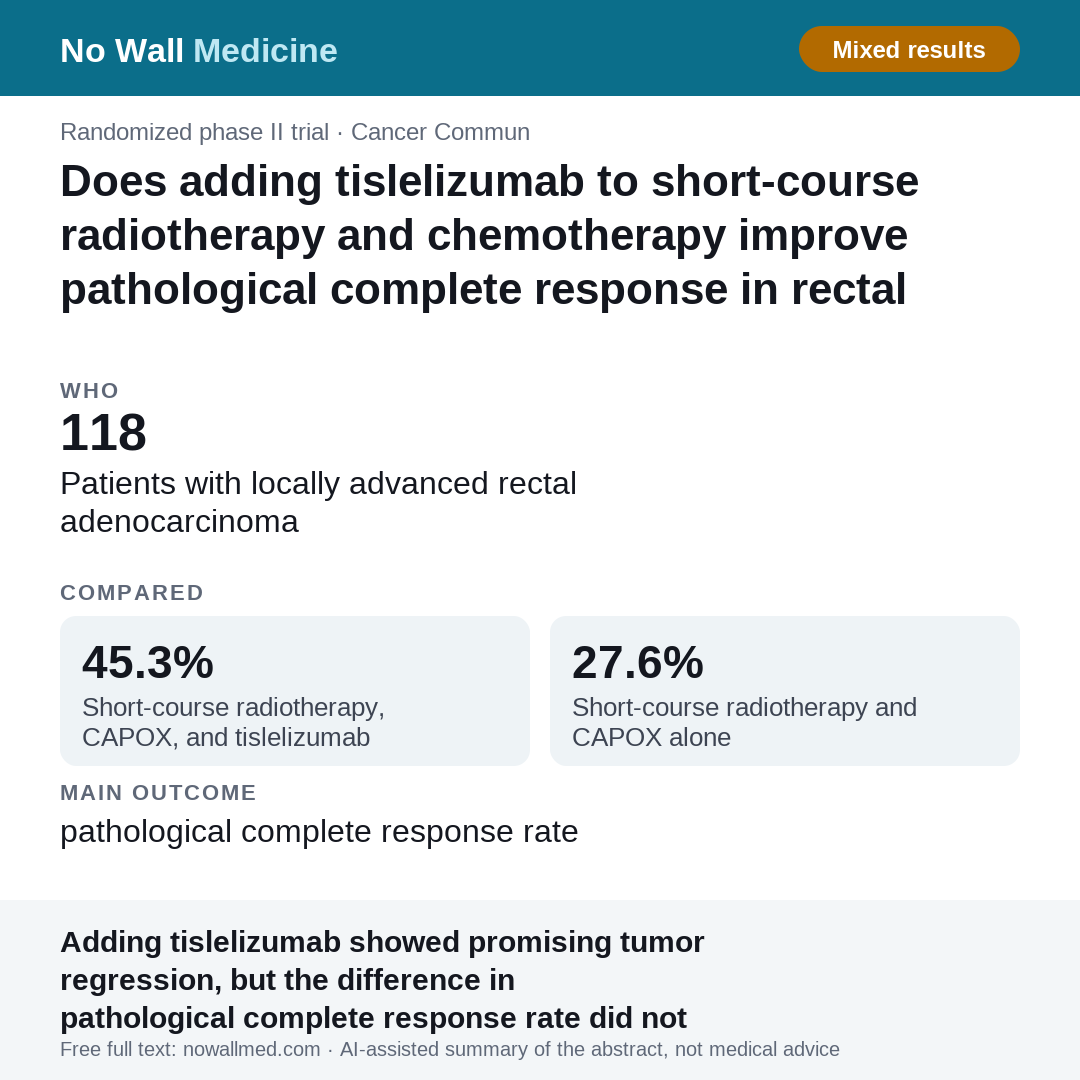
Does adding tislelizumab to short-course radiotherapy and chemotherapy improve pathological complete response in rectal cancer?
Who
118
Patients with locally advanced rectal adenocarcinoma
Compared
45.3%Short-course radiotherapy, CAPOX, and tislelizumab (95% CI, 31.5% to 59.8%)
27.6%Short-course radiotherapy and CAPOX alone (95% CI, 16.6% to 40.8%)
Main outcome
pathological complete response rate
Result: odds ratio = 2.17; 95% CI, 0.99 to 4.79
Bottom line: Adding tislelizumab showed promising tumor regression, but the difference in pathological complete response rate did not reach statistical significance.
Limitation: This phase II study provides preliminary evidence warranting further validation in phase III trials.
Clinical question: Does adding tislelizumab to short-course radiotherapy and chemotherapy improve pathological complete response in rectal cancer?
Why it matters: The pathological complete response rate for patients with locally advanced rectal cancer currently remains around 30%.
Key points
Researchers studied 118 patients with locally advanced rectal cancer assigned to receive short-course radiotherapy followed by chemotherapy alone or chemotherapy plus the immune checkpoint inhibitor tislelizumab.
The pathological complete response rate was 45.3% in the group receiving tislelizumab compared to 27.6% in the chemotherapy-only group, though this difference was not statistically significant.
The rate of major pathological response, meaning significant tumor regression, was 50.9% in the tislelizumab group and 31.0% in the chemotherapy-only group.
Headline and key points written with AI from the paper’s abstract, with every number checked against it. Read the paper before relying on them.
Prostate and pelvic nodal stereotactic body radiotherapy (SBRT) versus prostate-only SBRT for high-risk, localised prostate cancer (PACE-NODES): early adverse event results from an international, open-label, phase 3, randomised controlled trial