Five-year survival rates for patients receiving toripalimab for advanced colorectal cancer
Neoadjuvant PD-1 blockade with toripalimab with or without celecoxib for patients with mismatch repair-deficient or microsatellite instability-high, locally advanced, colorectal cancer (PICC): long-term outcomes of a single-centre, parallel-group, non-comparative, randomised phase 2 trial
Randomised, open-label, parallel-group, phase 2 trialBenefit found
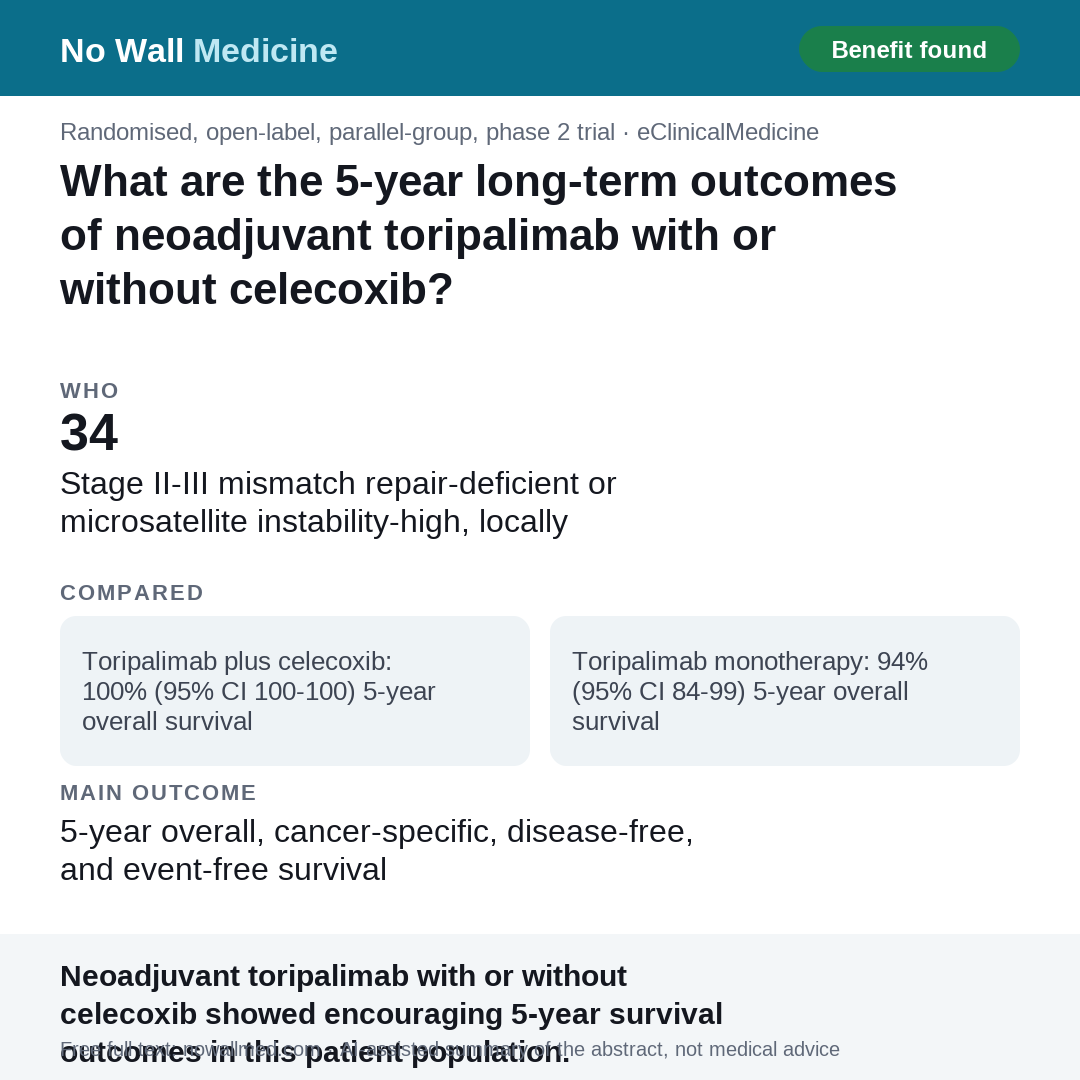
What are the 5-year long-term outcomes of neoadjuvant toripalimab with or without celecoxib?
Who
34
Stage II-III mismatch repair-deficient or microsatellite instability-high, locally advanced colorectal cancer · Single-centre
Compared
Toripalimab plus celecoxib: 100% (95% CI 100-100) 5-year overall survival
Toripalimab monotherapy: 94% (95% CI 84-99) 5-year overall survival
Main outcome
5-year overall, cancer-specific, disease-free, and event-free survival
Bottom line: Neoadjuvant toripalimab with or without celecoxib showed encouraging 5-year survival outcomes in this patient population.
Limitation: This was a single-centre, non-comparative, phase 2 study.
Funded by: National Natural Science Foundation of China and others
eClinicalMedicine · 2025-09-12Download image
Clinical question: What are the 5-year long-term outcomes of neoadjuvant toripalimab with or without celecoxib?
Why it matters: Prospective data on long-term survival for patients receiving neoadjuvant PD-1 blockade for mismatch repair-deficient or microsatellite instability-high, locally advanced colorectal cancer remain limited.
Key points
- The study randomized 34 patients with stage II-III mismatch repair-deficient or microsatellite instability-high colorectal cancer to receive toripalimab plus celecoxib or toripalimab alone before surgery.
- At a median follow-up of 61.9 months, the 5-year overall survival rates were 100% for the combination group and 94% for the monotherapy group.
- No disease recurrence was observed in either group, and 5-year cancer-specific survival was 100% in both groups.
Limitation the authors note: The study was a single-centre, open-label, parallel-group, non-comparative, randomised phase 2 trial.
Headline and key points written with AI from the paper’s abstract, with every number checked against it. Read the paper before relying on them.
Cite this article
Shen X, Cai Y, Li W, Shi L, Zhang J, Xie X. Neoadjuvant PD-1 blockade with toripalimab with or without celecoxib for patients with mismatch repair-deficient or microsatellite instability-high, locally advanced, colorectal cancer (PICC): long-term outcomes of a single-centre, parallel-group, non-comparative, randomised phase 2 trial. eClinicalMedicine. 2025. doi:10.1016/j.eclinm.2025.103499
Spotted a mistake? Suggest a correction
Top studies every Monday
The week’s key trials and guidelines in your specialties, by email. Free.
Get the weekly digest