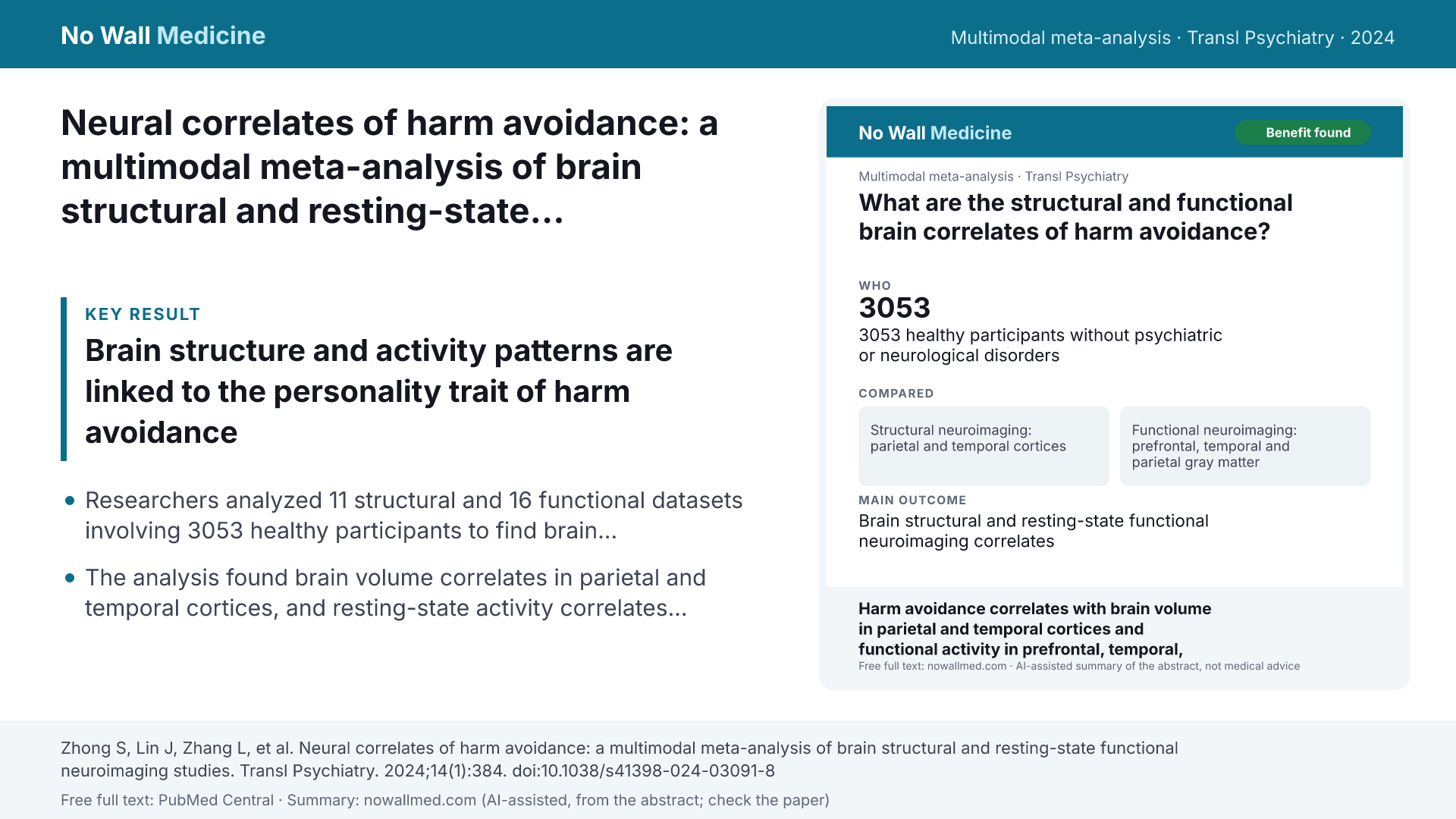
Brain structure and activity patterns are linked to the personality trait of harm avoidance
Neural correlates of harm avoidance: a multimodal meta-analysis of brain structural and resting-state functional neuroimaging studies
Multimodal meta-analysisBenefit found
What are the structural and functional brain correlates of harm avoidance?
Who
3053
3053 healthy participants without psychiatric or neurological disorders
Compared
Structural neuroimaging: parietal and temporal cortices
Functional neuroimaging: prefrontal, temporal and parietal gray matter
Main outcome
Brain structural and resting-state functional neuroimaging correlates
Bottom line: Harm avoidance correlates with brain volume in parietal and temporal cortices and functional activity in prefrontal, temporal, and parietal areas.
Transl Psychiatry · 2024-09-20Download image
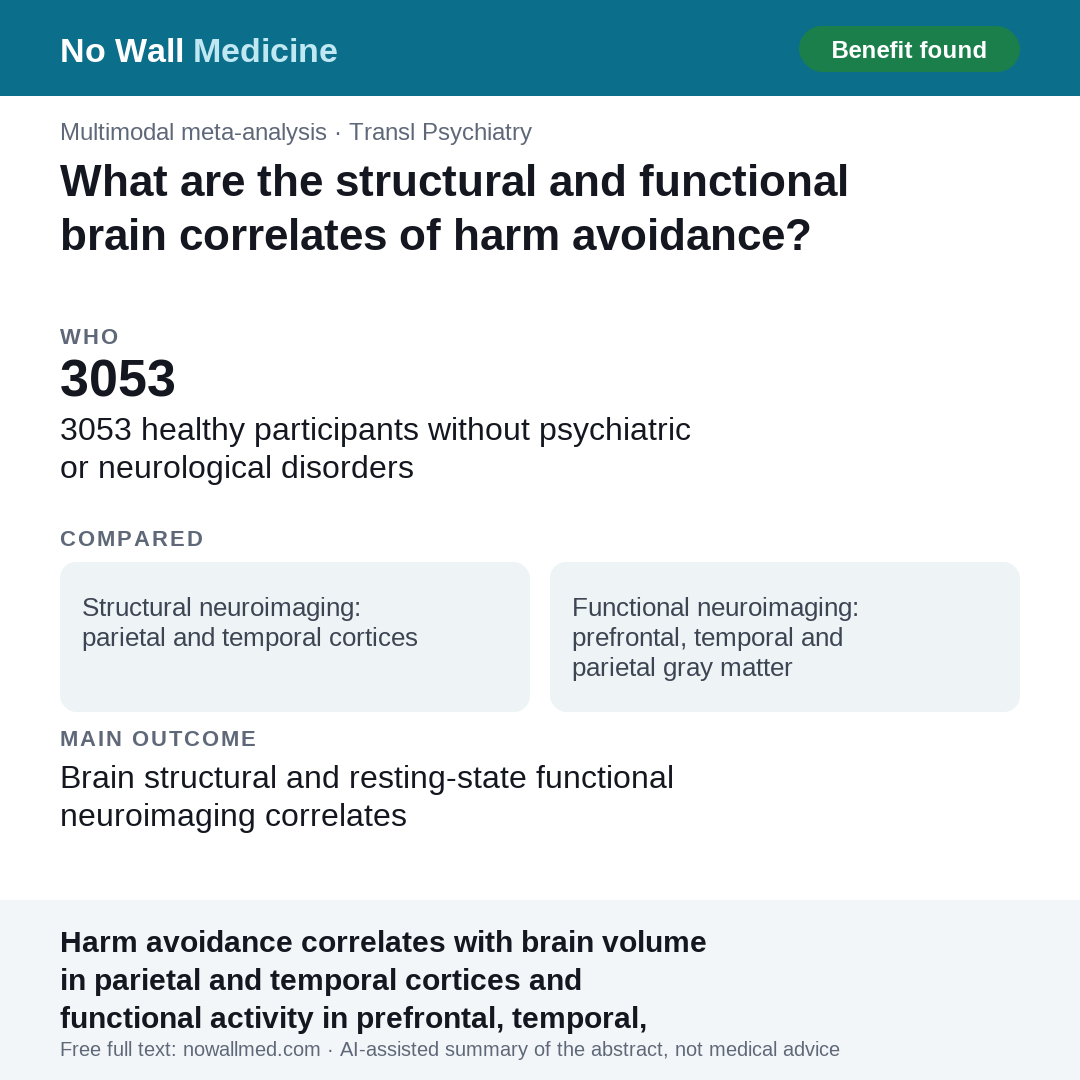
Clinical question: What are the structural and functional brain correlates of harm avoidance?
Why it matters: Neuroimaging findings regarding the brain structures and functions related to harm avoidance have been inconsistent in previous research.
Key points
- Researchers analyzed 11 structural and 16 functional datasets involving 3053 healthy participants to find brain patterns related to harm avoidance.
- The analysis found brain volume correlates in parietal and temporal cortices, and resting-state activity correlates in prefrontal, temporal, and parietal gray matter.
- Structural and functional brain patterns both occurred in the left superior frontal gyrus and left middle frontal gyrus.
Headline and key points written with AI from the paper’s abstract, with every number checked against it. Read the paper before relying on them.
Was this summary helpful?
Subject terms
Cite this article
Zhong S, Lin J, Zhang L, et al. Neural correlates of harm avoidance: a multimodal meta-analysis of brain structural and resting-state functional neuroimaging studies. Transl Psychiatry. 2024. doi:10.1038/s41398-024-03091-8
Spotted a mistake? Suggest a correction