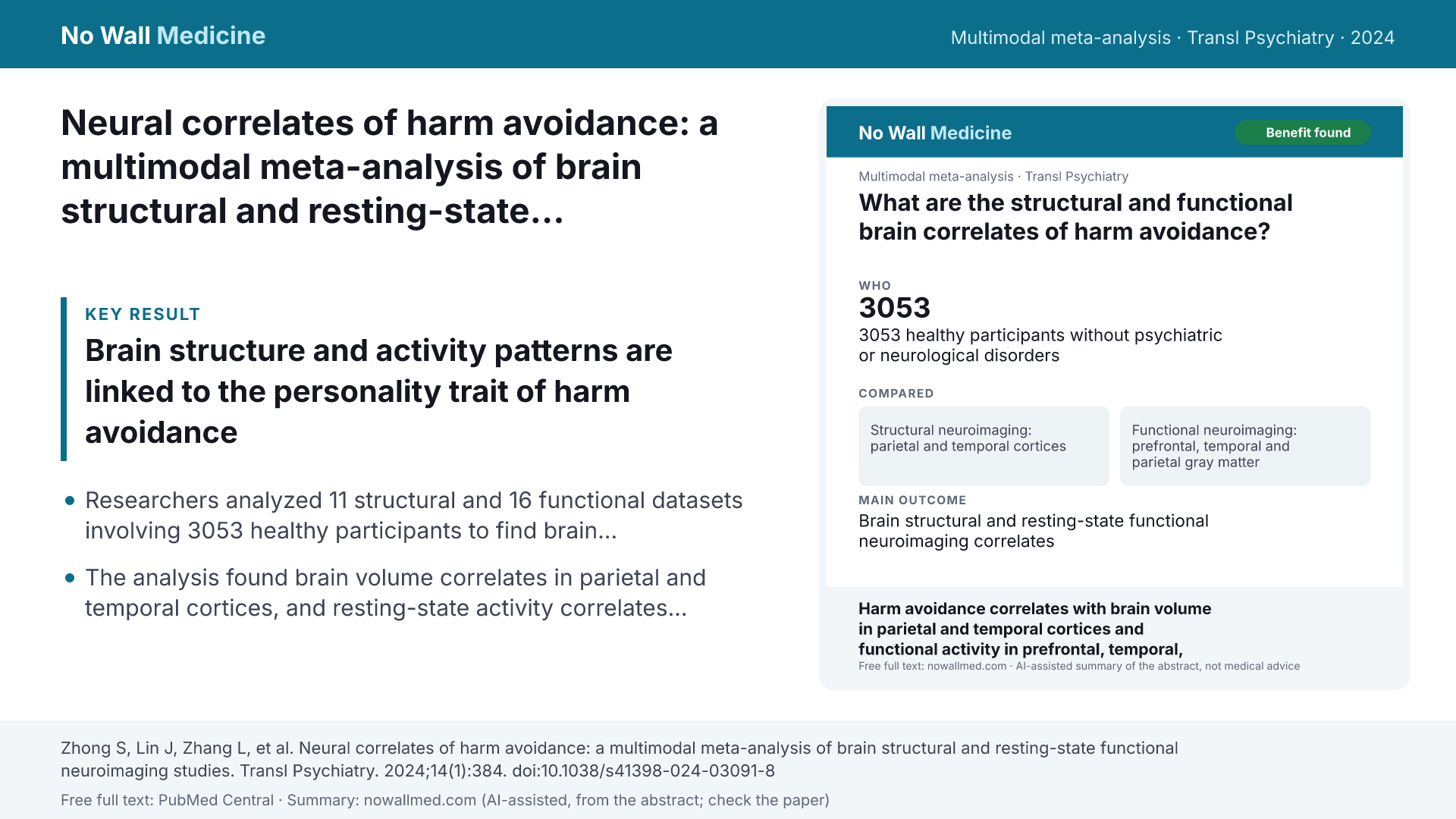
Neural correlates of harm avoidance: a multimodal meta-analysis of brain structural and resting-state functional neuroimaging studies
Key result: Brain structure and activity patterns are linked to the personality trait of harm avoidance
Multimodal meta-analysisBenefit found
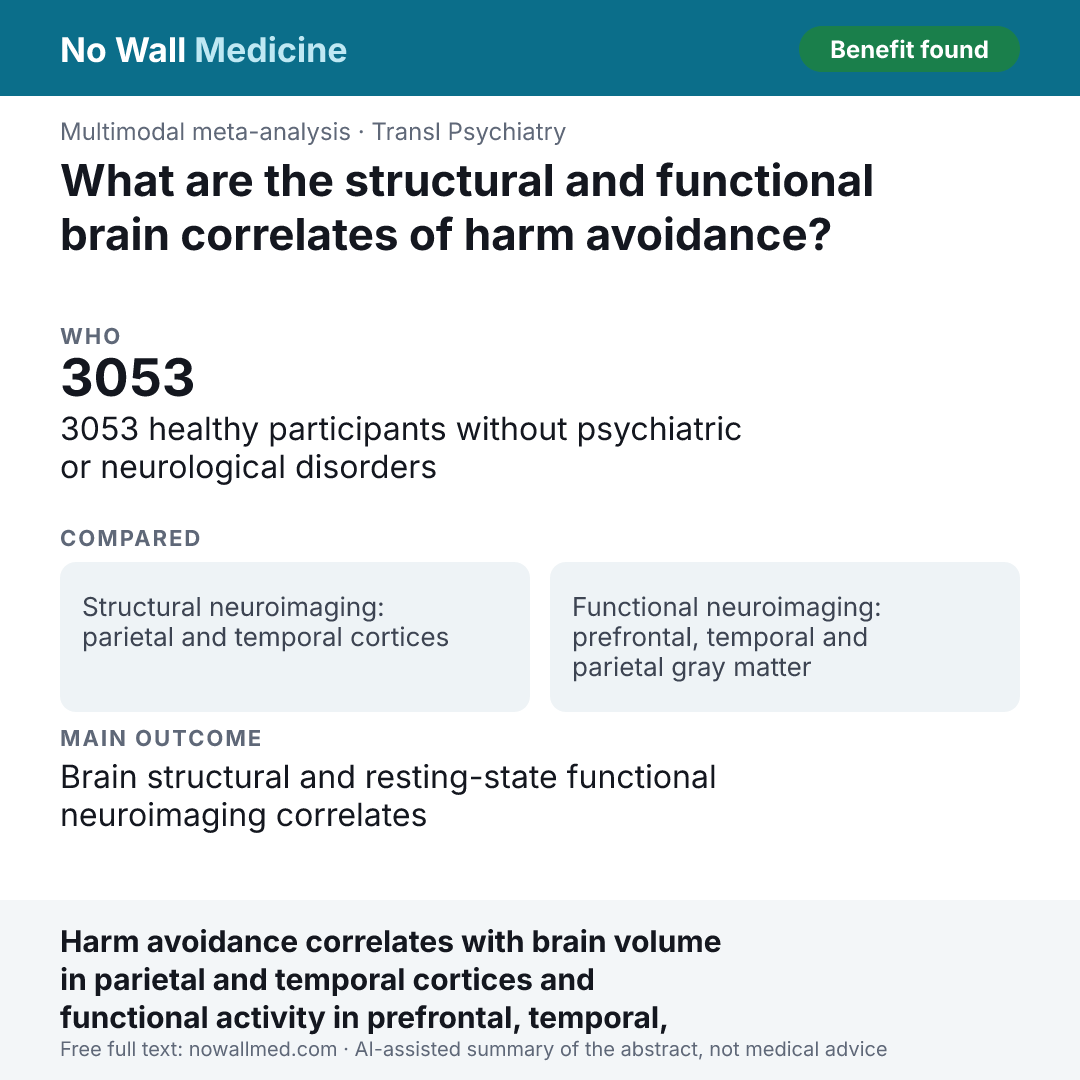
What are the structural and functional brain correlates of harm avoidance?
Who
3053
3053 healthy participants without psychiatric or neurological disorders
Compared
Structural neuroimaging: parietal and temporal cortices
Functional neuroimaging: prefrontal, temporal and parietal gray matter
Main outcome
Brain structural and resting-state functional neuroimaging correlates
Bottom line: Harm avoidance correlates with brain volume in parietal and temporal cortices and functional activity in prefrontal, temporal, and parietal areas.
Transl Psychiatry · 2024-09-20 · Save PNG
Key points
- Researchers analyzed 11 structural and 16 functional datasets involving 3053 healthy participants to find brain patterns related to harm avoidance.
- The analysis found brain volume correlates in parietal and temporal cortices, and resting-state activity correlates in prefrontal, temporal, and parietal gray matter.
- Structural and functional brain patterns both occurred in the left superior frontal gyrus and left middle frontal gyrus.
Why it matters: Neuroimaging findings regarding the brain structures and functions related to harm avoidance have been inconsistent in previous research.
Discussion prompts
- Would these patients look like yours? Who was left out?
- Is the main outcome one that matters to patients?
- Is the difference large enough to change what you do?
Cite: Zhong S, Lin J, Zhang L, et al. Neural correlates of harm avoidance: a multimodal meta-analysis of brain structural and resting-state functional neuroimaging studies. Transl Psychiatry. 2024;14(1):384. doi:10.1038/s41398-024-03091-8
Free full text: PubMed Central · Summary and visual abstract: nowallmed.com/a/neural-correlates-of-harm-avoidance-a-multimodal-meta-analysis-of-1kz2ard/ (AI-assisted from the abstract; check the paper before relying on it).