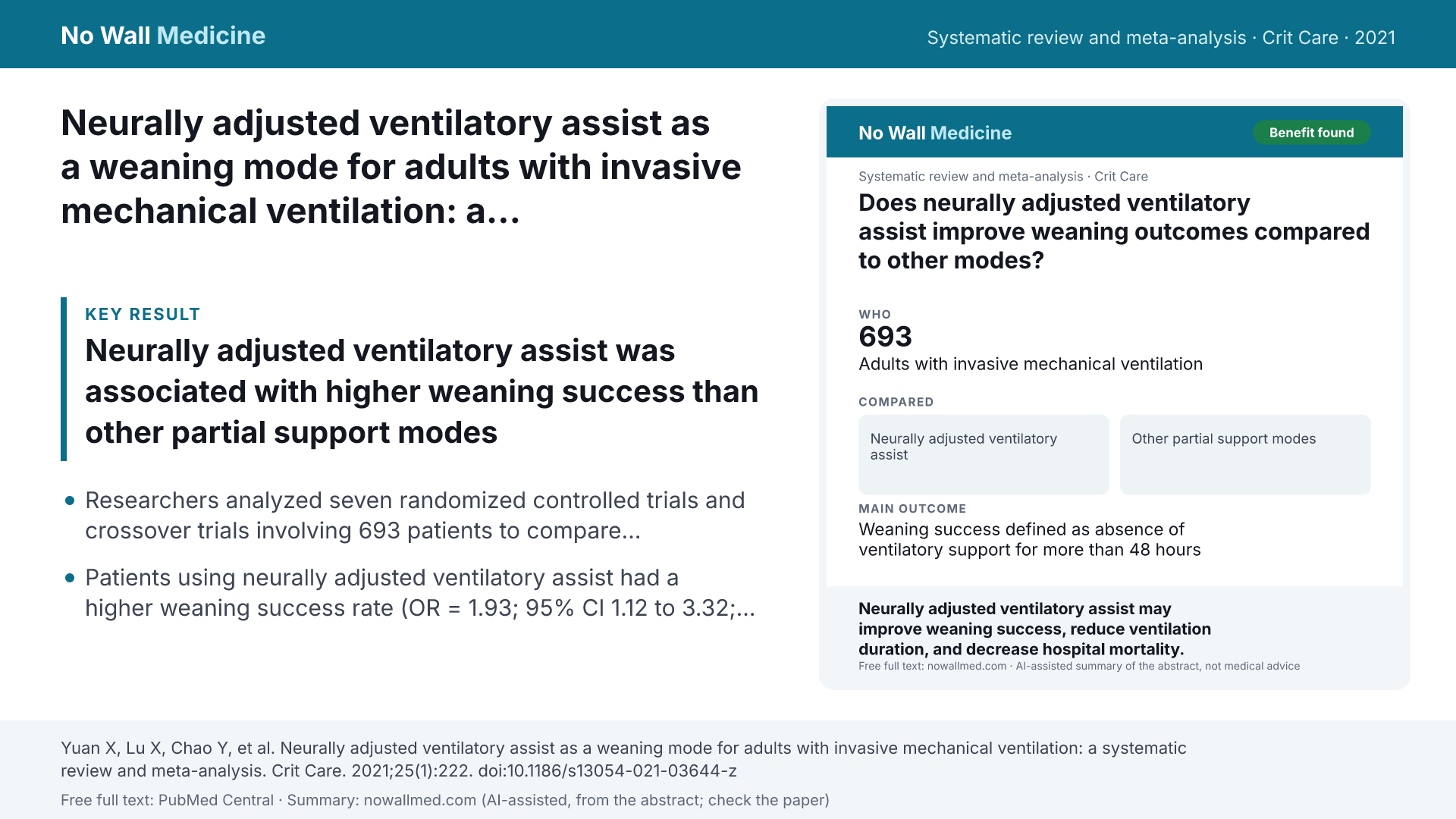
Neurally adjusted ventilatory assist was associated with higher weaning success than other partial support modes
Neurally adjusted ventilatory assist as a weaning mode for adults with invasive mechanical ventilation: a systematic review and meta-analysis
Systematic review and meta-analysisBenefit found
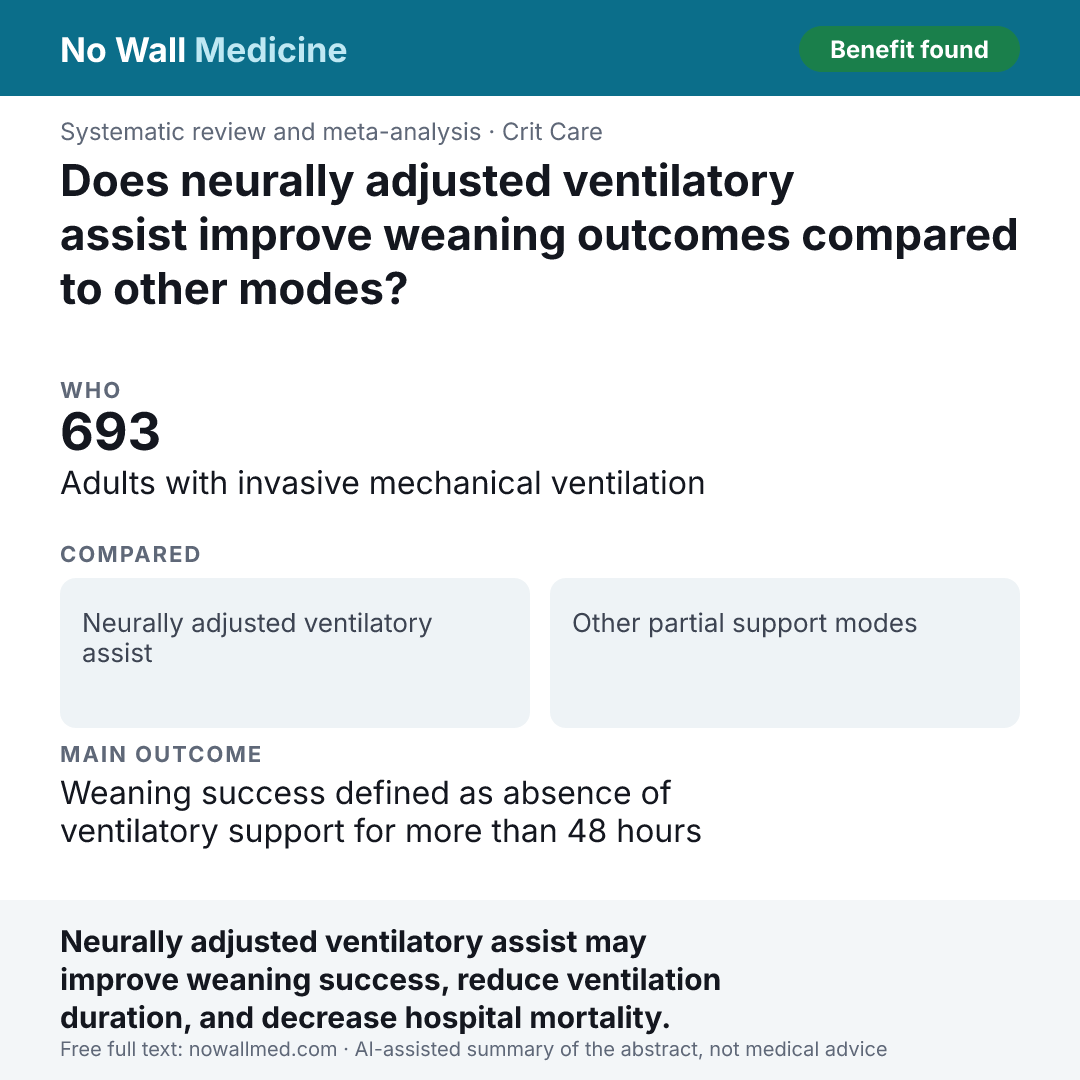
Does neurally adjusted ventilatory assist improve weaning outcomes compared to other modes?
Who
693
Adults with invasive mechanical ventilation
Compared
Neurally adjusted ventilatory assist
Other partial support modes
Main outcome
Weaning success defined as absence of ventilatory support for more than 48 hours
Result: odds ratio 1.93 (95% CI 1.12 to 3.32)
Bottom line: Neurally adjusted ventilatory assist may improve weaning success, reduce ventilation duration, and decrease hospital mortality.
Crit Care · 2021-06-29 · Save PNG
Clinical question: Does neurally adjusted ventilatory assist improve weaning outcomes compared to other modes?
Key points
- Researchers analyzed seven randomized controlled trials and crossover trials involving 693 patients to compare neurally adjusted ventilatory assist with other ventilation modes.
- Patients using neurally adjusted ventilatory assist had a higher weaning success rate (OR = 1.93; 95% CI 1.12 to 3.32; P = 0.02) than those using other modes.
- The use of neurally adjusted ventilatory assist was associated with a reduction in mechanical ventilation duration (MD = -2.63; 95% CI -4.22 to -1.03; P = 0.001) and hospital mortality (OR = 0.58; 95% CI 0.40 to 0.84; P = 0.004).
Headline and key points written with AI from the paper’s abstract, with every number checked against it. Read the paper before relying on them.
Was this summary helpful?
Abstract
Background
Prolonged ventilatory support is associated with poor clinical outcomes. Partial support modes, especially pressure support ventilation, are frequently used in clinical practice but are associated with patient-ventilation asynchrony and deliver fixed levels of assist. Neurally adjusted ventilatory assist (NAVA), a mode of partial ventilatory assist that reduces patient-ventilator asynchrony, may be an alternative for weaning. However, the effects of NAVA on weaning outcomes in clinical practice are unclear. Methods
We searched PubMed, Embase, Medline, and Cochrane Library from 2007 to December 2020. Randomized controlled trials and crossover trials that compared NAVA and other modes were identified in this study. The primary outcome was weaning success which was defined as the absence of ventilatory support for more than 48 h. Summary estimates of effect using odds ratio (OR) for dichotomous outcomes and mean difference (MD) for continuous outcomes with accompanying 95% confidence interval (CI) were expressed. Results
Seven studies (n = 693 patients) were included. Regarding the primary outcome, patients weaned with NAVA had a higher success rate compared with other partial support modes (OR = 1.93; 95% CI 1.12 to 3.32; P = 0.02). For the secondary outcomes, NAVA may reduce duration of mechanical ventilation (MD = - 2.63; 95% CI - 4.22 to - 1.03; P = 0.001) and hospital mortality (OR = 0.58; 95% CI 0.40 to 0.84; P = 0.004) and prolongs ventilator-free days (MD = 3.48; 95% CI 0.97 to 6.00; P = 0.007) when compared with other modes. Conclusions
Our study suggests that the NAVA mode may improve the rate of weaning success compared with other partial support modes for difficult to wean patients.
Abstract reproduced under the article’s CC BY licence.
Subject terms
Headline, design, result, key points, caveat and citation as plain text.
Cite this article
Yuan X, Lu X, Chao Y, et al. Neurally adjusted ventilatory assist as a weaning mode for adults with invasive mechanical ventilation: a systematic review and meta-analysis. Crit Care. 2021. doi:10.1186/s13054-021-03644-z
Spotted a mistake? Suggest a correction