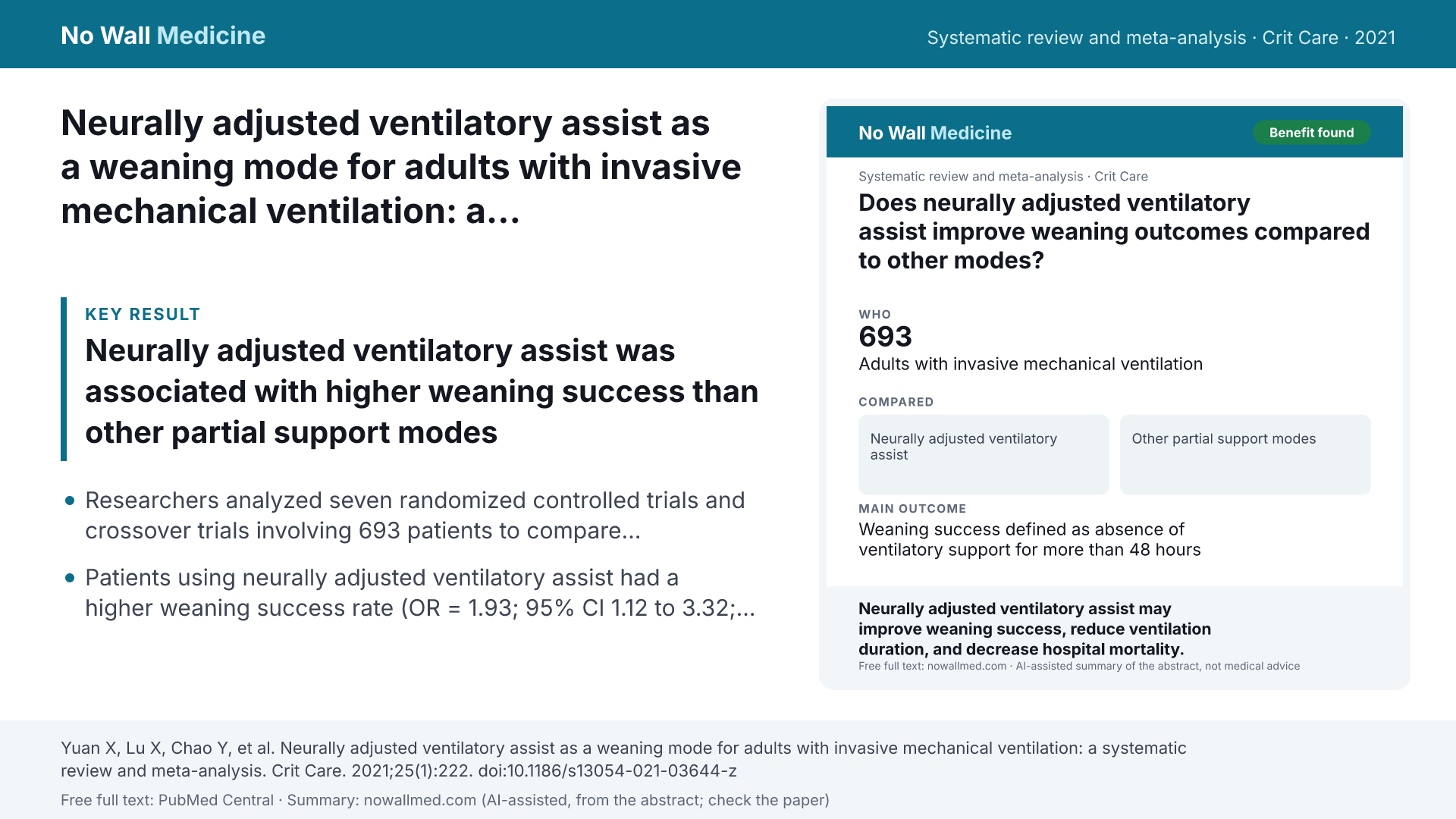
Neurally adjusted ventilatory assist as a weaning mode for adults with invasive mechanical ventilation: a systematic review and meta-analysis
Key result: Neurally adjusted ventilatory assist was associated with higher weaning success than other partial support modes
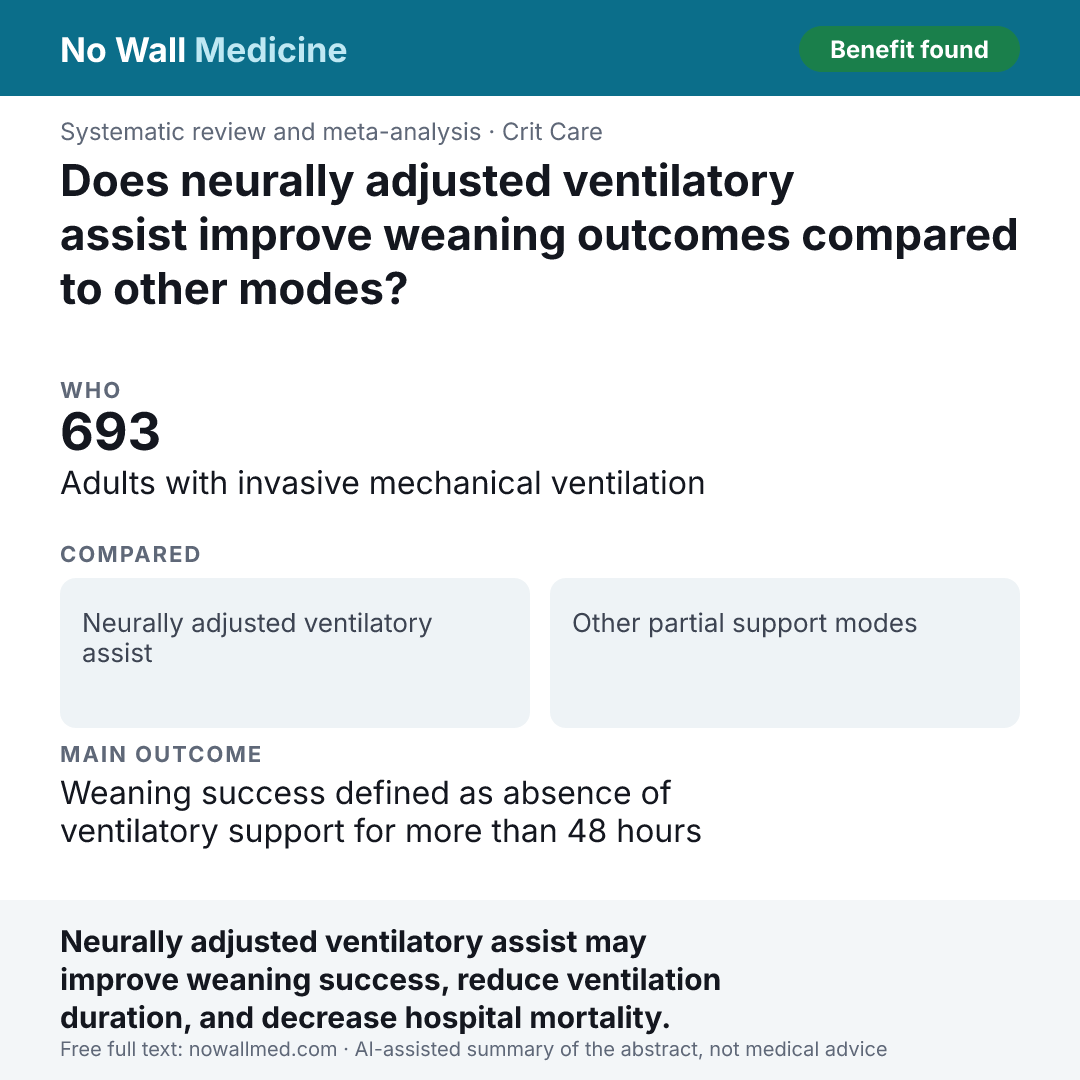
Systematic review and meta-analysisBenefit found
Does neurally adjusted ventilatory assist improve weaning outcomes compared to other modes?
Who
693
Adults with invasive mechanical ventilation
Compared
Neurally adjusted ventilatory assist
Other partial support modes
Main outcome
Weaning success defined as absence of ventilatory support for more than 48 hours
Result: odds ratio 1.93 (95% CI 1.12 to 3.32)
Bottom line: Neurally adjusted ventilatory assist may improve weaning success, reduce ventilation duration, and decrease hospital mortality.
Crit Care · 2021-06-29 · Save PNG
Key points
- Researchers analyzed seven randomized controlled trials and crossover trials involving 693 patients to compare neurally adjusted ventilatory assist with other ventilation modes.
- Patients using neurally adjusted ventilatory assist had a higher weaning success rate (OR = 1.93; 95% CI 1.12 to 3.32; P = 0.02) than those using other modes.
- The use of neurally adjusted ventilatory assist was associated with a reduction in mechanical ventilation duration (MD = -2.63; 95% CI -4.22 to -1.03; P = 0.001) and hospital mortality (OR = 0.58; 95% CI 0.40 to 0.84; P = 0.004).
Discussion prompts
- Would these patients look like yours? Who was left out?
- Is the main outcome one that matters to patients?
- Is the difference large enough to change what you do?
Cite: Yuan X, Lu X, Chao Y, et al. Neurally adjusted ventilatory assist as a weaning mode for adults with invasive mechanical ventilation: a systematic review and meta-analysis. Crit Care. 2021. doi:10.1186/s13054-021-03644-z
Free full text: PubMed Central · Summary and visual abstract: nowallmed.com/a/neurally-adjusted-ventilatory-assist-as-a-weaning-mode-for-adults-14wecaq/ (AI-assisted from the abstract; check the paper before relying on it).