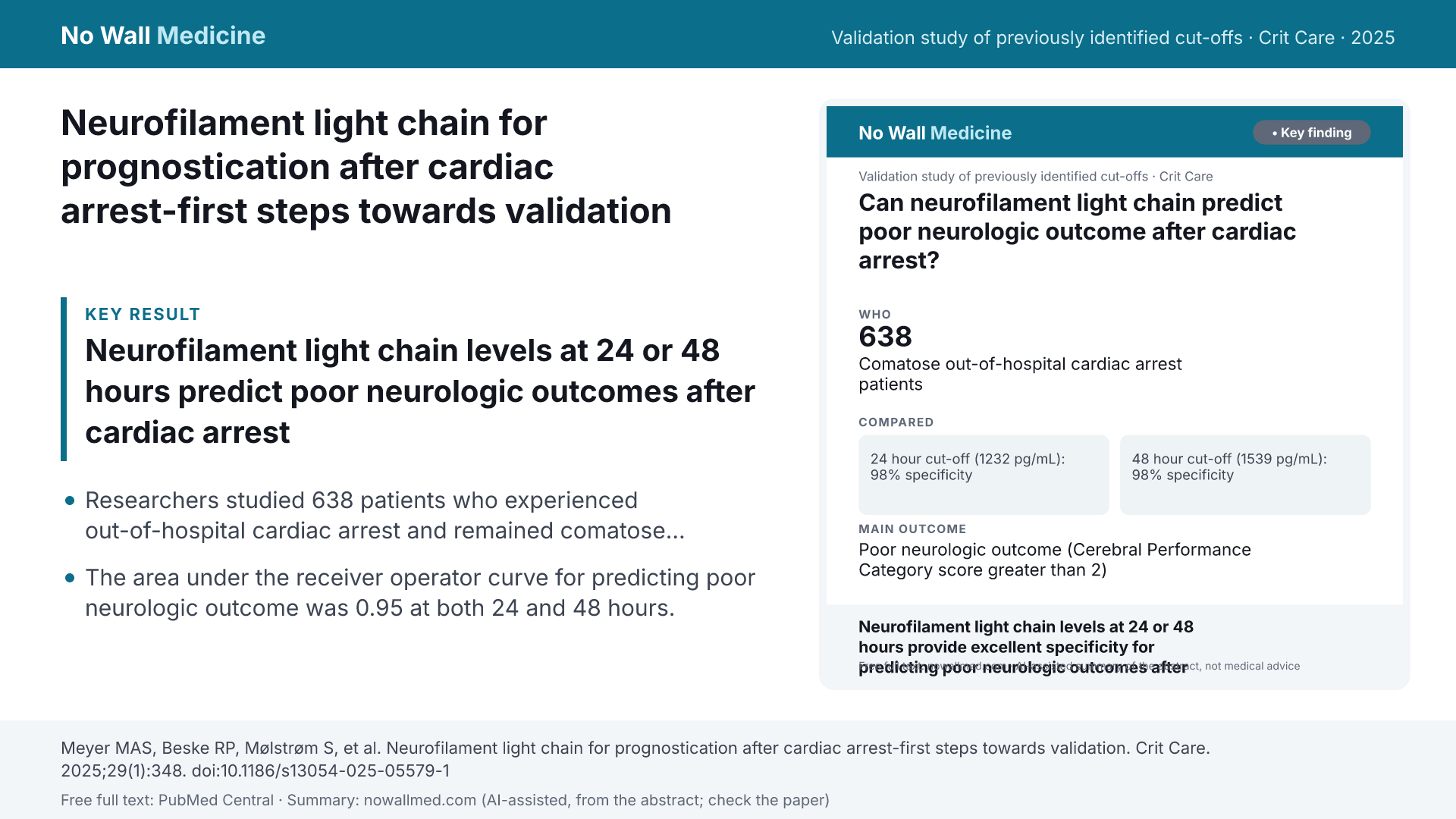
Neurofilament light chain levels at 24 or 48 hours predict poor neurologic outcomes after cardiac arrest
Neurofilament light chain for prognostication after cardiac arrest-first steps towards validation
Validation study of previously identified cut-offsKey finding
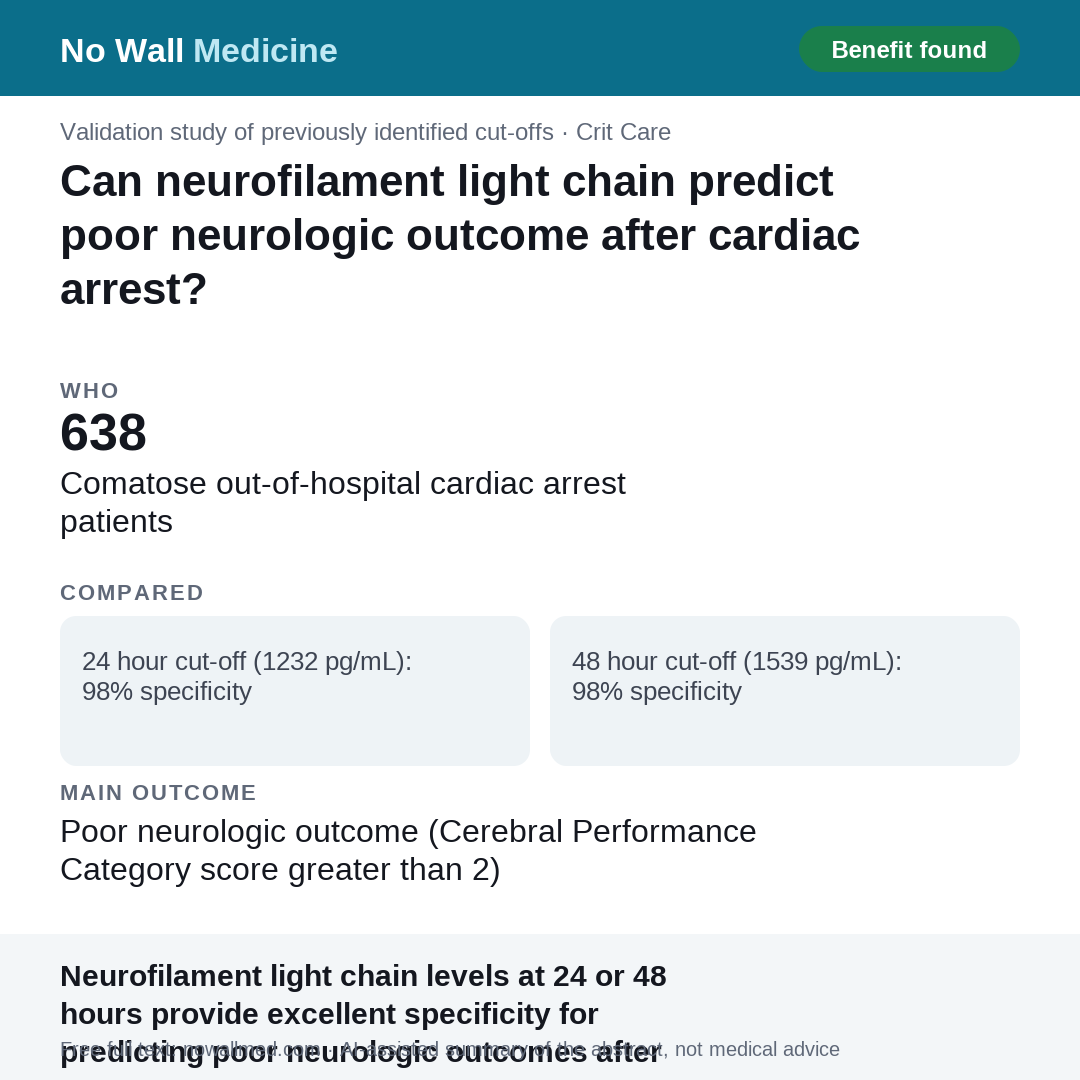
Can neurofilament light chain predict poor neurologic outcome after cardiac arrest?
Who
638
Comatose out-of-hospital cardiac arrest patients
Compared
24 hour cut-off (1232 pg/mL): 98% specificity
48 hour cut-off (1539 pg/mL): 98% specificity
Main outcome
Poor neurologic outcome (Cerebral Performance Category score greater than 2)
Result: area under the receiver operator curve 0.95 at 24 and 48 h
Bottom line: Neurofilament light chain levels at 24 or 48 hours provide excellent specificity for predicting poor neurologic outcomes after cardiac arrest.
Crit Care · 2025-08-06Download image
Same trial (NCT03141099)
Papers we list that report this registered trial, oldest first. Read a secondary analysis alongside the main results.
- Main results Key finding
Low oxygen saturation in blood was associated with higher mortality after out-of-hospital cardiac arrest Crit Care 2023-10 - Secondary analysis No clear difference
Blood pressure, oxygenation, and fever prevention targets showed no difference in 1-year mortality after cardiac arrest Crit Care 2024-01 - Secondary analysis Key finding
Higher SCAI shock classification was associated with increased 1-year mortality in comatose cardiac arrest patients J Am Heart Assoc 2024-12 - Related analysis Key finding
This paper Crit Care 2025-08
Clinical question: Can neurofilament light chain predict poor neurologic outcome after cardiac arrest?
Key points
- Researchers studied 638 patients who experienced out-of-hospital cardiac arrest and remained comatose upon admission.
- The area under the receiver operator curve for predicting poor neurologic outcome was 0.95 at both 24 and 48 hours.
- A cut-off of 1232 pg/mL at 24 hours and 1539 pg/mL at 48 hours both showed 98% specificity for poor neurologic outcome.
Headline and key points written with AI from the paper’s abstract, with every number checked against it. Read the paper before relying on them.
Was this summary helpful?
Subject terms
Headline, design, result, key points, caveat and citation as plain text.
Cite this article
Meyer MAS, Beske RP, Mølstrøm S, et al. Neurofilament light chain for prognostication after cardiac arrest-first steps towards validation. Crit Care. 2025. doi:10.1186/s13054-025-05579-1
Spotted a mistake? Suggest a correction