Cortical brain activity is linked to postural control in people with Parkinson's disease
Neuroimaging and cognitive correlates of postural control in Parkinson's disease: a systematic review
Systematic reviewUnclear result
Neural mechanisms of postural control in Parkinson's disease
Who
79
Patients with Parkinson's disease
Compared
Patients with Parkinson's
Controls
Main outcome
Postural control function
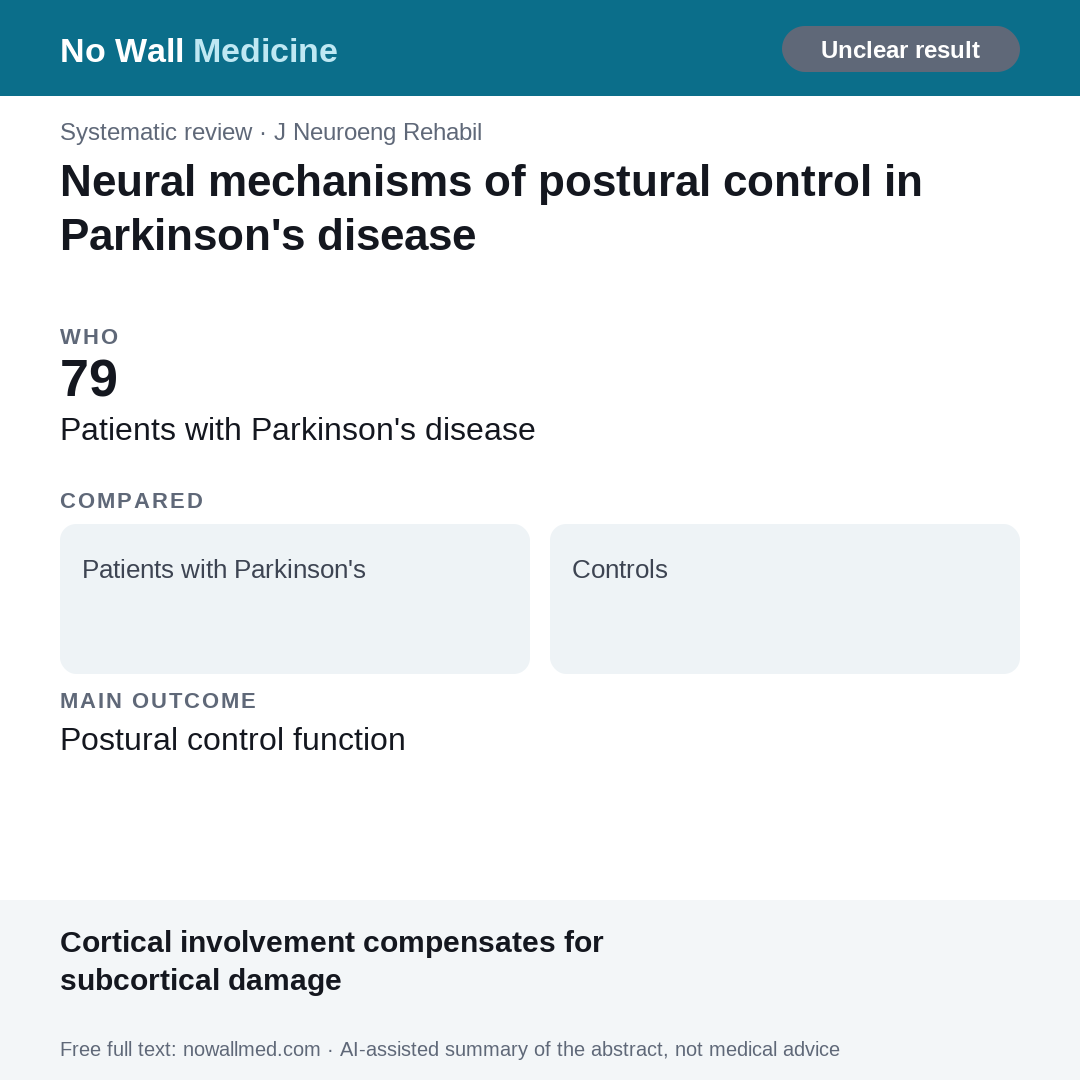
Bottom line: Cortical involvement compensates for subcortical damage
J Neuroeng Rehabil · 2025-02-08Download image
Why it matters: The specific neural mechanisms and cognitive links that underlie postural control and instability in Parkinson's disease are not fully understood.
Key points
- Researchers reviewed 79 studies investigating the neural mechanisms and cognitive links to postural control in Parkinson's disease.
- Findings supported the idea that the cortex, the brain's outer layer, is involved in postural control to compensate for damage in subcortical areas.
- The review examined various methods including functional neuroimaging, resting-state neural correlates, and behavioral studies.
Headline and key points written with AI from the paper’s abstract, with every number checked against it. Read the paper before relying on them.
Was this summary helpful?
Subject terms
Cite this article
Tait P, Graham L, Vitorio R, Watermeyer T, Timm EC, O'Keefe J. Neuroimaging and cognitive correlates of postural control in Parkinson's disease: a systematic review. J Neuroeng Rehabil. 2025. doi:10.1186/s12984-024-01539-y
Spotted a mistake? Suggest a correction
Top studies every Monday
The week’s key trials and guidelines in your specialties, plus any topics you follow. By email, free.
Get the weekly digest