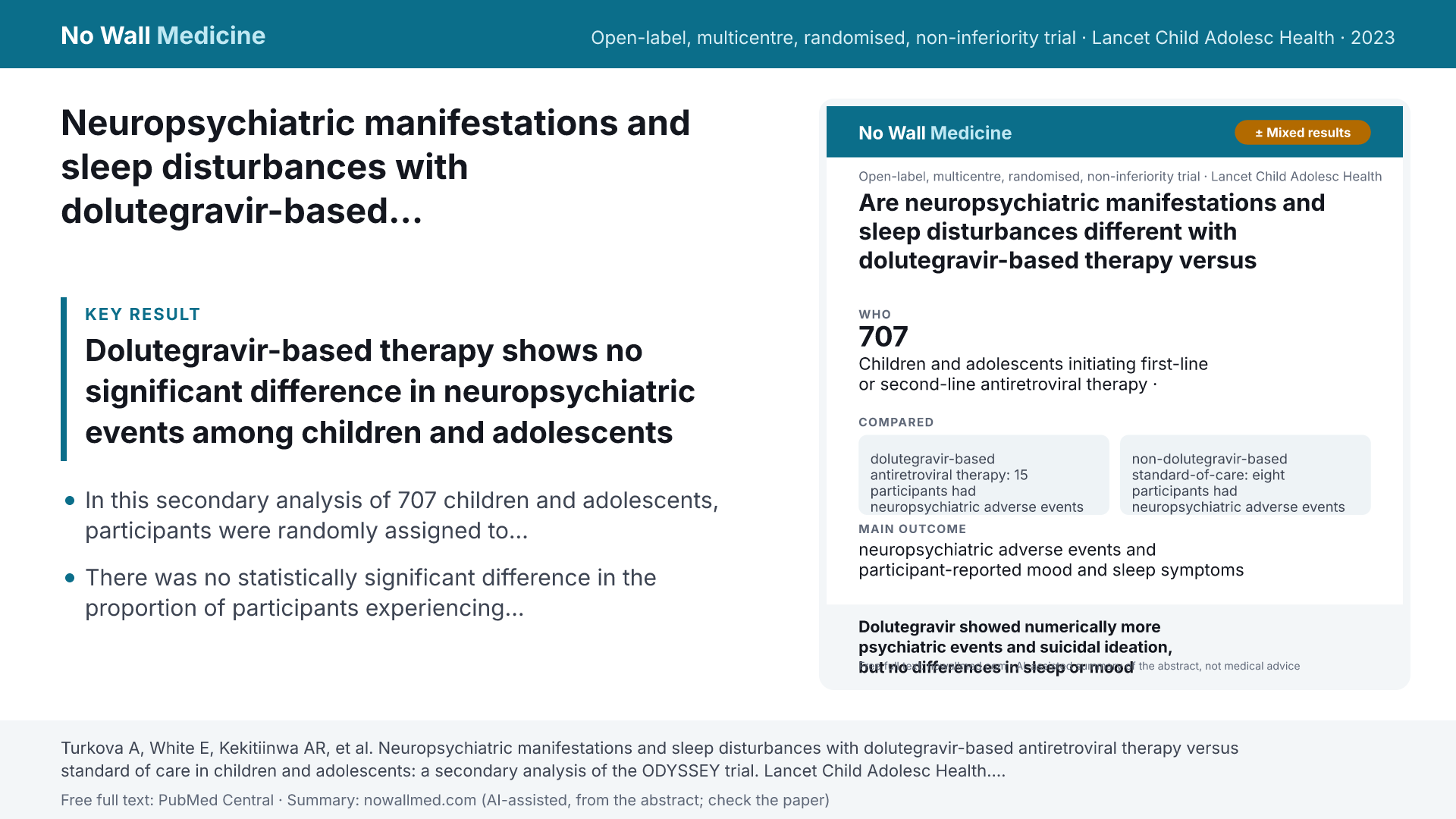
Dolutegravir-based therapy shows no significant difference in neuropsychiatric events among children and adolescents
Neuropsychiatric manifestations and sleep disturbances with dolutegravir-based antiretroviral therapy versus standard of care in children and adolescents: a secondary analysis of the ODYSSEY trial
Secondary analysis of a trialMixed results
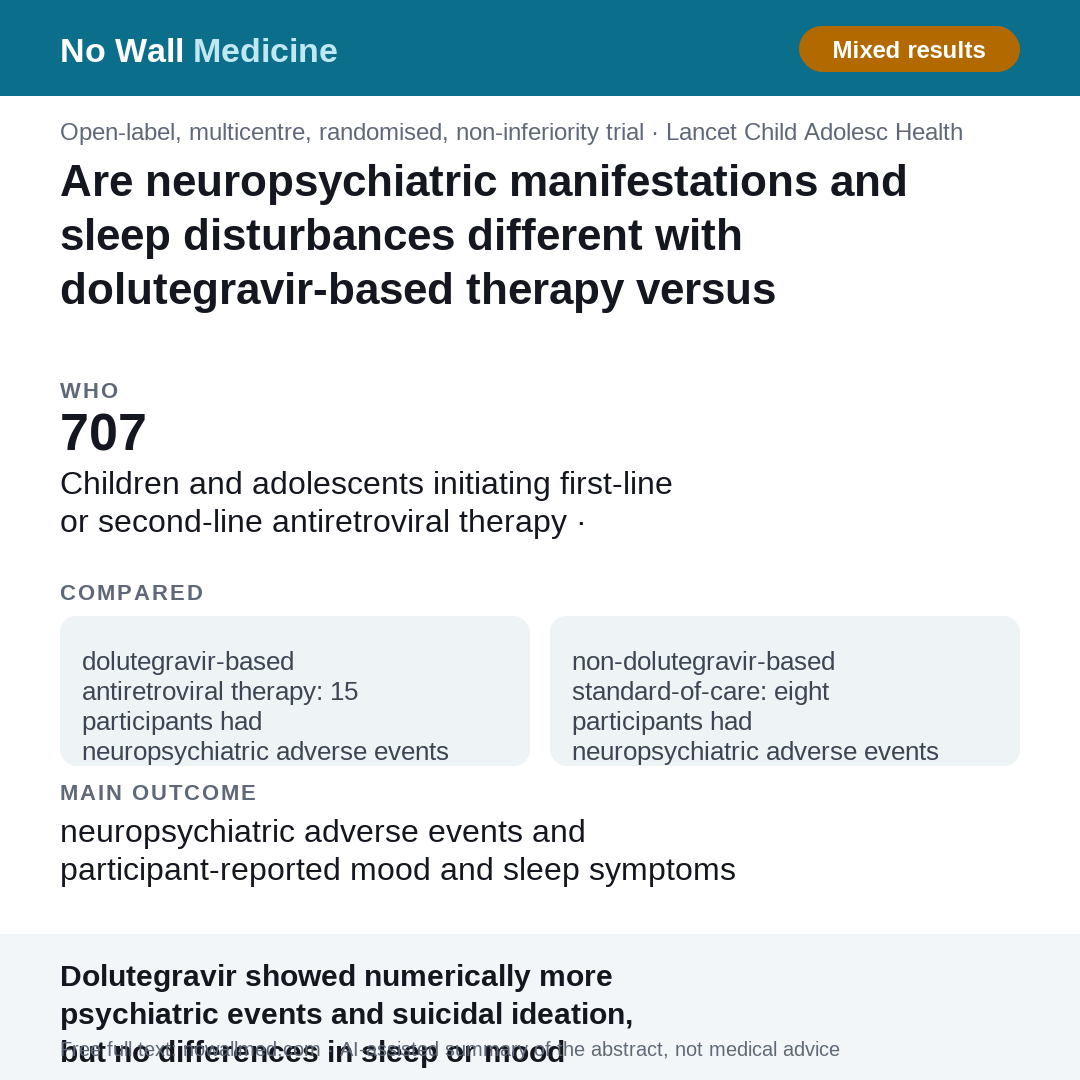
Are neuropsychiatric manifestations and sleep disturbances different with dolutegravir-based therapy versus standard of care in children and adolescents?
Who
707
Children and adolescents initiating first-line or second-line antiretroviral therapy · Multicentre
Compared
dolutegravir-based antiretroviral therapy: 15 participants had neuropsychiatric adverse events
non-dolutegravir-based standard-of-care: eight participants had neuropsychiatric adverse events
Main outcome
neuropsychiatric adverse events and participant-reported mood and sleep symptoms
Bottom line: Dolutegravir showed numerically more psychiatric events and suicidal ideation, but no differences in sleep or mood symptoms.
Limitation: These differences should be interpreted with caution in an open-label trial.
Funded by: Penta Foundation, ViiV Healthcare, and UK Medical Research Council
Lancet Child Adolesc Health · 2023-08-08Download image
Clinical question: Are neuropsychiatric manifestations and sleep disturbances different with dolutegravir-based therapy versus standard of care in children and adolescents?
Key points
- In this secondary analysis of 707 children and adolescents, participants were randomly assigned to either dolutegravir-based antiretroviral therapy or standard-of-care treatment.
- There was no statistically significant difference in the proportion of participants experiencing neuropsychiatric adverse events, with 15 events in the dolutegravir group and eight in the standard-of-care group.
- Participants in the dolutegravir group reported more symptoms of self-harm, life not worth living, or suicidal thoughts compared to the standard-of-care group.
Limitation the authors note: The authors state that differences should be interpreted with caution because this was an open-label trial.
Headline and key points written with AI from the paper’s abstract, with every number checked against it. Read the paper before relying on them.
Was this summary helpful?
Abstract
Background
Cohort studies in adults with HIV showed that dolutegravir was associated with neuropsychiatric adverse events and sleep problems, yet data are scarce in children and adolescents. We aimed to evaluate neuropsychiatric manifestations in children and adolescents treated with dolutegravir-based treatment versus alternative antiretroviral therapy. Methods
This is a secondary analysis of ODYSSEY, an open-label, multicentre, randomised, non-inferiority trial, in which adolescents and children initiating first-line or second-line antiretroviral therapy were randomly assigned 1:1 to dolutegravir-based treatment or standard-of-care treatment. We assessed neuropsychiatric adverse events (reported by clinicians) and responses to the mood and sleep questionnaires (reported by the participant or their carer) in both groups. We compared the proportions of patients with neuropsychiatric adverse events (neurological, psychiatric, and total), time to first neuropsychiatric adverse event, and participant-reported responses to questionnaires capturing issues with mood, suicidal thoughts, and sleep problems. Findings
Between Sept 20, 2016, and June 22, 2018, 707 participants were enrolled, of whom 345 (49%) were female and 362 (51%) were male, and 623 (88%) were Black-African. Of 707 participants, 350 (50%) were randomly assigned to dolutegravir-based antiretroviral therapy and 357 (50%) to non-dolutegravir-based standard-of-care. 311 (44%) of 707 participants started first-line antiretroviral therapy (ODYSSEY-A; 145 [92%] of 157 participants had efavirenz-based therapy in the standard-of-care group), and 396 (56%) of 707 started second-line therapy (ODYSSEY-B; 195 [98%] of 200 had protease inhibitor-based therapy in the standard-of-care group). During follow-up (median 142 weeks, IQR 124-159), 23 participants had 31 neuropsychiatric adverse events (15 in the dolutegravir group and eight in the standard-of-care group; difference in proportion of participants with ≥1 event p=0·13). 11 participants had one or more neurological events (six and five; p=0·74) and 14 participants had one or more psychiatric events (ten and four; p=0·097). Among 14 participants with psychiatric events, eight participants in the dolutegravir group and four in standard-of-care group had suicidal ideation or behaviour. More participants in the dolutegravir group than the standard-of-care group reported symptoms of self-harm (eight vs one; p=0·025), life not worth living (17 vs five; p=0·0091), or suicidal thoughts (13 vs none; p=0·0006) at one or more follow-up visits. Most reports were transient. There were no differences by treatment group in low mood or feeling sad, problems concentrating, feeling worried or feeling angry or aggressive, sleep problems, or sleep quality. Interpretation
The numbers of neuropsychiatric adverse events and reported neuropsychiatric symptoms were low. However, numerically more participants had psychiatric events and reported suicidality ideation in the dolutegravir group than the standard-of-care group. These differences should be interpreted with caution in an open-label trial. Clinicians and policy makers should consider including suicidality screening of children or adolescents receiving dolutegravir. Funding
Penta Foundation, ViiV Healthcare, and UK Medical Research Council.
Abstract reproduced under the article’s CC BY licence.
Subject terms
Cite this article
Turkova A, White E, Kekitiinwa AR, et al. Neuropsychiatric manifestations and sleep disturbances with dolutegravir-based antiretroviral therapy versus standard of care in children and adolescents: a secondary analysis of the ODYSSEY trial. Lancet Child Adolesc Health. 2023;7(10):718-727. doi:10.1016/S2352-4642(23)00164-5
Spotted a mistake? Suggest a correction