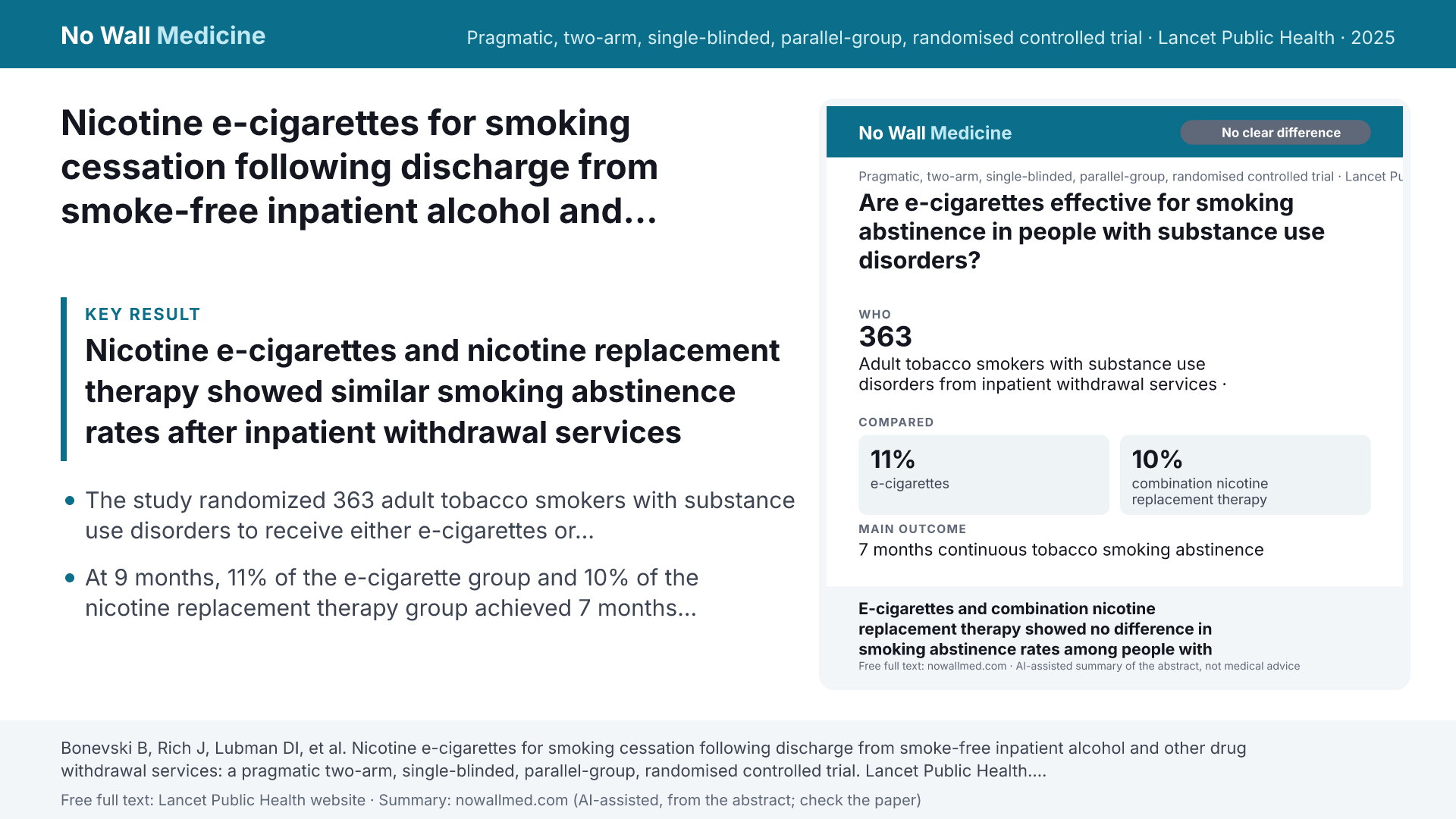
Nicotine e-cigarettes and nicotine replacement therapy showed similar smoking abstinence rates after inpatient withdrawal services
Nicotine e-cigarettes for smoking cessation following discharge from smoke-free inpatient alcohol and other drug withdrawal services: a pragmatic two-arm, single-blinded, parallel-group, randomised controlled trial
Pragmatic, two-arm, single-blinded, parallel-group, randomised controlled trialNo clear difference
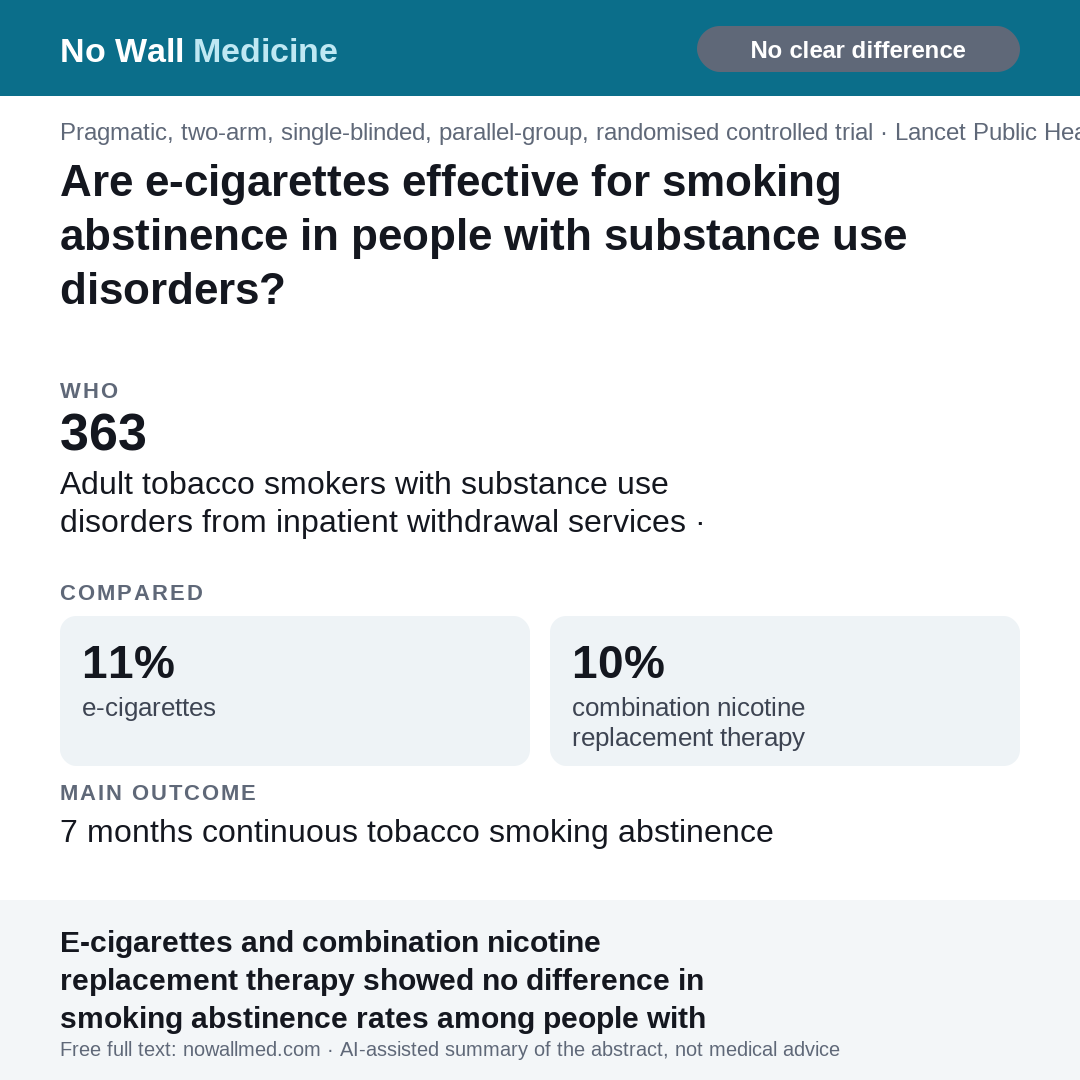
Are e-cigarettes effective for smoking abstinence in people with substance use disorders?
Who
363
Adult tobacco smokers with substance use disorders from inpatient withdrawal services · Five smoke-free inpatient withdrawal services in Australia
Compared
11%e-cigarettes (19/179)
10%combination nicotine replacement therapy (18/184)
Main outcome
7 months continuous tobacco smoking abstinence
Result: risk ratio 1·09 (95% credible interval 0·52-1·89)
Bottom line: E-cigarettes and combination nicotine replacement therapy showed no difference in smoking abstinence rates among people with substance use disorders.
Funded by: National Health and Medical Research Council of Australia
Lancet Public Health · 2025-07-03Download image
Clinical question: Are e-cigarettes effective for smoking abstinence in people with substance use disorders?
Why it matters: Evidence is limited regarding the effectiveness of e-cigarettes for smoking cessation in people with substance use disorders following discharge from inpatient withdrawal services.
Key points
- The study randomized 363 adult tobacco smokers with substance use disorders to receive either e-cigarettes or combination nicotine replacement therapy with behavioral counseling.
- At 9 months, 11% of the e-cigarette group and 10% of the nicotine replacement therapy group achieved 7 months of continuous smoking abstinence.
- There were no significant differences in smoking abstinence or serious adverse events between the two treatment groups.
Headline and key points written with AI from the paper’s abstract, with every number checked against it. Read the paper before relying on them.
Was this summary helpful?
Abstract
Background
Nicotine-containing electronic cigarettes (e-cigarettes) have been shown to be effective for smoking cessation among general populations, but there is little evidence in people with substance use disorders (SUDs). We aimed to assess the effectiveness of e-cigarettes for smoking abstinence in people with SUD following discharge from smoke-free inpatient withdrawal services. Methods
We conducted a pragmatic, two-arm, single-blinded, parallel-group randomised controlled trial. The majority of this study took place in the community after the participants were discharged from inpatient stay. Adults who were tobacco smokers (motivated to quit; not using e-cigarettes) from five smoke-free inpatient withdrawal services in Australia were recruited and randomly assigned by computer using stratified block (1:1) to receive a 12-week supply of either e-cigarettes or combination nicotine replacement therapy (cNRT) with Quitline behavioural counselling on discharge. Participants were advised to use e-cigarettes as much or as often as necessary or desired and cNRT according to instructions. Researchers collecting outcome data were masked to treatment group. The primary outcome was 7 months continuous tobacco smoking abstinence as measured at 9 months after randomisation. The primary analysis was performed using an intention-to-treat approach, with sensitivity analyses following per-protocol, treatment adherence, and complete case analysis approaches. Serious adverse events were classified by a physician as non-serious or serious and causality assessed. We analysed serious adverse events by treatment group and calculated an incident rate ratio for each comparison. This trial is completed and is registered with the Australian and New Zealand Clinical Trials Registry (ACTRN12619001787178). Findings
Between Sept 29, 2020, and June 3, 2022, 363 participants were enrolled. Of 363 participants, 207 (57%) were men and 151 (42%) were women; 179 (49%) were randomly assigned to e-cigarettes and 184 (51%) to cNRT. At follow-up, 19 (11%) of 179 participants in the e-cigarette group reported 7 months' continuous abstinence, compared with 18 (10%) of 184 participants in the cNRT group, with no significant differences between groups (risk ratio 1·09; 95% credible interval [CrI] 0·52-1·89). The probability of a positive risk difference was 60% and Bayes factor was 0·04, indicating little evidence of a treatment effect. 15 serious adverse events occurred in the e-cigarette group and 13 occurred in the cNRT group (incident rate ratio 1·18; 95% CrI 0·56-2·54, p=0·65). None were treatment-related. Interpretation
There was no evidence of a difference in cessation rates or adverse effects after 9 months of follow-up between participants given e-cigarettes or cNRT following discharge from inpatient SUD withdrawal services. Both treatments had approximately 10% smoking continuous abstinence rates among a population that is hard to treat and who have disproportionate tobacco-related morbidity and mortality. Funding
National Health and Medical Research Council of Australia.
Abstract reproduced under the article’s CC BY licence.
Subject terms
Cite this article
Bonevski B, Rich J, Lubman DI, Segan C, Baker A, Borland R. Nicotine e-cigarettes for smoking cessation following discharge from smoke-free inpatient alcohol and other drug withdrawal services: a pragmatic two-arm, single-blinded, parallel-group, randomised controlled trial. Lancet Public Health. 2025. doi:10.1016/S2468-2667(25)00101-X
Spotted a mistake? Suggest a correction
Top studies every Monday
The week’s key trials and guidelines in your specialties, plus any topics you follow. By email, free.
Get the weekly digest