Closed-loop insulin system showed no significant difference in low blood sugar during physical activity
No more hypoglycaemia on days with physical activity and unrestricted diet when using a closed-loop system for 12 weeks: A post hoc secondary analysis of the multicentre, randomized controlled Diabeloop WP7 trial
Post hoc secondary analysis of a randomized controlled trialNo clear difference
Does the closed-loop system control hypoglycemia induced by physical activity in type 1 diabetes?
Who
56
56 patients with type 1 diabetes · multicentre
Compared
days with physical activity: 2.0% ± 1.5%
days without physical activity: 2.2% ± 1.1%
Main outcome
time spent in glucose range less than 70 mg/dL
Bottom line: The closed-loop system avoids physical activity-induced hypoglycemia without changing time spent below 70 mg/dL.
Diabetes Obes Metab · 2021-06-03Download image
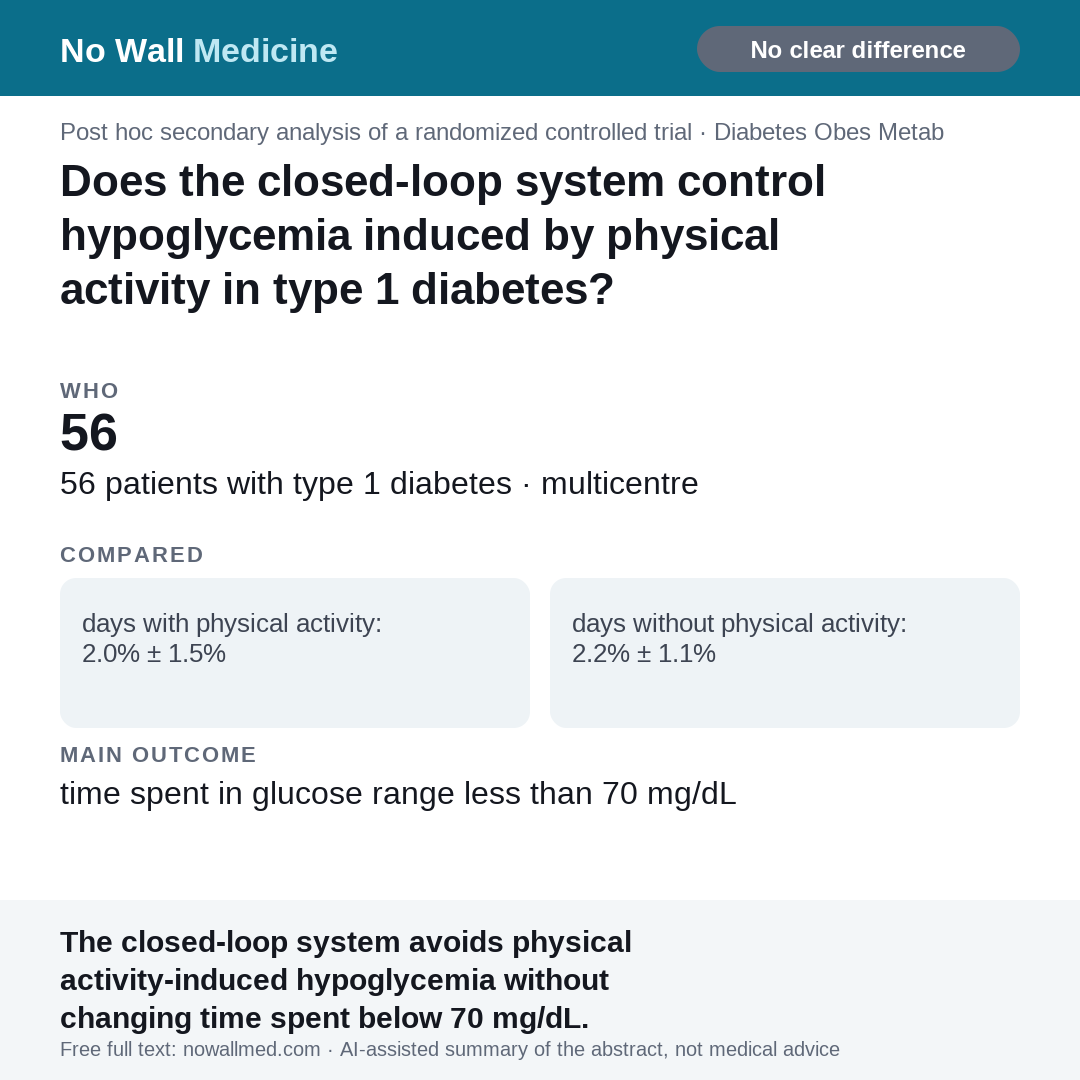
Clinical question: Does the closed-loop system control hypoglycemia induced by physical activity in type 1 diabetes?
Why it matters: It was unknown if the Diabeloop Generation-1 closed-loop system could effectively control low blood sugar levels specifically induced by physical activity in real-life conditions.
Key points
- Researchers analyzed 56 patients with type 1 diabetes using the Diabeloop Generation-1 closed-loop system, which is an automated insulin delivery device, for 12 weeks.
- Time spent with glucose levels below 70 mg/dL was not significantly different on days with physical activity compared to days without (2.0% ± 1.5% vs. 2.2% ± 1.1%).
- On days with physical activity, the system recommended more preventive carbohydrates (41.1 ± 35.5 g/day vs. 21.8 ± 28.5 g/day) and delivered less insulin (31.5 ± 10.5 U/day vs. 34.0 ± 10.5 U/day).
Headline and key points written with AI from the paper’s abstract, with every number checked against it. Read the paper before relying on them.
Was this summary helpful?
Subject terms
Cite this article
Franc S, Benhamou PY, Borot S, Chaillous L, Delemer B, Doron M. No more hypoglycaemia on days with physical activity and unrestricted diet when using a closed-loop system for 12 weeks: A post hoc secondary analysis of the multicentre, randomized controlled Diabeloop WP7 trial. Diabetes Obes Metab. 2021. doi:10.1111/dom.14442
Spotted a mistake? Suggest a correction
Top studies every Monday
The week’s key trials and guidelines in your specialties, plus any topics you follow. By email, free.
Get the weekly digest