Non-clozapine treatments show varying effects on symptoms in patients with treatment-resistant schizophrenia
Non-Clozapine interventions in treatment-resistant schizophrenia: a systematic review and meta-analysis
Systematic review and meta-analysisMixed results
What is the efficacy of non-clozapine interventions in treatment-resistant schizophrenia?
Who
3241
Patients with treatment-resistant schizophrenia
Compared
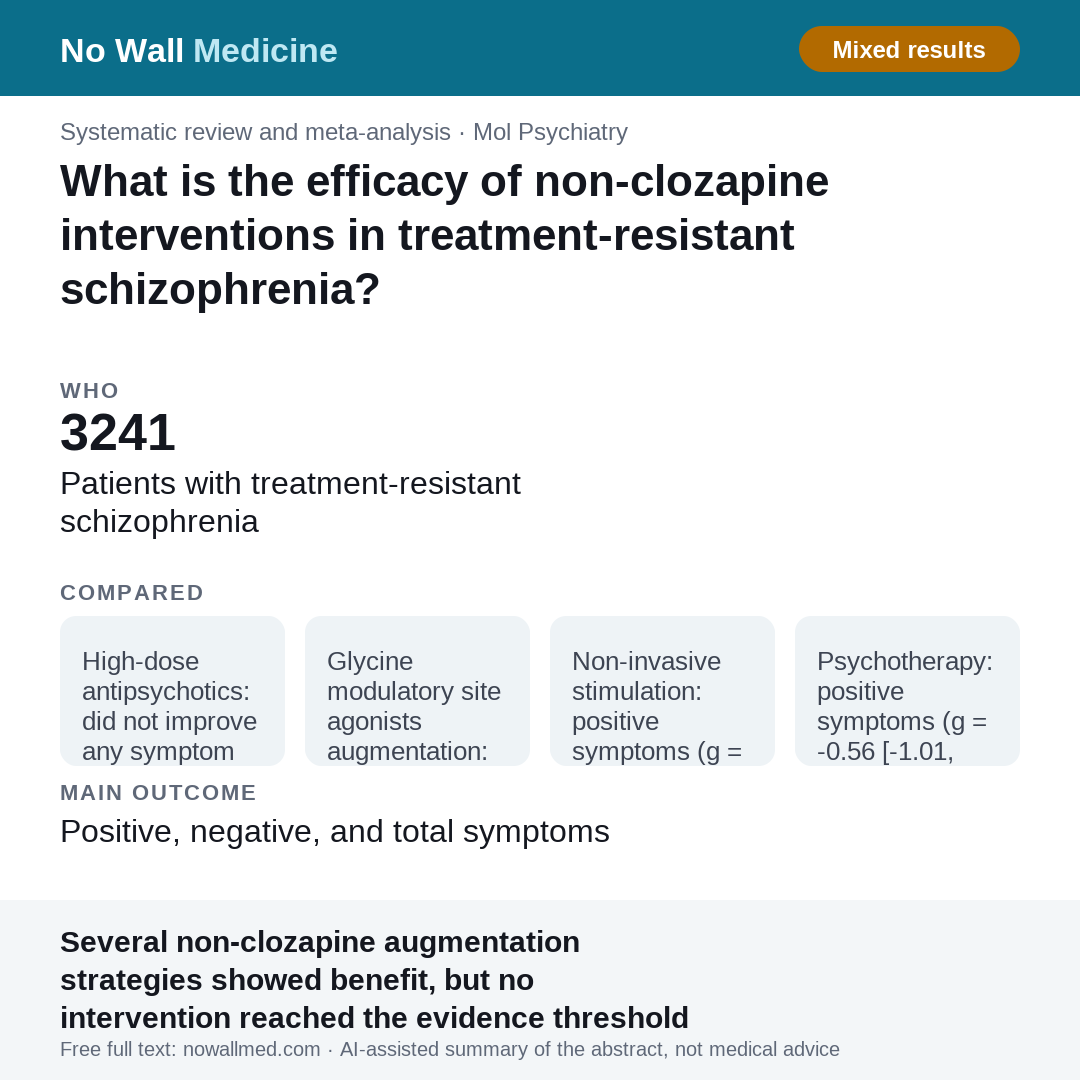
High-dose antipsychotics: did not improve any symptom domain
Glycine modulatory site agonists augmentation: positive (g = -0.56 [-0.81, -0.31]), negative (g = -1.18 [-1.49, -0.87]), total (g = -1.17 [-1.75, -0.59])
Non-invasive stimulation: positive symptoms (g = -0.42 [-0.65, -0.18])
Psychotherapy: positive symptoms (g = -0.56 [-1.01, -0.10])
Main outcome
Positive, negative, and total symptoms
Bottom line: Several non-clozapine augmentation strategies showed benefit, but no intervention reached the evidence threshold for routine recommendation.
Limitation: Small sample sizes and apparent publication bias for non-invasive stimulation studies.
Mol Psychiatry · 2025-10-03Download image
Clinical question: What is the efficacy of non-clozapine interventions in treatment-resistant schizophrenia?
Why it matters: Clinicians need to know which non-clozapine interventions may be effective when clozapine is not a suitable treatment option for schizophrenia.
Key points
- Researchers analyzed 68 studies involving 3241 patients to evaluate non-clozapine options for treatment-resistant schizophrenia.
- Glycine modulatory site agonists were associated with improvements in positive (g = -0.56), negative (g = -1.18), and total symptoms (g = -1.17).
- High-dose antipsychotics involving 467 participants did not improve any symptom domain.
Limitation the authors note: The authors stated that sample sizes were small and publication bias was apparent for non-invasive stimulation studies.
Headline and key points written with AI from the paper’s abstract, with every number checked against it. Read the paper before relying on them.
Was this summary helpful?
Subject terms
Cite this article
Carr R, Cannon A, Finelli V, Bukala B, Cimen Y, Filipova P. Non-Clozapine interventions in treatment-resistant schizophrenia: a systematic review and meta-analysis. Mol Psychiatry. 2025. doi:10.1038/s41380-025-03255-y
Spotted a mistake? Suggest a correction
Top studies every Monday
The week’s key trials and guidelines in your specialties, plus any topics you follow. By email, free.
Get the weekly digest