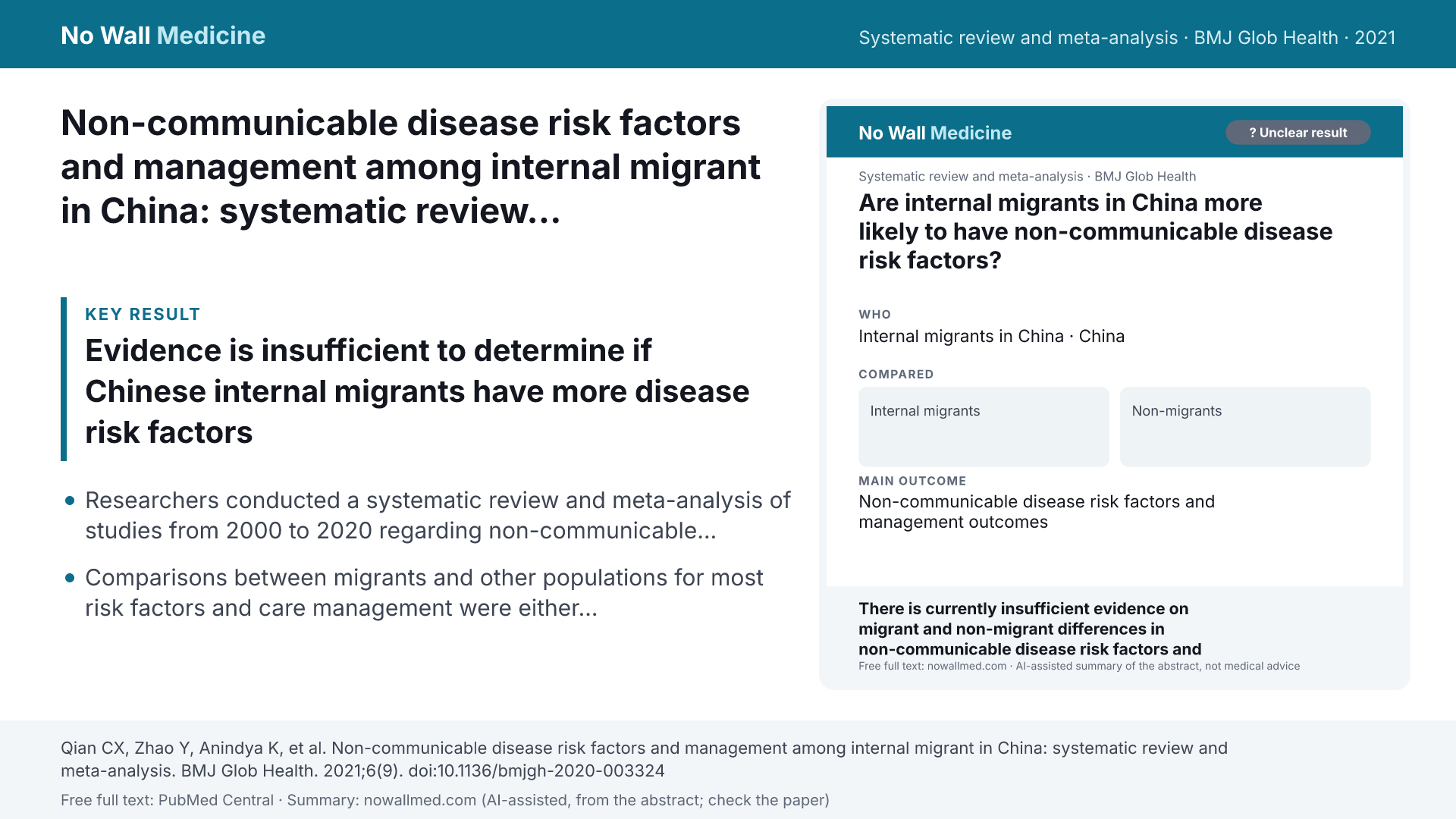
Evidence is insufficient to determine if Chinese internal migrants have more disease risk factors
Non-communicable disease risk factors and management among internal migrant in China: systematic review and meta-analysis
Systematic review and meta-analysisUnclear result
Are internal migrants in China more likely to have non-communicable disease risk factors?
Who
Internal migrants in China · China
Compared
Internal migrants
Non-migrants
Main outcome
Non-communicable disease risk factors and management outcomes
Bottom line: There is currently insufficient evidence on migrant and non-migrant differences in non-communicable disease risk factors and management in China.
BMJ Glob Health · 2021-10-01Download image
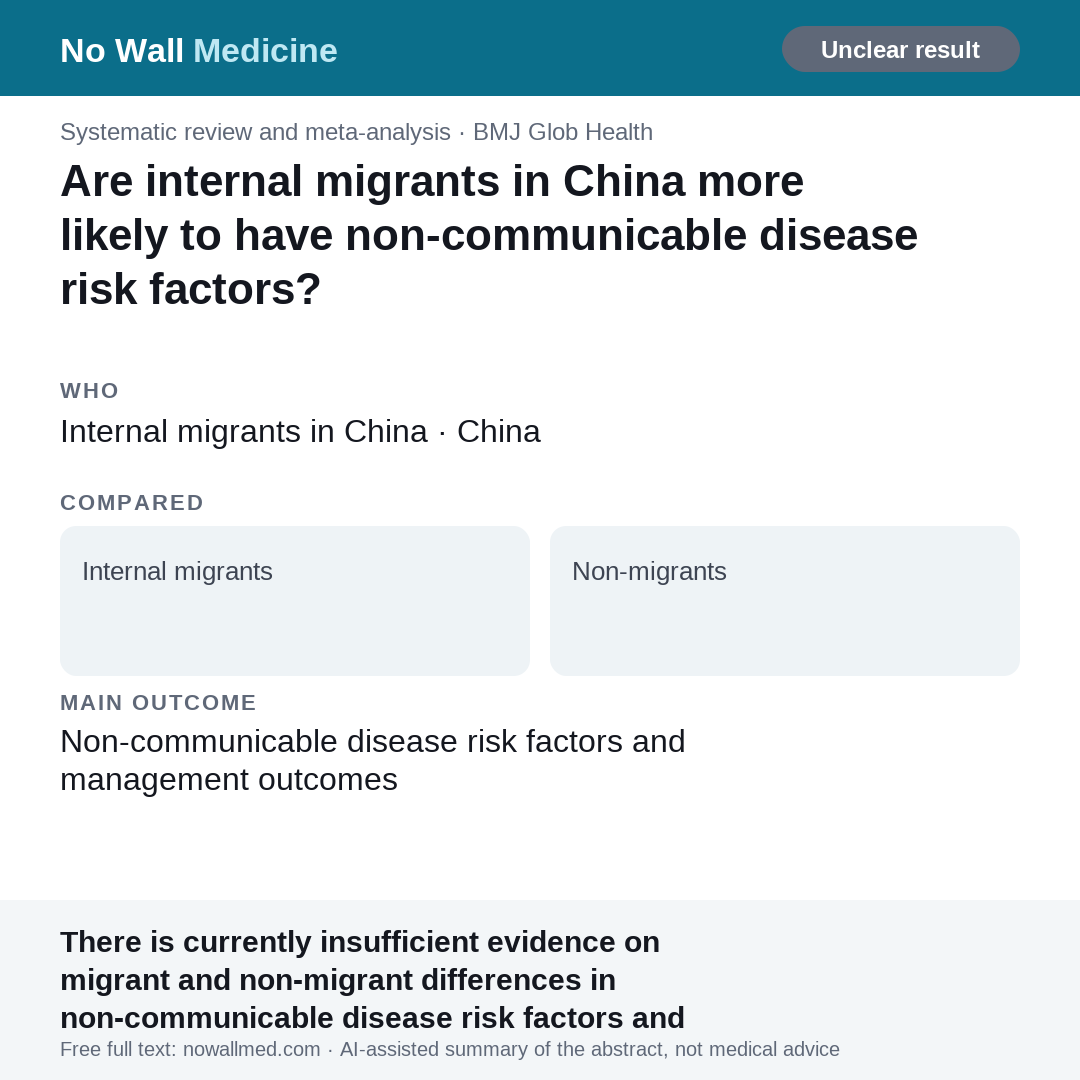
Clinical question: Are internal migrants in China more likely to have non-communicable disease risk factors?
Key points
- Researchers conducted a systematic review and meta-analysis of studies from 2000 to 2020 regarding non-communicable disease risk factors and management among internal migrants in China.
- Comparisons between migrants and other populations for most risk factors and care management were either statistically insignificant or inconclusive.
- While some studies suggested migrants had higher tobacco use or worse treatment access, these findings were not statistically significant in the meta-analysis.
Headline and key points written with AI from the paper’s abstract, with every number checked against it. Read the paper before relying on them.
Was this summary helpful?
Abstract
Background
In 2019, there are more than 290 million people who have ever migrated from rural to urban areas in China. These rural-to-urban internal migrants account for more than one-fifth of China's population and is the largest internal migrant group globally. We present the first systematic review that examines whether internal migrants are more likely to exhibit non-communicable diseases (NCDs) risk factors and have worse NCD management outcomes than non-migrant counterparts in China. Methods
A systematic review was conducted via medical, public health, and economic databases including Scopus, MEDLINE, JSTOR, WHO Library Database and World Bank e-Library from 2000 to 2020. Study quality was assessed using the National Institute of Health Quality Assessment tool. We conducted a narrative review and synthesised differences for all studies included, stratified by different types of outcomes. We also conducted random-effects meta-analysis where we had a minimum of two studies with 95% CIs reported. The study protocol has been registered with PROSPERO: CRD42019139407. Results
For most NCD risk factors and care cascade management, comparisons between internal migrants and other populations were either statistically insignificant or inconclusive. While most studies found migrants have a higher prevalence of tobacco use than urban residents, these differences were not statistically significant in the meta-analysis. Although three out four studies suggested that migrants may have worse access to NCD treatment and both studies suggested migrants have lower blood pressure control rates than non-migrants, these findings were not statistically significant. Conclusion
Findings from this systematic review demonstrate that there is currently insufficient evidence on migrant and non-migrant differences in NCD risk factors and management in China. Further research is expected to investigate access to healthcare among internal and its effect on both their NCD outcomes and long-term healthcare costs in China.
Abstract reproduced under the article’s CC BY NC licence.
Subject terms
Headline, design, result, key points, caveat and citation as plain text.
Cite this article
Qian CX, Zhao Y, Anindya K, et al. Non-communicable disease risk factors and management among internal migrant in China: systematic review and meta-analysis. BMJ Glob Health. 2021. doi:10.1136/bmjgh-2020-003324
Spotted a mistake? Suggest a correction