Non-pharmacological and pharmacological interventions show small effects on challenging behaviours in people with intellectual disabilities
Non-pharmacological and pharmacological interventions for the reduction or prevention of topographies of behaviours that challenge in people with intellectual disabilities: a systematic review and meta-analysis of randomised controlled trials
Systematic review and meta-analysis of randomised controlled trialsBenefit found
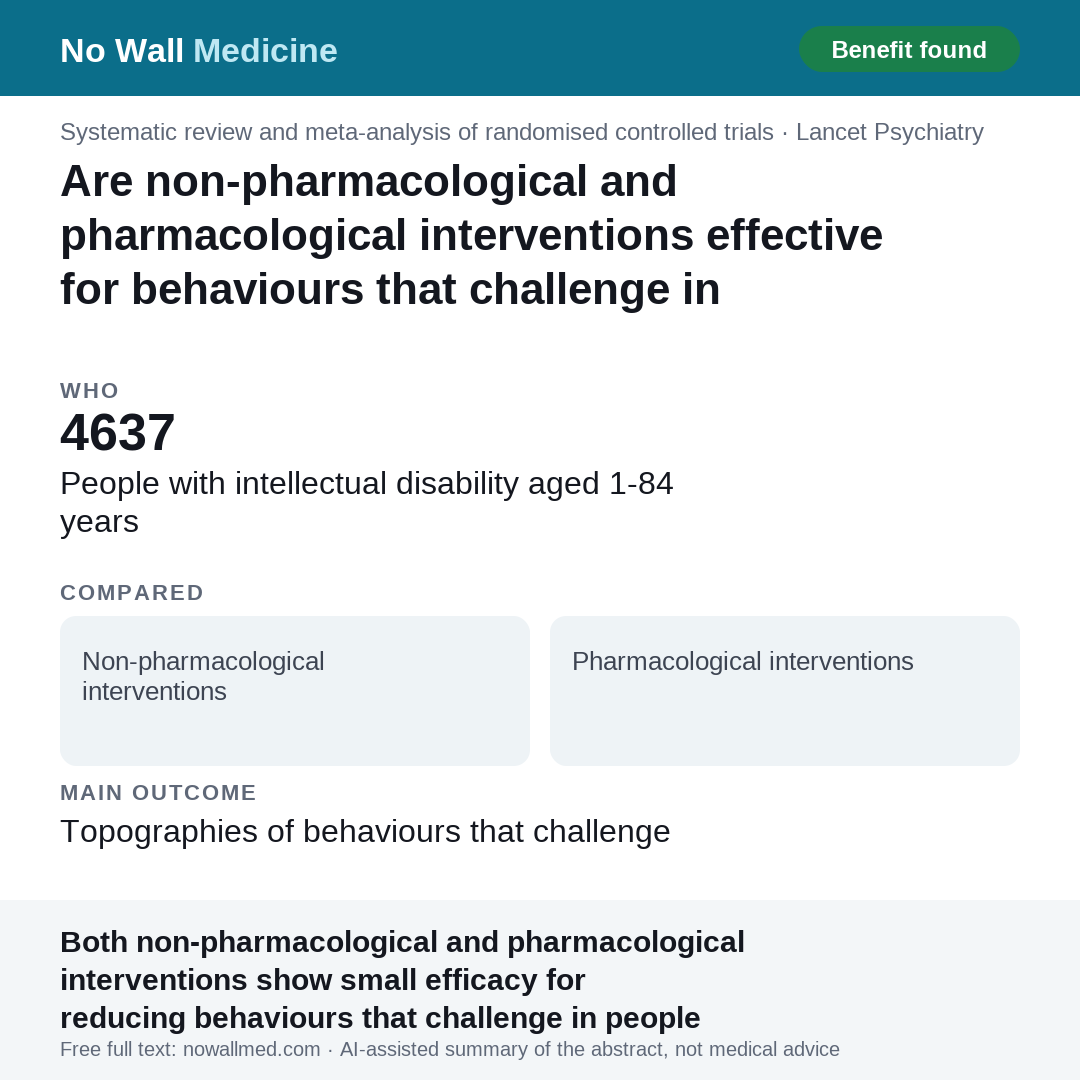
Are non-pharmacological and pharmacological interventions effective for behaviours that challenge in intellectual disabilities?
Who
4637
People with intellectual disability aged 1-84 years
Compared
Non-pharmacological interventions
Pharmacological interventions
Main outcome
Topographies of behaviours that challenge
Result: standard mean difference -0·422 (95% CI -0·565 to -0·279)
Bottom line: Both non-pharmacological and pharmacological interventions show small efficacy for reducing behaviours that challenge in people with intellectual disabilities.
Funded by: Cerebra
Lancet Psychiatry · 2023-08-19Download image
Clinical question: Are non-pharmacological and pharmacological interventions effective for behaviours that challenge in intellectual disabilities?
Key points
- Researchers analyzed 82 randomized controlled trials involving 4637 people with intellectual disabilities, aged 1-84 years, to compare drug and non-drug treatments.
- Both types of interventions showed small effects for overall challenging behaviours at post-intervention (SMD -0.422) and follow-up (SMD -0.324).
- No significant differences were found between non-pharmacological and pharmacological interventions for any specific behaviour, such as aggression or self-injury (all p>0.05).
Headline and key points written with AI from the paper’s abstract, with every number checked against it. Read the paper before relying on them.
Was this summary helpful?
Abstract
Background
People with intellectual disability show a high prevalence of behaviours that challenge. Clinical guidelines recommend that such behaviour should first be treated with non-pharmacological interventions, but research suggests off-label pharmaceuticals are commonly used. We aimed to evaluate the efficacy of non-pharmacological and pharmacological interventions for topographies of behaviours that challenge drawn from randomised controlled trials (RCTs). Methods
In this systematic review and meta-analysis, we searched PsycINFO, MEDLINE, Embase, CINAHL, and CENTRAL databases for RCT studies assessing an intervention (pharmacological or non-pharmacological) for behaviours that challenge (self-injury behaviour, aggression, destruction of property, irritability, and a composite overall measure) in participants with intellectual disability. The primary aim was to assess the efficacy of non-pharmacological and pharmacological interventions on behaviours that challenge. Secondary aims were to evaluate how effects varied over time and whether intervention, methodological, and participant characteristics moderate efficacy. We extracted standard mean difference (SMD) effect sizes (Cohen's d) from eligible studies and meta-analysed the data using a series of random effects models and subgroup analyses. This study was registered with PROSPERO 2021, CRD4202124997. Findings
Of 11 912 reports identified, 82 studies were included. 42 (51%) studies assessed non-pharmacological interventions and 40 (49%) assessed pharmacological interventions. Across all studies, 4637 people with intellectual disability aged 1-84 years (mean age 17·2 years) were included. 2873 (68·2%) were male, 1339 (28·9%) were female, and for 425 (9·2%) individuals, data on gender were not available. Data on ethnicity were unavailable. Small intervention effects were found for overall behaviours that challenge at post-intervention (SMD -0·422, 95% CI -0·565 to -0·279), overall behaviours that challenge at follow-up (-0·324, -0·551 to -0·097), self-injury behaviour at post-intervention (-0·238, -0·453 to -0·023), aggression at post-intervention (-0·438, -0·566 to -0·309), and irritability at post-intervention (-0·255, -0·484 to -0·026). No significant differences between non-pharmacological and pharmacological interventions were found for any topography of behaviours that challenge (all p>0·05). Interpretation
A broad range of interventions for behaviours that challenge are efficacious with small effect sizes for people with intellectual disability. These findings highlight the importance of precision in the measurement of behaviours that challenge, and when operationalising intervention components and dosages. Funding
Cerebra.
Abstract reproduced under the article’s CC BY licence.
Subject terms
Cite this article
Groves L, Jones C, Welham A, Hamilton A, Liew A, Richards C. Non-pharmacological and pharmacological interventions for the reduction or prevention of topographies of behaviours that challenge in people with intellectual disabilities: a systematic review and meta-analysis of randomised controlled trials. Lancet Psychiatry. 2023. doi:10.1016/S2215-0366(23)00197-9
Spotted a mistake? Suggest a correction
Top studies every Monday
The week’s key trials and guidelines in your specialties, plus any topics you follow. By email, free.
Get the weekly digest