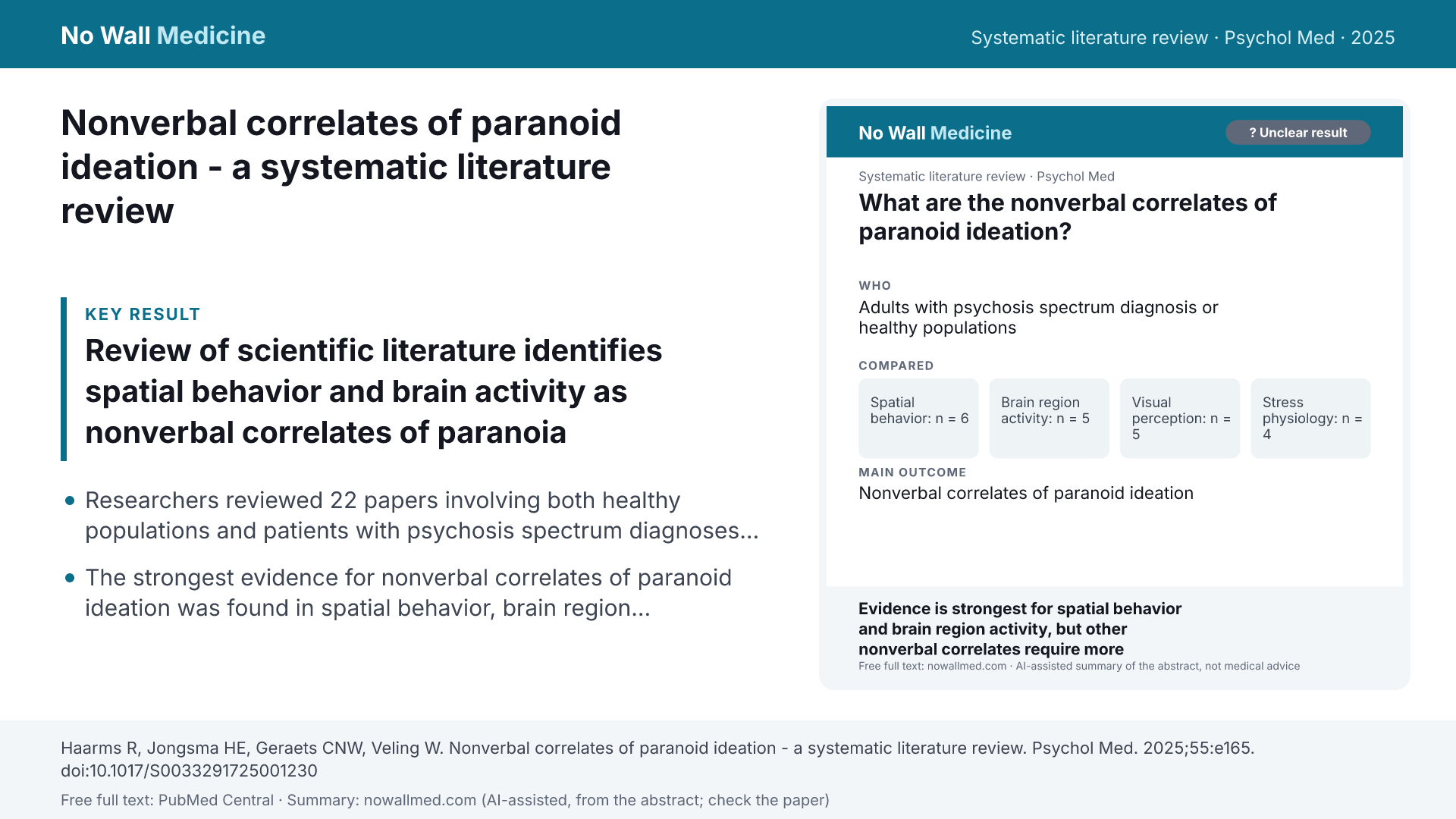
Review of scientific literature identifies spatial behavior and brain activity as nonverbal correlates of paranoia
Nonverbal correlates of paranoid ideation - a systematic literature review
Systematic literature reviewUnclear result
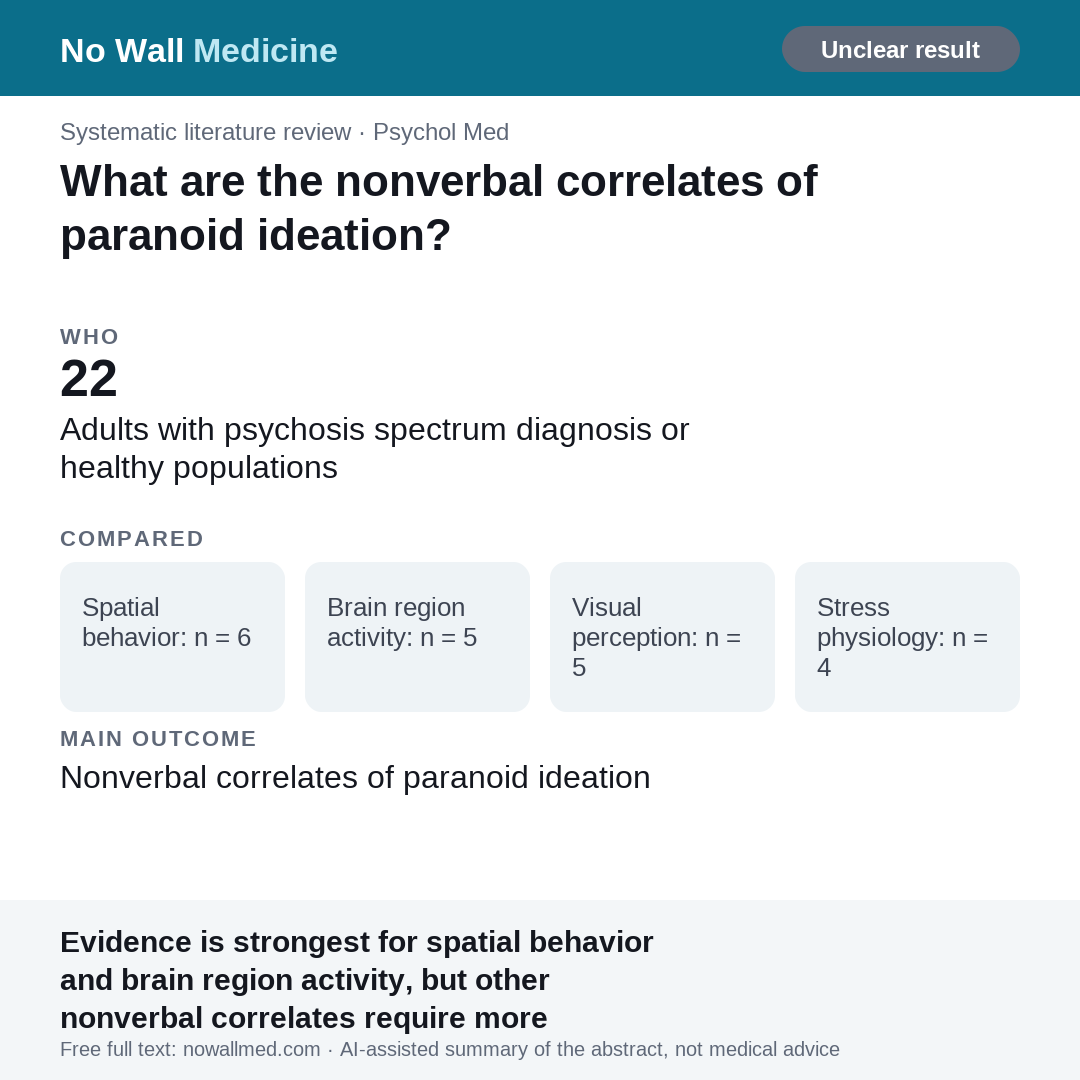
What are the nonverbal correlates of paranoid ideation?
Who
22
Adults with psychosis spectrum diagnosis or healthy populations
Compared
Spatial behavior: n = 6
Brain region activity: n = 5
Visual perception: n = 5
Stress physiology: n = 4
Main outcome
Nonverbal correlates of paranoid ideation
Bottom line: Evidence is strongest for spatial behavior and brain region activity, but other nonverbal correlates require more investigation.
Psychol Med · 2025-06-04Download image
Clinical question: What are the nonverbal correlates of paranoid ideation?
Why it matters: It is unknown which nonverbal behaviors or physiological markers are reliably associated with paranoid ideation to assist in diagnostic procedures.
Key points
- Researchers reviewed 22 papers involving both healthy populations and patients with psychosis spectrum diagnoses to identify nonverbal signs of paranoid ideation.
- The strongest evidence for nonverbal correlates of paranoid ideation was found in spatial behavior, brain region activity, and visual perception.
- Evidence for stress physiology, information processing, and aggression was less robust due to small numbers of publications and inconsistent findings.
Headline and key points written with AI from the paper’s abstract, with every number checked against it. Read the paper before relying on them.
Was this summary helpful?
Subject terms
Cite this article
Haarms R, Jongsma HE, Geraets CNW, Veling W. Nonverbal correlates of paranoid ideation - a systematic literature review. Psychol Med. 2025. doi:10.1017/S0033291725001230
Spotted a mistake? Suggest a correction