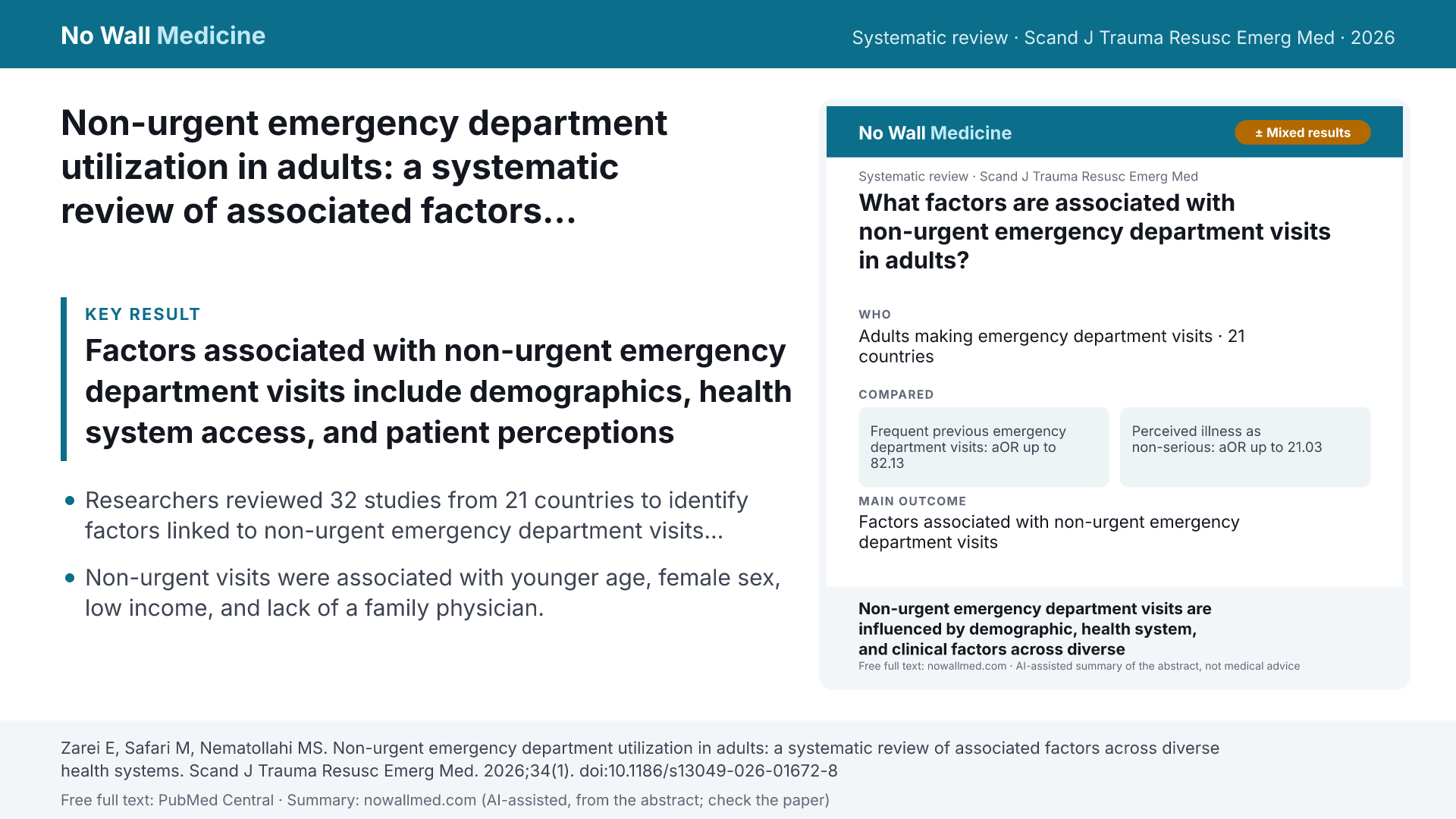
Non-urgent emergency department utilization in adults: a systematic review of associated factors across diverse health systems
Key result: Factors associated with non-urgent emergency department visits include demographics, health system access, and patient perceptions
Systematic reviewMixed results
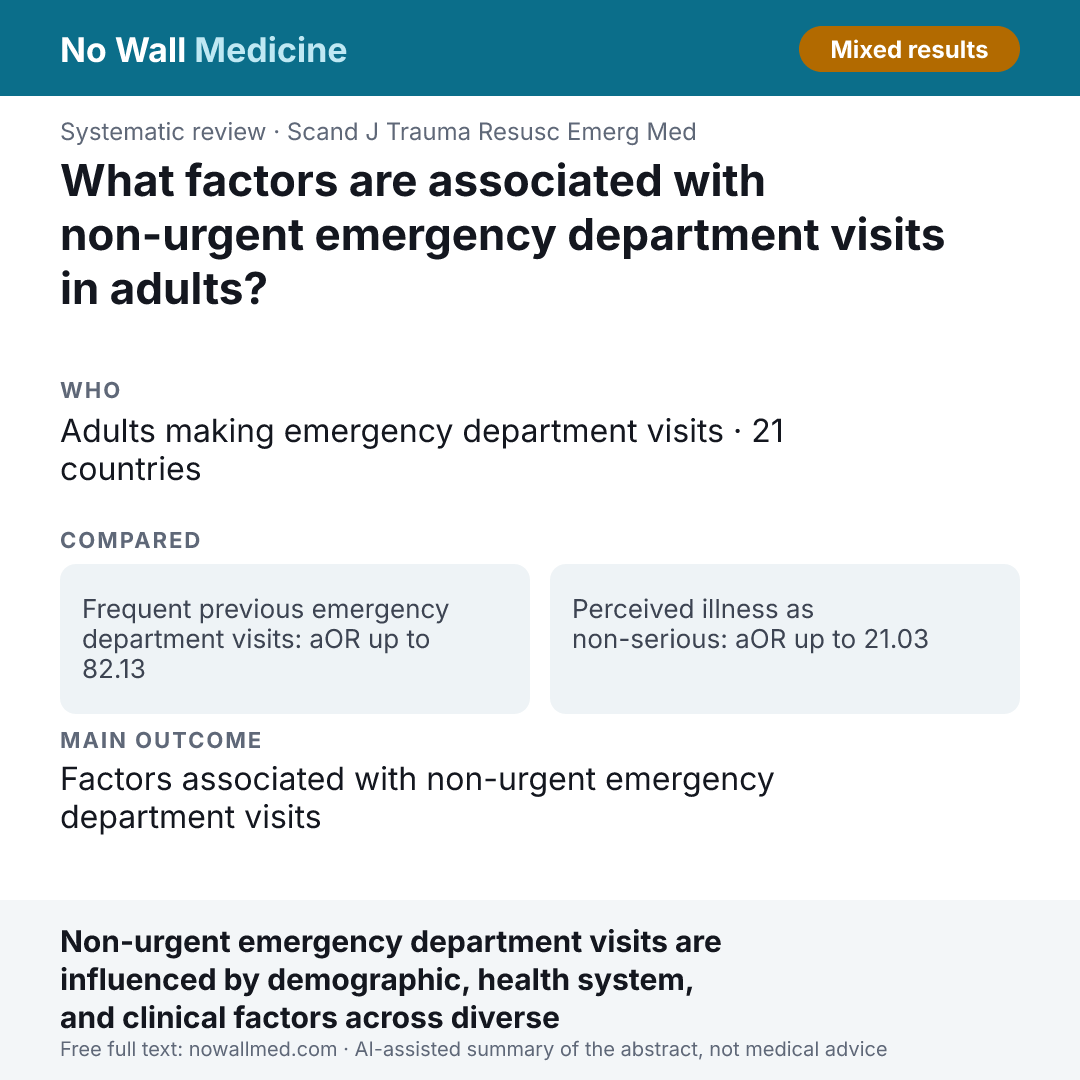
What factors are associated with non-urgent emergency department visits in adults?
Who
Adults making emergency department visits · 21 countries
Compared
Frequent previous emergency department visits: aOR up to 82.13
Perceived illness as non-serious: aOR up to 21.03
Main outcome
Factors associated with non-urgent emergency department visits
Bottom line: Non-urgent emergency department visits are influenced by demographic, health system, and clinical factors across diverse settings.
Scand J Trauma Resusc Emerg Med · 2026-08-13 · Save PNG
Key points
- Researchers reviewed 32 studies from 21 countries to identify factors linked to non-urgent emergency department visits in adults.
- Non-urgent visits were associated with younger age, female sex, low income, and lack of a family physician.
- The strongest associations were linked to frequent previous emergency department visits (aOR up to 82.13) and patients perceiving their illness as non-serious (aOR up to 21.03).
Discussion prompts
- Would these patients look like yours? Who was left out?
- Is the main outcome one that matters to patients?
- Is the difference large enough to change what you do?
Cite: Zarei E, Safari M, Nematollahi MS. Non-urgent emergency department utilization in adults: a systematic review of associated factors across diverse health systems. Scand J Trauma Resusc Emerg Med. 2026;34(1). doi:10.1186/s13049-026-01672-8
Free full text: PubMed Central · Summary and visual abstract: nowallmed.com/a/non-urgent-emergency-department-utilization-in-adults-a-systematic-zlm8ys/ (AI-assisted from the abstract; check the paper before relying on it).