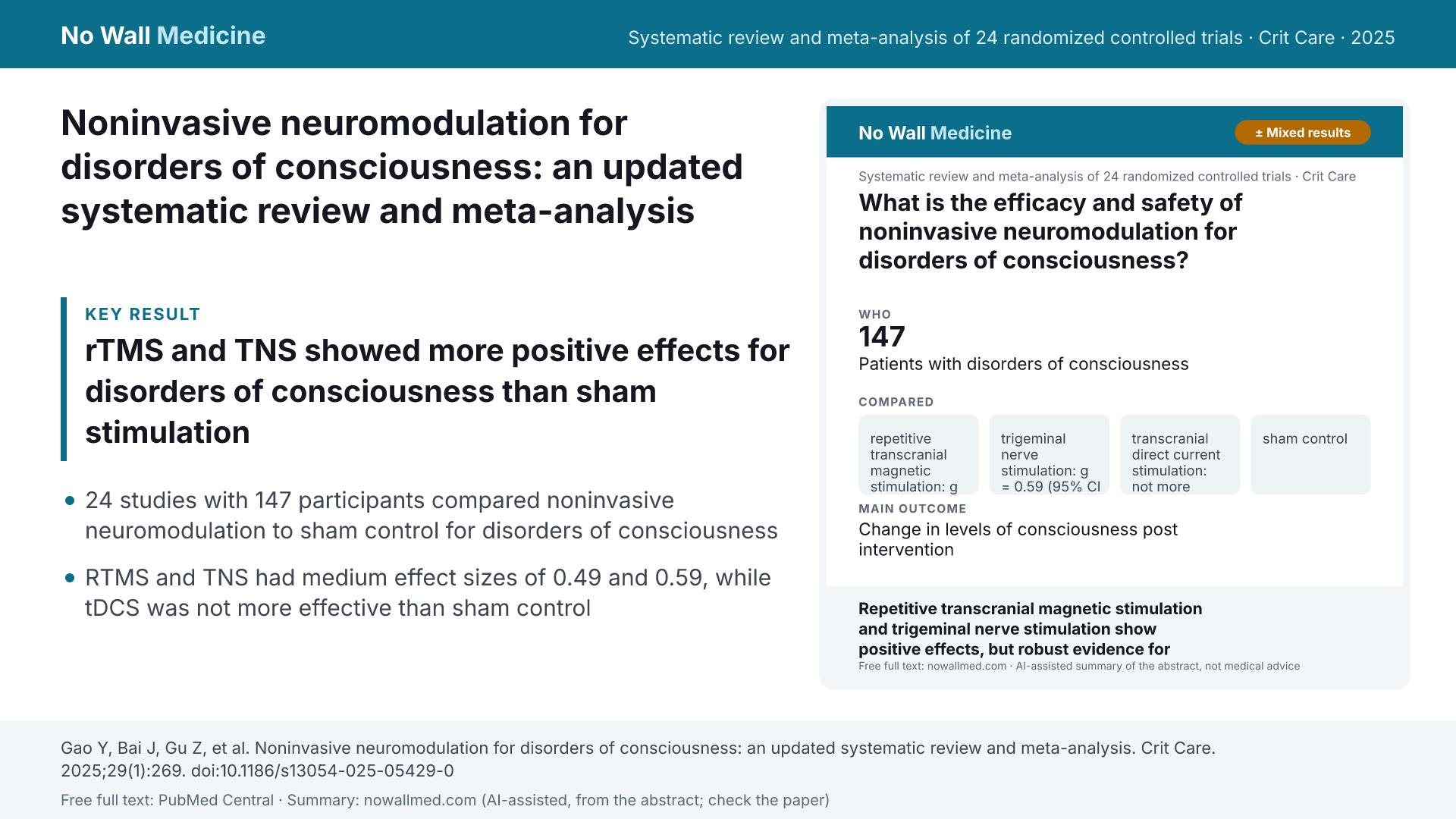
rTMS and TNS showed more positive effects for disorders of consciousness than sham stimulation
Noninvasive neuromodulation for disorders of consciousness: an updated systematic review and meta-analysis
Systematic review and meta-analysis of 24 randomized controlled trialsMixed results
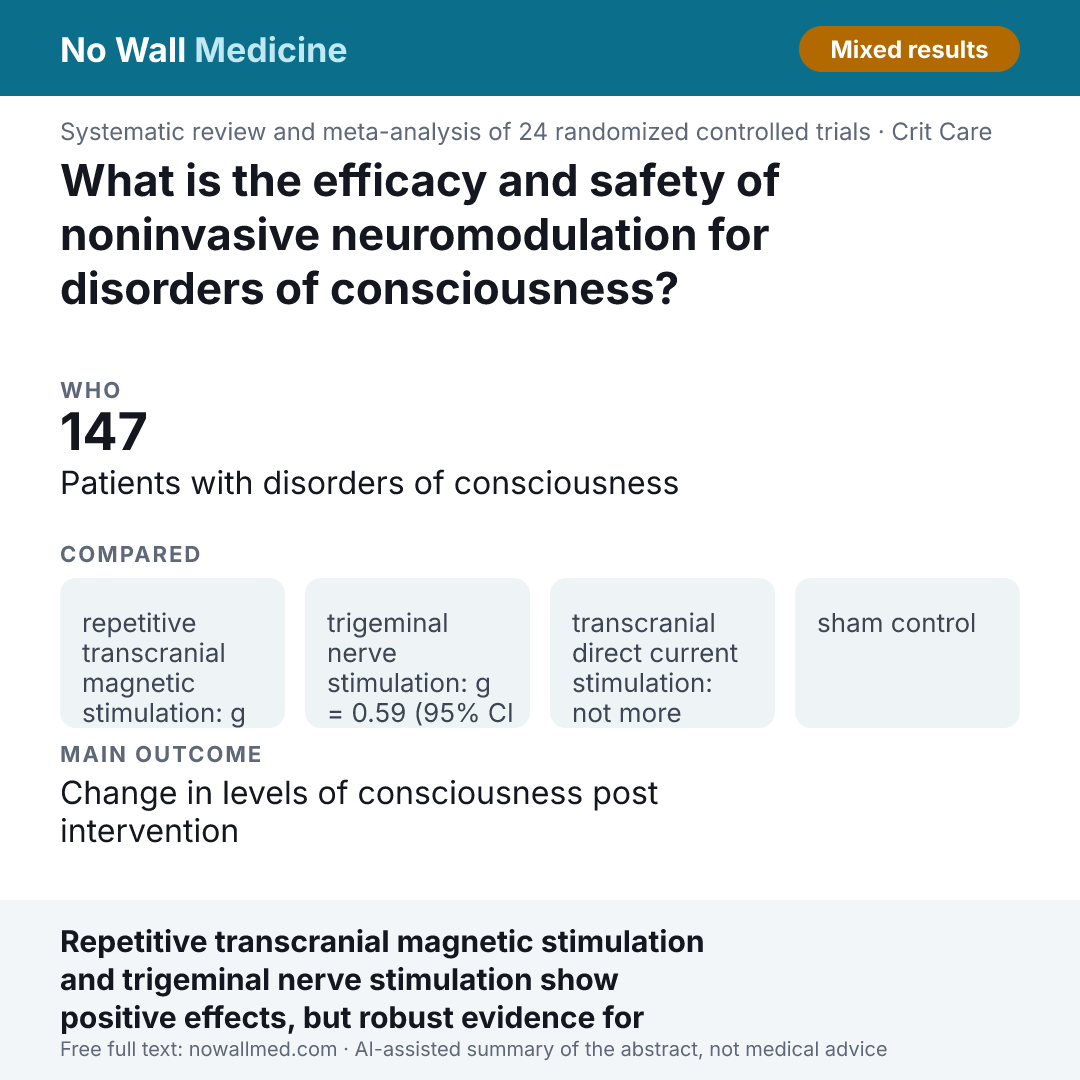
What is the efficacy and safety of noninvasive neuromodulation for disorders of consciousness?
Who
147
Patients with disorders of consciousness
Compared
repetitive transcranial magnetic stimulation: g = 0.49 (95% CI 0.01, 0.98)
trigeminal nerve stimulation: g = 0.59 (95% CI 0.08, 1.10)
transcranial direct current stimulation: not more effective than sham control
sham control
Main outcome
Change in levels of consciousness post intervention
Result: rTMS g = 0.49 (95% CI 0.01, 0.98); TNS g = 0.59 (95% CI 0.08, 1.10)
Bottom line: Repetitive transcranial magnetic stimulation and trigeminal nerve stimulation show positive effects, but robust evidence for neuromodulation is lacking.
Limitation: Small number of patients, few studies, and potential risk of bias in the meta-analysis.
Crit Care · 2025-07-03 · Save PNG
Clinical question: What is the efficacy and safety of noninvasive neuromodulation for disorders of consciousness?
Why it matters: Evidence on noninvasive neuromodulation for disorders of consciousness is inconclusive
Key points
- 24 studies with 147 participants compared noninvasive neuromodulation to sham control for disorders of consciousness.
- RTMS and TNS had medium effect sizes of 0.49 and 0.59, while tDCS was not more effective than sham control.
- No difference was found in dropout rates for TNS or rTMS compared to sham control.
Limitation the authors note: Small number of patients and potential risk of bias in the meta-analysis limited the robustness of the evidence
Headline and key points written with AI from the paper’s abstract, with every number checked against it. Read the paper before relying on them.
Was this summary helpful?
Subject terms
Headline, design, result, key points, caveat and citation as plain text.
Cite this article
Gao Y, Bai J, Gu Z, et al. Noninvasive neuromodulation for disorders of consciousness: an updated systematic review and meta-analysis. Crit Care. 2025;29(1):269. doi:10.1186/s13054-025-05429-0
Spotted a mistake? Suggest a correction