Novel Artificial Intelligence Systems in Detecting Adenomas in Colonoscopy: A Systemic Review and Network Meta-Analysis
Systematic review and network meta-analysisBenefit found
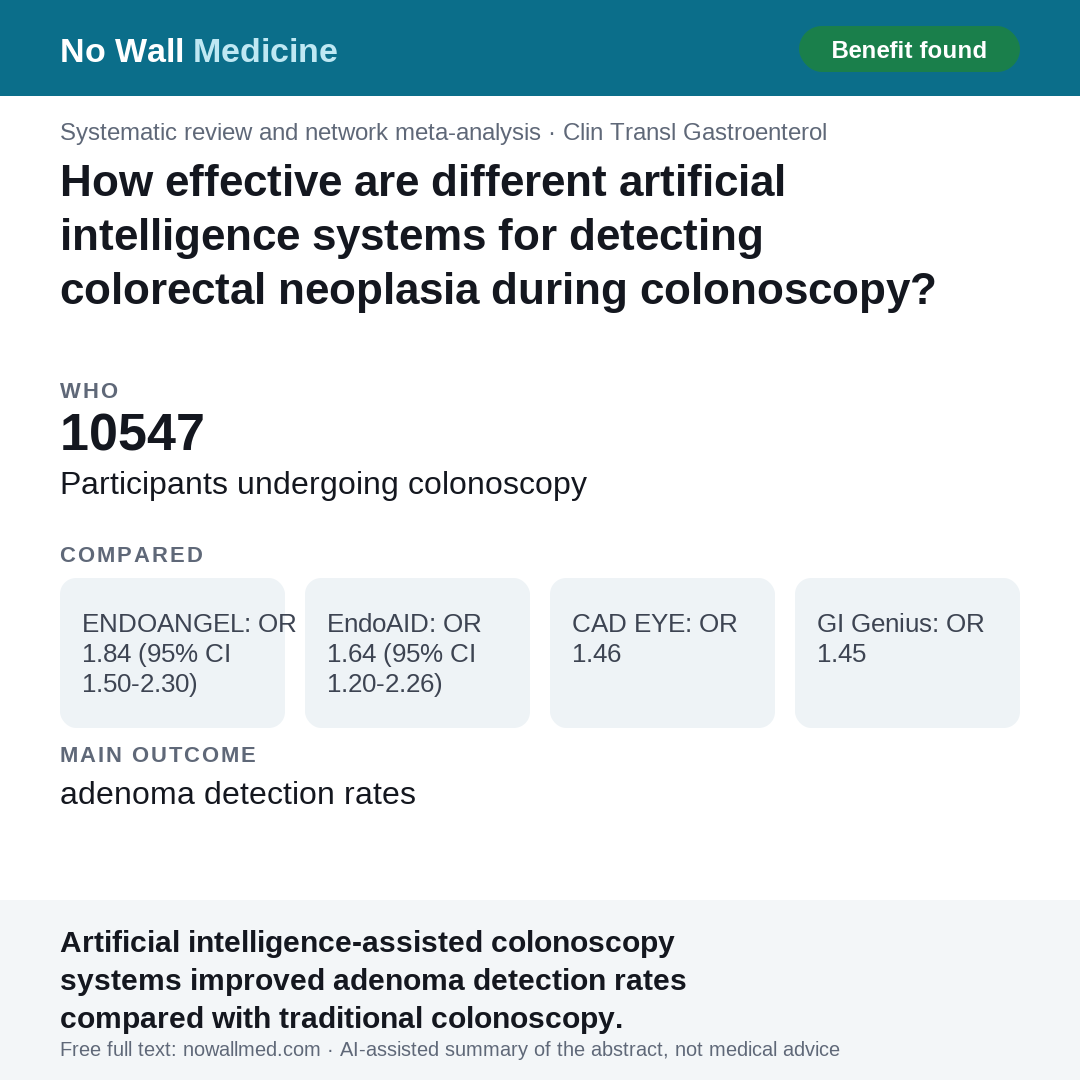
How effective are different artificial intelligence systems for detecting colorectal neoplasia during colonoscopy?
Who
10547
Participants undergoing colonoscopy
Compared
ENDOANGEL: OR 1.84 (95% CI 1.50-2.30)
EndoAID: OR 1.64 (95% CI 1.20-2.26)
CAD EYE: OR 1.46
GI Genius: OR 1.45
Main outcome
adenoma detection rates
Bottom line: Artificial intelligence-assisted colonoscopy systems improved adenoma detection rates compared with traditional colonoscopy.
Limitation: additional large-scale studies are needed to confirm these findings
Clin Transl Gastroenterol · 2025-10-01Download image
Clinical question: How effective are different artificial intelligence systems for detecting colorectal neoplasia during colonoscopy?
Abstract
Introduction
Artificial intelligence (AI) has the potential to improve adenoma detection rates (ADRs) during colonoscopy, but the efficacy of various AI-assisted systems remains unclear. To evaluate and compare the effectiveness of different AI-assisted systems for detecting colorectal neoplasia during colonoscopy. Methods
A systematic literature search of PubMed, Scopus, and Google Scholar databases was conducted up to March 4, 2025, to identify randomized controlled trials comparing AI-assisted colonoscopy with conventional colonoscopy. The analysis included AI systems such as GI Genius (Medtronic, Dublin, Ireland), CAD EYE (Fujifilm, Tokyo, Japan), ENDOANGEL, EndoScreener, and EndoAID. The primary outcome was ADR, analyzed using random-effects models to calculate pooled odds ratios (OR) and 95% confidence intervals (CI). Surface under the cumulative ranking curve (SUCRA) rankings and subgroup analyses were also performed. Results
Seventeen randomized controlled trials with 10,547 participants were included. ENDOANGEL showed the highest efficacy (OR 1.84, 95% CI 1.50-2.30; SUCRA 0.9), followed by EndoAID (OR 1.64, 95% CI 1.20-2.26; SUCRA 0.7). CAD EYE and GI Genius were similarly ranked (OR 1.46 and 1.45, respectively). EndoScreener was ranked just above the control group (OR 1.37, 95% CI 1.20-1.56; SUCRA 0.4). Discussion
AI-assisted colonoscopy systems showed improved ADR detection rates compared with traditional colonoscopy. These results suggest that artificial intelligence may help enhance detection during colonoscopy procedures; however, additional large-scale studies are needed to confirm these findings.
Topics
Cite this article
Kumar S, Maheshwari M, Aleem S, Batool Z, Alsubaie N, Syed S. Novel Artificial Intelligence Systems in Detecting Adenomas in Colonoscopy: A Systemic Review and Network Meta-Analysis. Clin Transl Gastroenterol. 2025. doi:10.14309/ctg.0000000000000904
Spotted a mistake? Suggest a correction