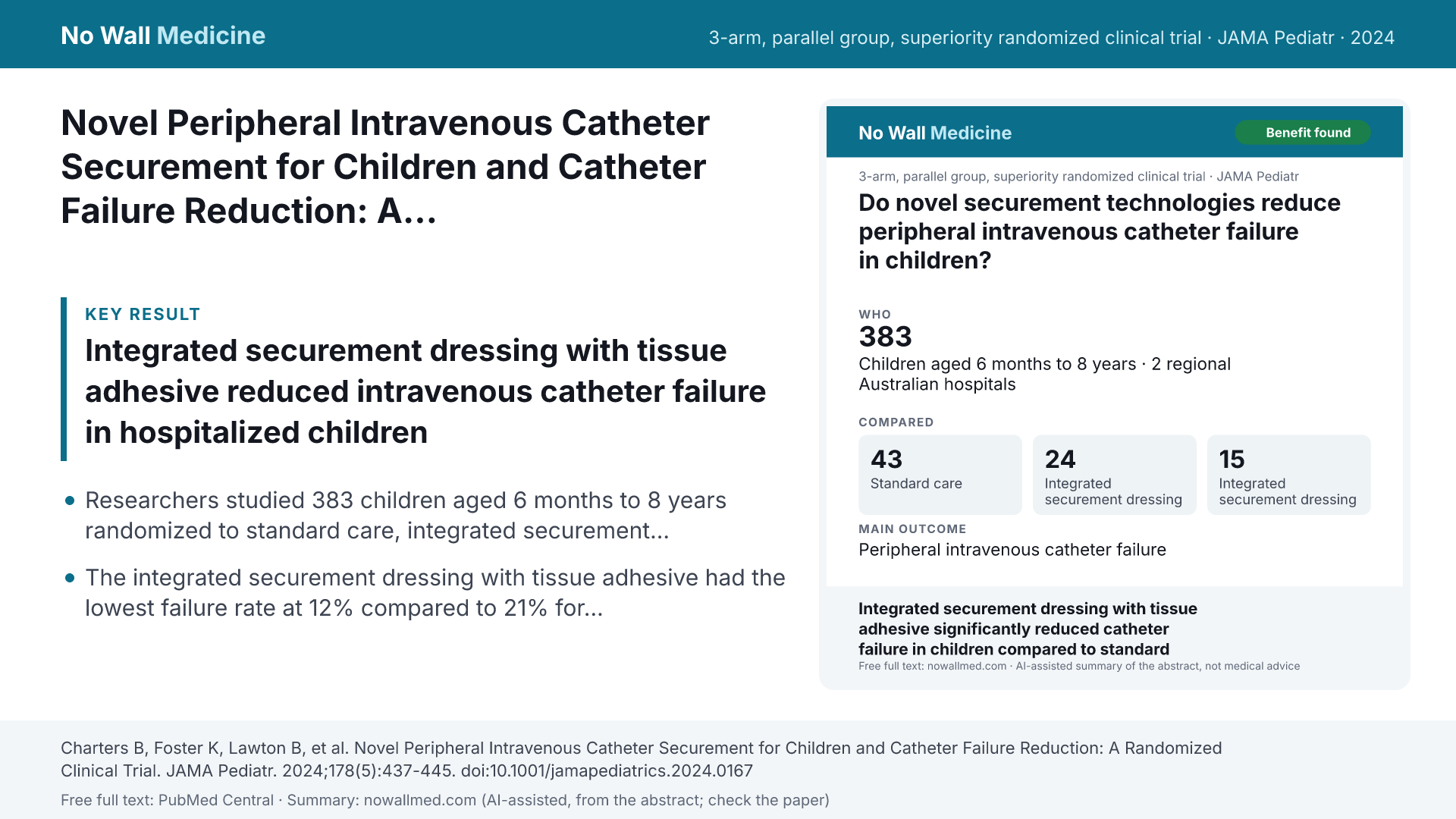
Integrated securement dressing with tissue adhesive reduced intravenous catheter failure in hospitalized children
Novel Peripheral Intravenous Catheter Securement for Children and Catheter Failure Reduction: A Randomized Clinical Trial
3-arm, parallel group, superiority randomized clinical trialBenefit found
Do novel securement technologies reduce peripheral intravenous catheter failure in children?
Who
383
Children aged 6 months to 8 years · 2 regional Australian hospitals
Compared
43Standard care (34%)
24Integrated securement dressing (21%)
15Integrated securement dressing with tissue adhesive (12%)
Main outcome
Peripheral intravenous catheter failure
Result: adjusted hazard ratio 0.47 (95% CI, 0.26-0.84)
Bottom line: Integrated securement dressing with tissue adhesive significantly reduced catheter failure in children compared to standard care and integrated securement dressing.
JAMA Pediatr · 2024-04-01Download image
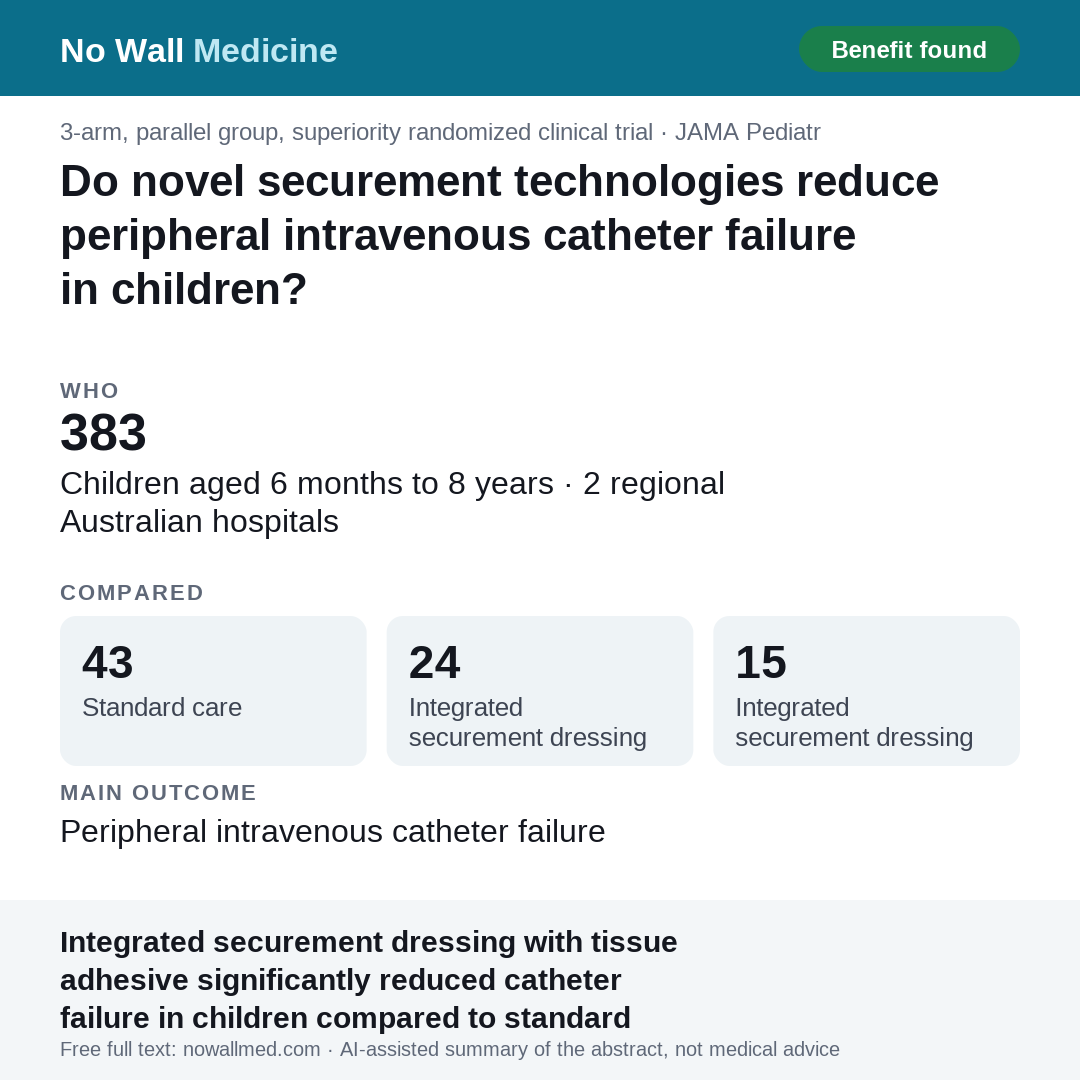
Clinical question: Do novel securement technologies reduce peripheral intravenous catheter failure in children?
Why it matters: It is unknown if new securement technologies for peripheral intravenous catheters can reduce device failure in pediatric patients.
Key points
- Researchers studied 383 children aged 6 months to 8 years randomized to standard care, integrated securement dressings, or integrated securement dressings with tissue adhesive.
- The integrated securement dressing with tissue adhesive had the lowest failure rate at 12% compared to 21% for integrated securement dressings and 34% for standard care.
- Direct costs related to device failure were lower for both integrated securement dressing types compared to standard care.
Headline and key points written with AI from the paper’s abstract, with every number checked against it. Read the paper before relying on them.
Was this summary helpful?
Subject terms
Cite this article
Charters B, Foster K, Lawton B, et al. Novel Peripheral Intravenous Catheter Securement for Children and Catheter Failure Reduction: A Randomized Clinical Trial. JAMA Pediatr. 2024. doi:10.1001/jamapediatrics.2024.0167
Spotted a mistake? Suggest a correction