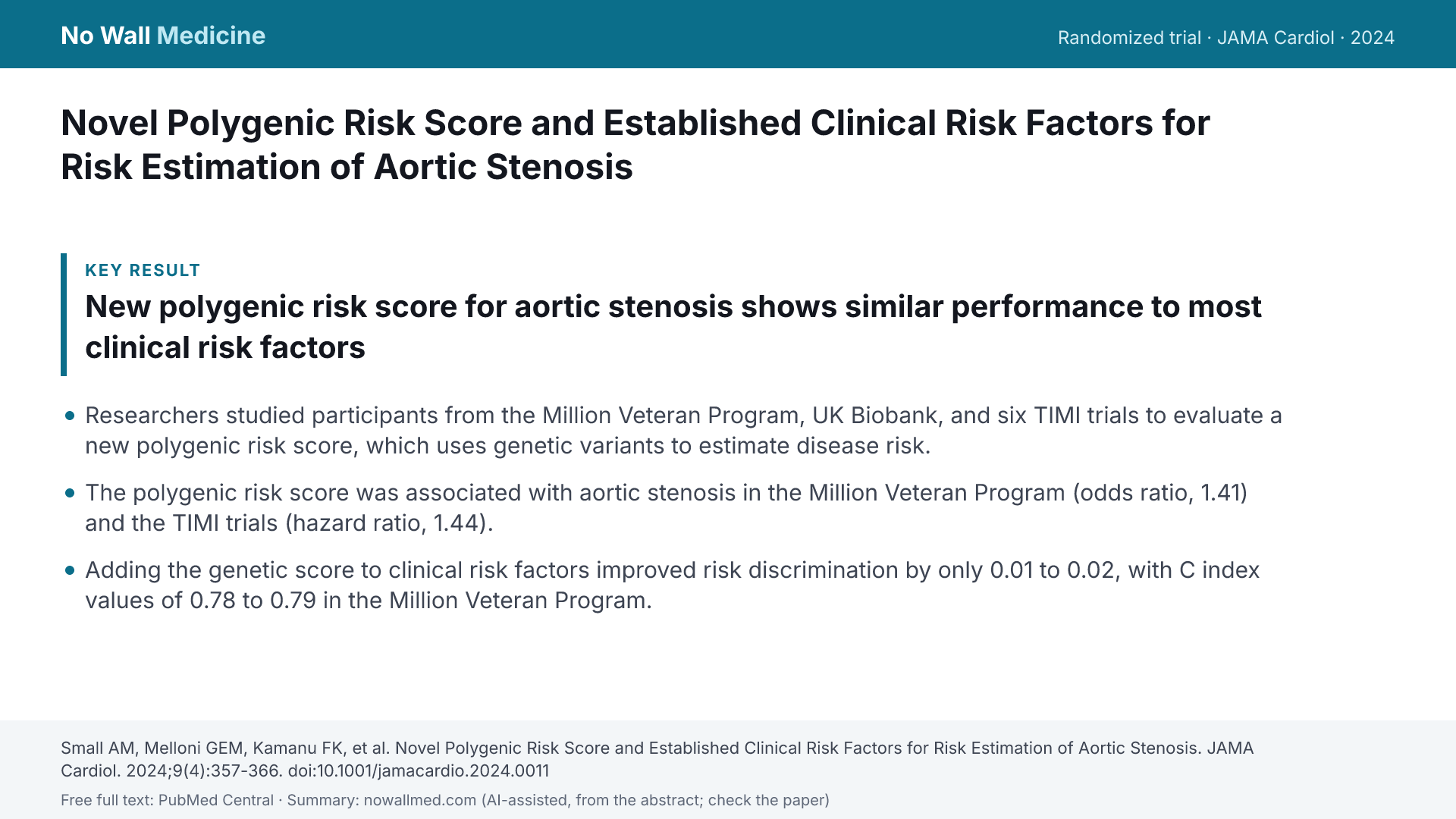
New polygenic risk score for aortic stenosis shows similar performance to most clinical risk factors
Novel Polygenic Risk Score and Established Clinical Risk Factors for Risk Estimation of Aortic Stenosis
Why it matters: It was unknown whether polygenic risk scores, which measure genetic predisposition, could estimate the risk of aortic stenosis as effectively as established clinical risk factors.
Key points
- Researchers studied participants from the Million Veteran Program, UK Biobank, and six TIMI trials to evaluate a new polygenic risk score, which uses genetic variants to estimate disease risk.
- The polygenic risk score was associated with aortic stenosis in the Million Veteran Program (odds ratio, 1.41) and the TIMI trials (hazard ratio, 1.44).
- Adding the genetic score to clinical risk factors improved risk discrimination by only 0.01 to 0.02, with C index values of 0.78 to 0.79 in the Million Veteran Program.
Headline and key points written with AI from the paper’s abstract, with every number checked against it. Read the paper before relying on them.
Was this summary helpful?
Subject terms
Cite this article
Small AM, Melloni GEM, Kamanu FK, Bergmark BA, Bonaca MP, O'Donoghue ML. Novel Polygenic Risk Score and Established Clinical Risk Factors for Risk Estimation of Aortic Stenosis. JAMA Cardiol. 2024. doi:10.1001/jamacardio.2024.0011
Spotted a mistake? Suggest a correction
Top studies every Monday
The week’s key trials and guidelines in your specialties, plus any topics you follow. By email, free.
Get the weekly digest