Novel Polygenic Risk Score and Established Clinical Risk Factors for Risk Estimation of Aortic Stenosis
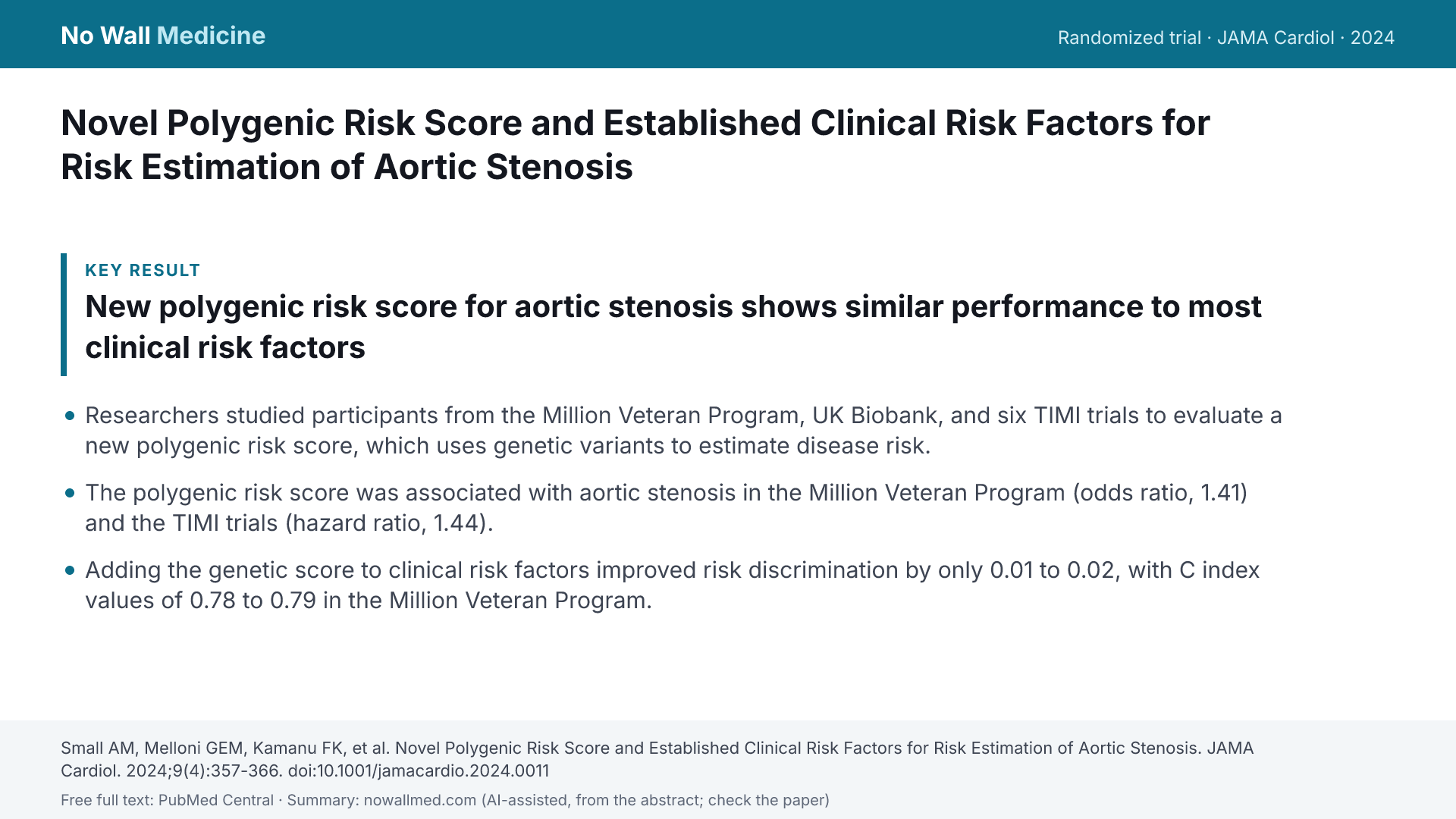
Key result: New polygenic risk score for aortic stenosis shows similar performance to most clinical risk factors
Key points
- Researchers studied participants from the Million Veteran Program, UK Biobank, and six TIMI trials to evaluate a new polygenic risk score, which uses genetic variants to estimate disease risk.
- The polygenic risk score was associated with aortic stenosis in the Million Veteran Program (odds ratio, 1.41) and the TIMI trials (hazard ratio, 1.44).
- Adding the genetic score to clinical risk factors improved risk discrimination by only 0.01 to 0.02, with C index values of 0.78 to 0.79 in the Million Veteran Program.
Discussion prompts
- Would these patients look like yours? Who was left out?
- Is the main outcome one that matters to patients?
- Is the difference large enough to change what you do?
Cite: Small AM, Melloni GEM, Kamanu FK, et al. Novel Polygenic Risk Score and Established Clinical Risk Factors for Risk Estimation of Aortic Stenosis. JAMA Cardiol. 2024. doi:10.1001/jamacardio.2024.0011
Free full text: PubMed Central · Summary and visual abstract: nowallmed.com/a/novel-polygenic-risk-score-and-established-clinical-risk-factors-for-1mtepbe/ (AI-assisted from the abstract; check the paper before relying on it).