New diagnostic technologies show high accuracy for detecting various gastrointestinal cancers in recent review
Novel Technologies for Gastrointestinal Cancer Detection: A Systematic Review and Meta-Analysis of Diagnostic Accuracy
Systematic review and meta-analysisBenefit found
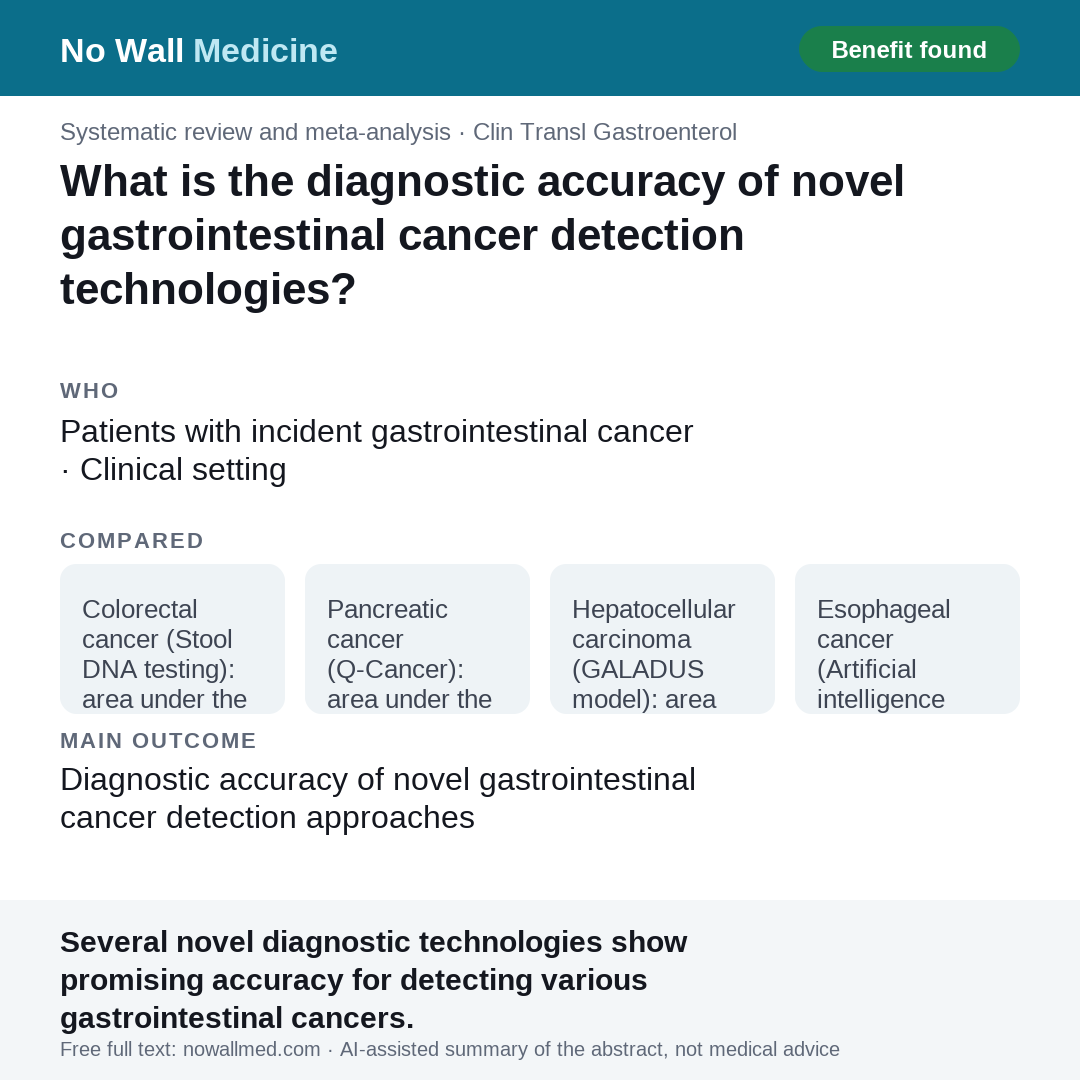
What is the diagnostic accuracy of novel gastrointestinal cancer detection technologies?
Who
Patients with incident gastrointestinal cancer · Clinical setting
Compared
Colorectal cancer (Stool DNA testing): area under the receiver operating characteristic curve 0.94-0.98
Pancreatic cancer (Q-Cancer): area under the receiver operating characteristic curve 0.89-0.92
Hepatocellular carcinoma (GALADUS model): area under the receiver operating characteristic curve 0.94
Esophageal cancer (Artificial intelligence model): area under the receiver operating characteristic curve 0.87
Main outcome
Diagnostic accuracy of novel gastrointestinal cancer detection approaches
Bottom line: Several novel diagnostic technologies show promising accuracy for detecting various gastrointestinal cancers.
Limitation: Need for external validation, population-level studies, and health economic evaluation.
Clin Transl Gastroenterol · 2026-06-04Download image
Clinical question: What is the diagnostic accuracy of novel gastrointestinal cancer detection technologies?
Why it matters: Gastrointestinal cancers represent a quarter of all cancers and one-third of cancer deaths, making early detection through new diagnostic approaches crucial.
Key points
- Researchers reviewed 72 studies involving at least 300 participants each to evaluate new ways of detecting gastrointestinal cancers.
- Stool DNA testing following a positive fecal immunochemical test had an area under the receiver operating characteristic curve of 0.94-0.98 for colorectal cancer.
- Other high-performing methods included Q-Cancer for pancreatic cancer (0.89-0.92), the GALADUS model for liver cancer (0.94), and artificial intelligence for esophageal cancer (0.87).
Limitation the authors note: The authors state that external validation, population-level studies, and health economic evaluations are needed to establish clinical utility.
Headline and key points written with AI from the paper’s abstract, with every number checked against it. Read the paper before relying on them.
Topics
Spotted a mistake? Suggest a correction