Specific genetic variations were associated with higher weight gain after starting HIV medication
Obesity-Related Single-Nucleotide Polymorphisms and Weight Gain Following First-Line Antiretroviral Therapy
Randomized trialMixed results
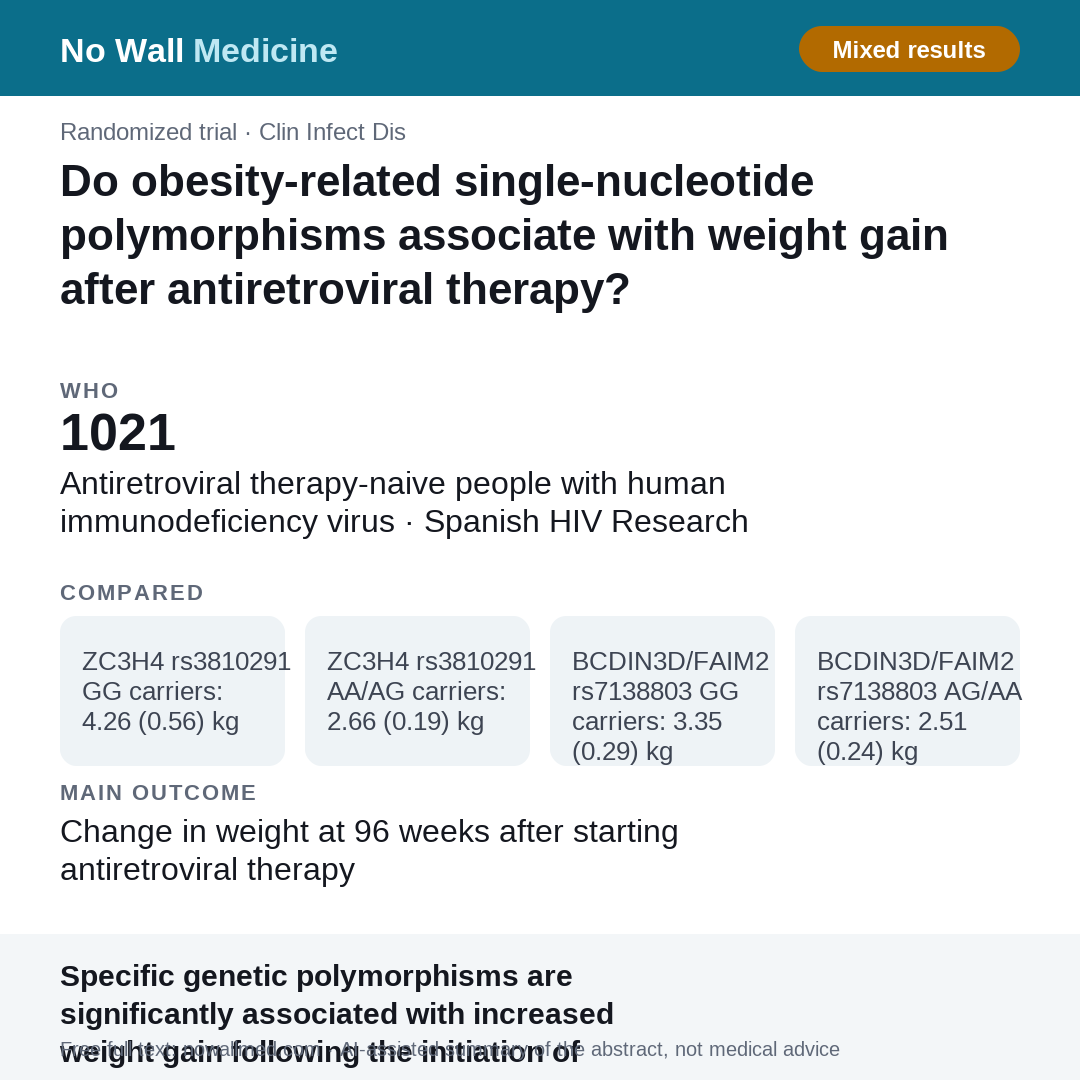
Do obesity-related single-nucleotide polymorphisms associate with weight gain after antiretroviral therapy?
Who
1021
Antiretroviral therapy-naive people with human immunodeficiency virus · Spanish HIV Research Cohort
Compared
ZC3H4 rs3810291 GG carriers: 4.26 (0.56) kg
ZC3H4 rs3810291 AA/AG carriers: 2.66 (0.19) kg
BCDIN3D/FAIM2 rs7138803 GG carriers: 3.35 (0.29) kg
BCDIN3D/FAIM2 rs7138803 AG/AA carriers: 2.51 (0.24) kg
Main outcome
Change in weight at 96 weeks after starting antiretroviral therapy
Bottom line: Specific genetic polymorphisms are significantly associated with increased weight gain following the initiation of antiretroviral therapy.
Clin Infect Dis · 2022-11-09Download image
Clinical question: Do obesity-related single-nucleotide polymorphisms associate with weight gain after antiretroviral therapy?
Why it matters: It is unknown if obesity-related single-nucleotide polymorphisms, which are small variations in DNA, influence how much weight people living with HIV gain after starting antiretroviral therapy.
Key points
- Researchers studied 1021 people living with HIV who were starting antiretroviral therapy, which is the standard medication for HIV.
- The mean weight gain over 96 weeks was 2.90 kg (95% confidence interval, 2.54-3.26 kg).
- Carriers of the ZC3H4 rs3810291 GG genotype had an estimated adjusted mean weight gain of 4.26 (0.56) kg compared to 2.66 (0.19) kg in AA/AG carriers.
Headline and key points written with AI from the paper’s abstract, with every number checked against it. Read the paper before relying on them.
Was this summary helpful?
Subject terms
Cite this article
Berenguer J, Jarrín I, Bellón JM, Díez C, Jiménez-Sousa MA, Roca C. Obesity-Related Single-Nucleotide Polymorphisms and Weight Gain Following First-Line Antiretroviral Therapy. Clin Infect Dis. 2022. doi:10.1093/cid/ciac880
Spotted a mistake? Suggest a correction
Top studies every Monday
The week’s key trials and guidelines in your specialties, plus any topics you follow. By email, free.
Get the weekly digest