GnRH agonist pretreatment was associated with higher low birthweight rates in singleton pregnancies
Obstetric and neonatal outcomes after programmed frozen embryo transfer with or without GnRH agonist for polycystic ovary syndrome: secondary analysis results from a randomized controlled trial
Secondary analysis of a randomized controlled trialMixed results
Do gonadotropin-releasing hormone agonist pretreatment cycles increase obstetrical and neonatal complications in polycystic ovary syndrome?
Who
Women with polycystic ovary syndrome aged 24 to 40 years · Single-center
Compared
Gonadotropin-releasing hormone agonist pretreatment: 10.2% low birthweight among singleton infants
No pretreatment: 1.3% low birthweight among singleton infants
Main outcome
Obstetrical and neonatal complications
Result: relative ratio 3.85 (95% confidence interval 1.13-7.11)
Bottom line: Gonadotropin-releasing hormone agonist pretreatment may increase the risk of low birthweight in singleton neonates for polycystic ovary syndrome patients.
AJOG Glob Rep · 2023-03-17Download image
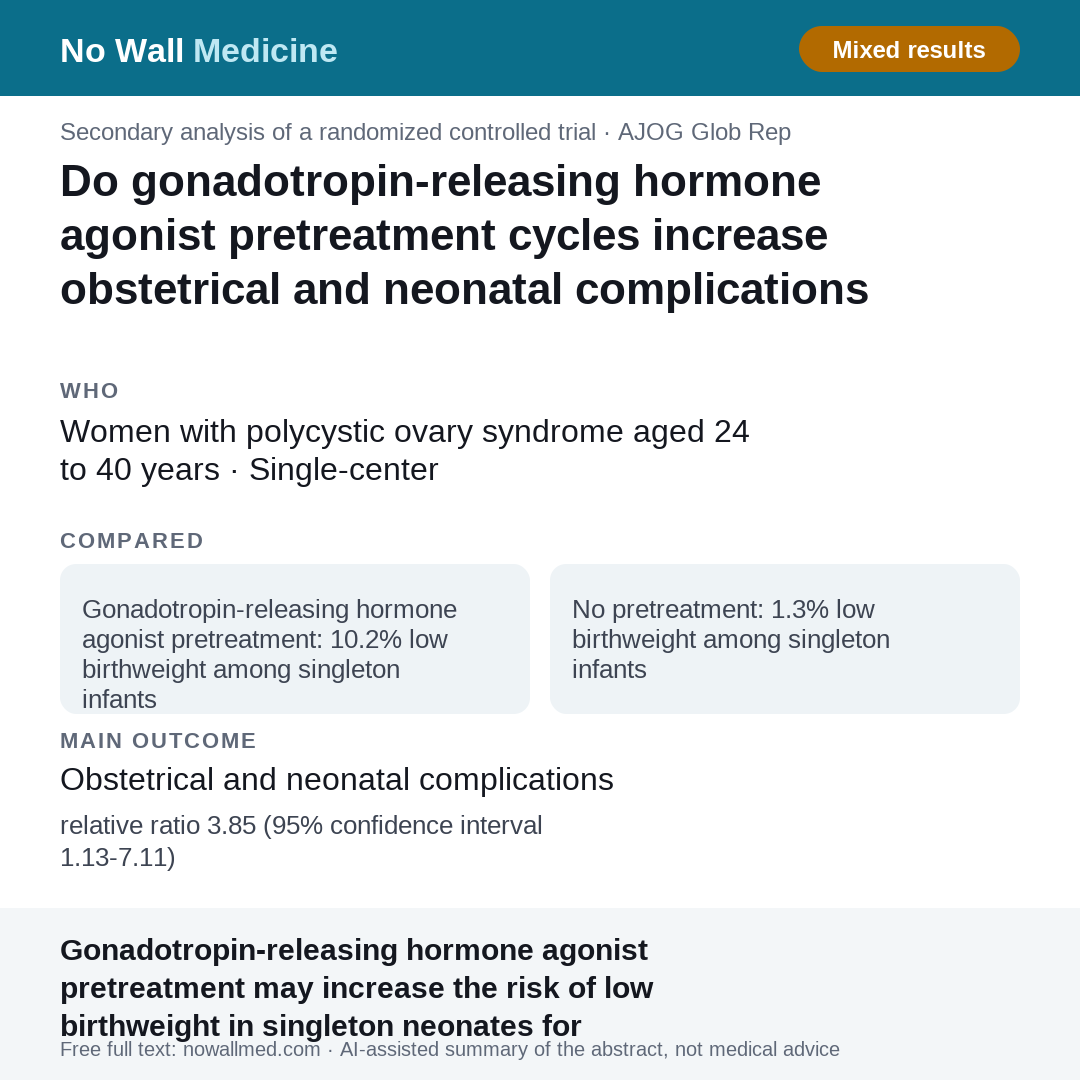
Clinical question: Do gonadotropin-releasing hormone agonist pretreatment cycles increase obstetrical and neonatal complications in polycystic ovary syndrome?
Why it matters: It was unclear if using gonadotropin-releasing hormone agonist pretreatment before programmed frozen embryo transfer increases the risk of obstetrical complications in women with polycystic ovary syndrome.
Key points
- Researchers analyzed 177 live single births and 38 twin births from women with polycystic ovary syndrome undergoing programmed frozen embryo transfer.
- Singleton infants born after gonadotropin-releasing hormone agonist pretreatment had a higher incidence of low birthweight compared to no pretreatment (10.2% vs 1.3%).
- There were no significant differences in obstetrical complications, such as hypertensive disorders of pregnancy, between the two groups for singleton or twin pregnancies.
Limitation the authors note: This was a secondary analysis of a single-center randomized controlled trial.
Headline and key points written with AI from the paper’s abstract, with every number checked against it. Read the paper before relying on them.
Was this summary helpful?
Cite this article
Jie HY, Hu R, Zhang L, Dong K, Wu C, Wang Q. Obstetric and neonatal outcomes after programmed frozen embryo transfer with or without GnRH agonist for polycystic ovary syndrome: secondary analysis results from a randomized controlled trial. AJOG Glob Rep. 2023. doi:10.1016/j.xagr.2023.100201
Spotted a mistake? Suggest a correction
Top studies every Monday
The week’s key trials and guidelines in your specialties, plus any topics you follow. By email, free.
Get the weekly digest