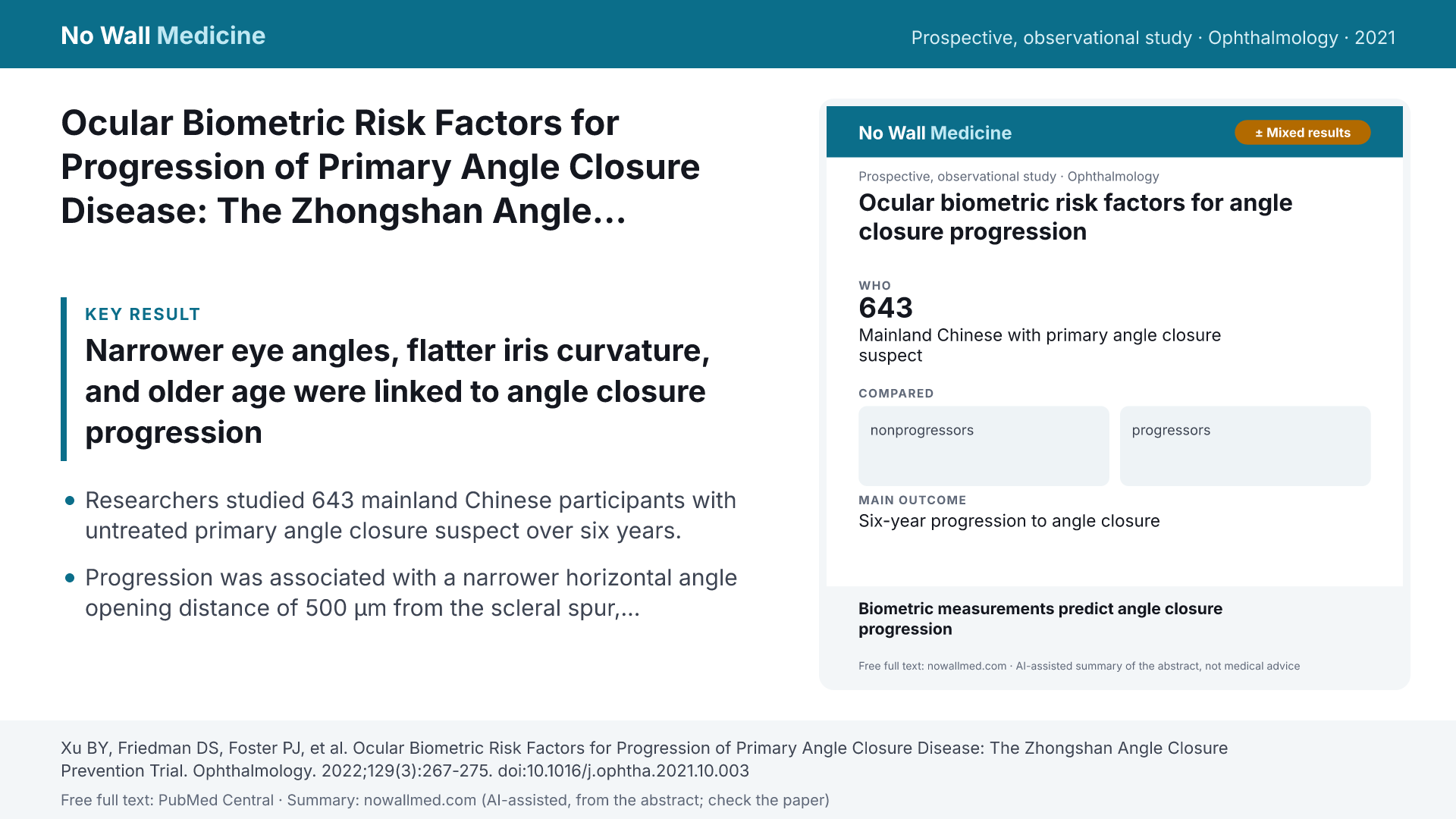
Narrower eye angles, flatter iris curvature, and older age were linked to angle closure progression
Ocular Biometric Risk Factors for Progression of Primary Angle Closure Disease: The Zhongshan Angle Closure Prevention Trial
Prospective, observational studyMixed results
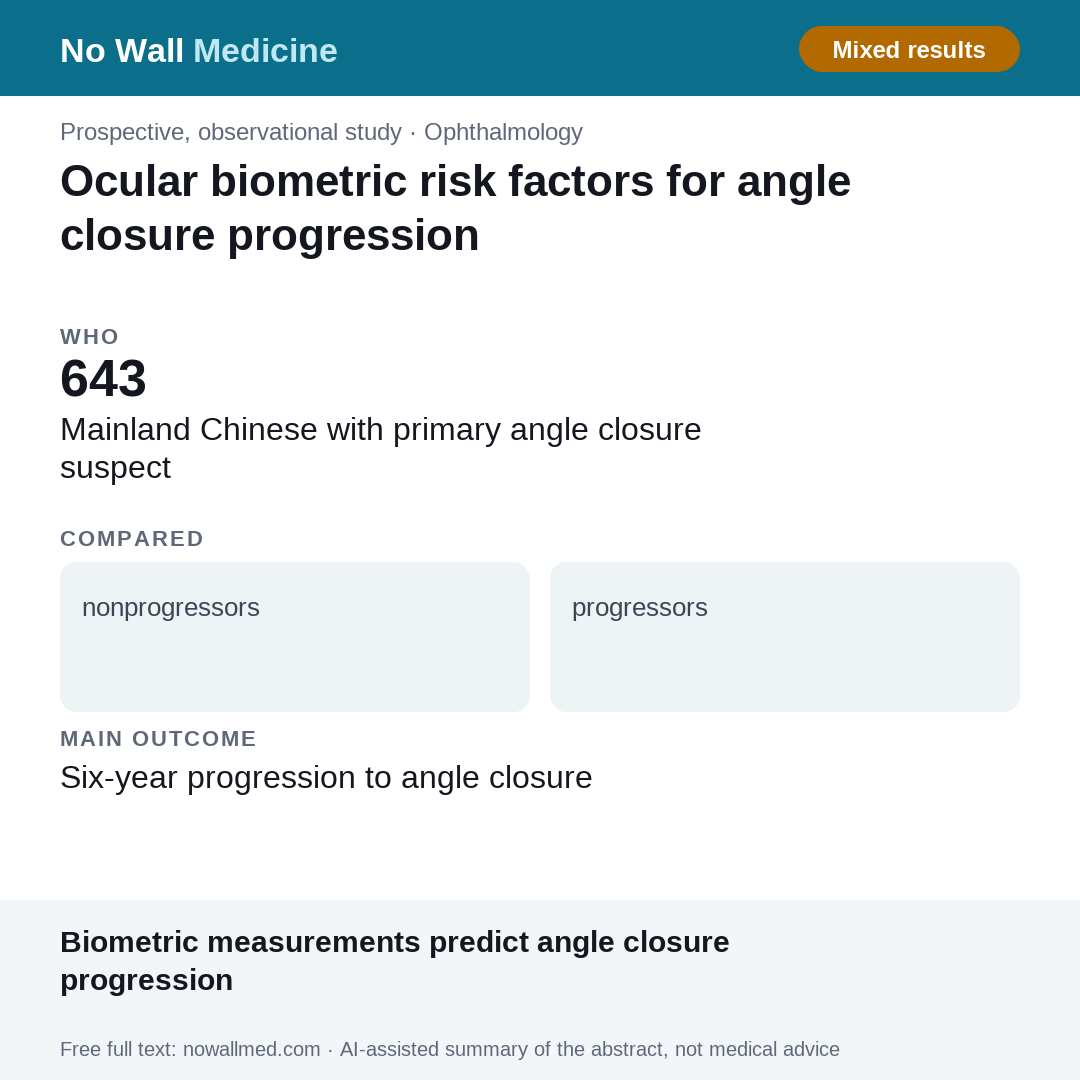
Ocular biometric risk factors for angle closure progression
Who
643
Mainland Chinese with primary angle closure suspect
Compared
nonprogressors
progressors
Main outcome
Six-year progression to angle closure
Bottom line: Biometric measurements predict angle closure progression
Ophthalmology · 2021-10-08Download image
Key points
- Researchers studied 643 mainland Chinese participants with untreated primary angle closure suspect over six years.
- Progression was associated with a narrower horizontal angle opening distance of 500 μm from the scleral spur, flatter horizontal iris curvature, and older age.
- A smaller cumulative gonioscopy score, which is a method to visualize the eye's drainage angle, was not associated with progression.
Headline and key points written with AI from the paper’s abstract, with every number checked against it. Read the paper before relying on them.
Was this summary helpful?
Subject terms
Cite this article
Xu BY, Friedman DS, Foster PJ, et al. Ocular Biometric Risk Factors for Progression of Primary Angle Closure Disease: The Zhongshan Angle Closure Prevention Trial. Ophthalmology. 2021. doi:10.1016/j.ophtha.2021.10.003
Spotted a mistake? Suggest a correction