Ocular Biometric Risk Factors for Progression of Primary Angle Closure Disease: The Zhongshan Angle Closure Prevention Trial
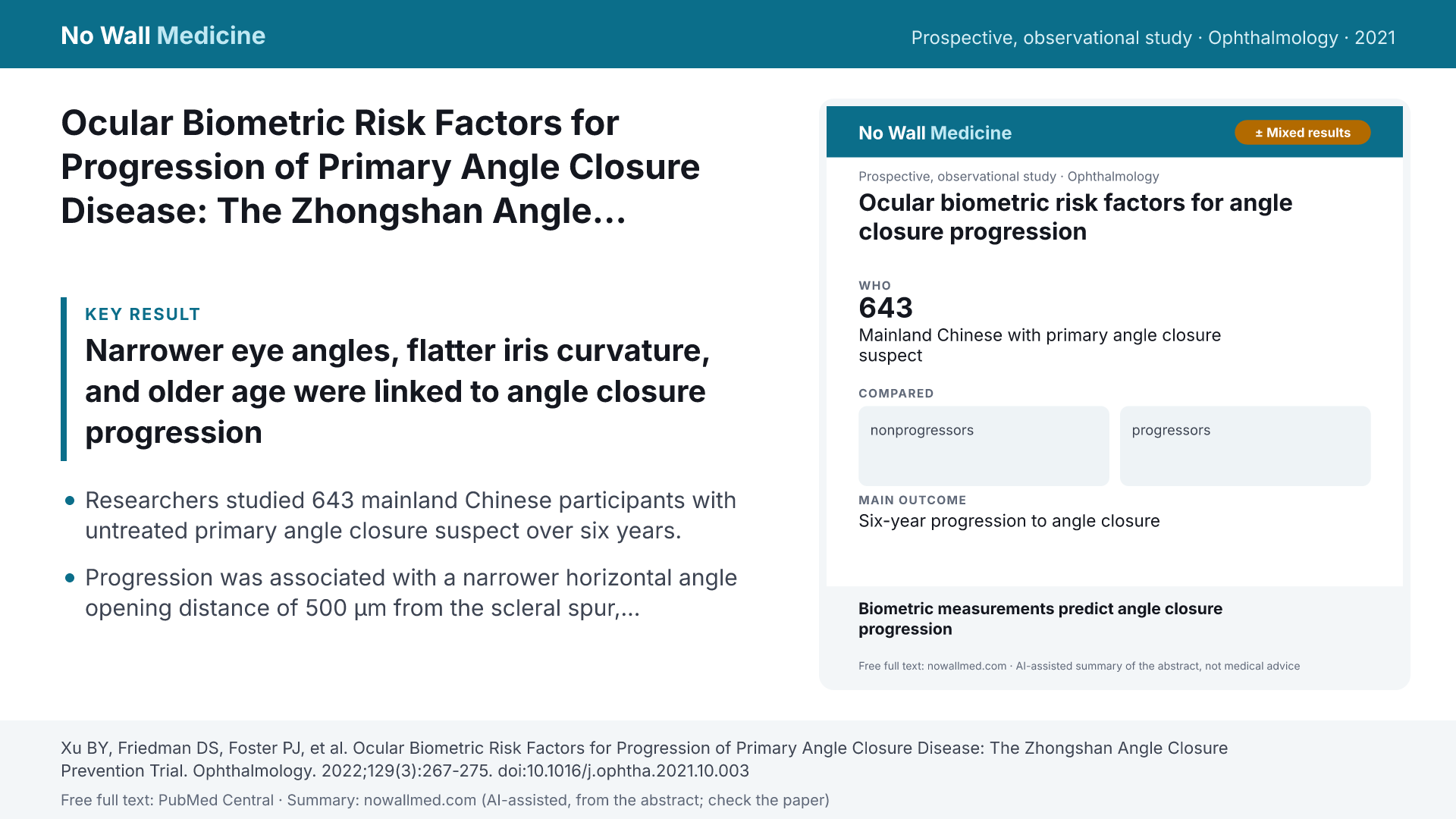
Key result: Narrower eye angles, flatter iris curvature, and older age were linked to angle closure progression
Prospective, observational studyMixed results
Ocular biometric risk factors for angle closure progression
Who
643
Mainland Chinese with primary angle closure suspect
Compared
nonprogressors
progressors
Main outcome
Six-year progression to angle closure
Bottom line: Biometric measurements predict angle closure progression
Ophthalmology · 2021-10-08
Key points
- Researchers studied 643 mainland Chinese participants with untreated primary angle closure suspect over six years.
- Progression was associated with a narrower horizontal angle opening distance of 500 μm from the scleral spur, flatter horizontal iris curvature, and older age.
- A smaller cumulative gonioscopy score, which is a method to visualize the eye's drainage angle, was not associated with progression.
Discussion prompts
- Would these patients look like yours? Who was left out?
- Is the main outcome one that matters to patients?
- Is the difference large enough to change what you do?
Cite: Xu BY, Friedman DS, Foster PJ, et al. Ocular Biometric Risk Factors for Progression of Primary Angle Closure Disease: The Zhongshan Angle Closure Prevention Trial. Ophthalmology. 2022;129(3):267-275. doi:10.1016/j.ophtha.2021.10.003
Free full text: PubMed Central · Summary and visual abstract: nowallmed.com/a/ocular-biometric-risk-factors-for-progression-of-primary-angle-18o8qem/ (AI-assisted from the abstract; check the paper before relying on it).