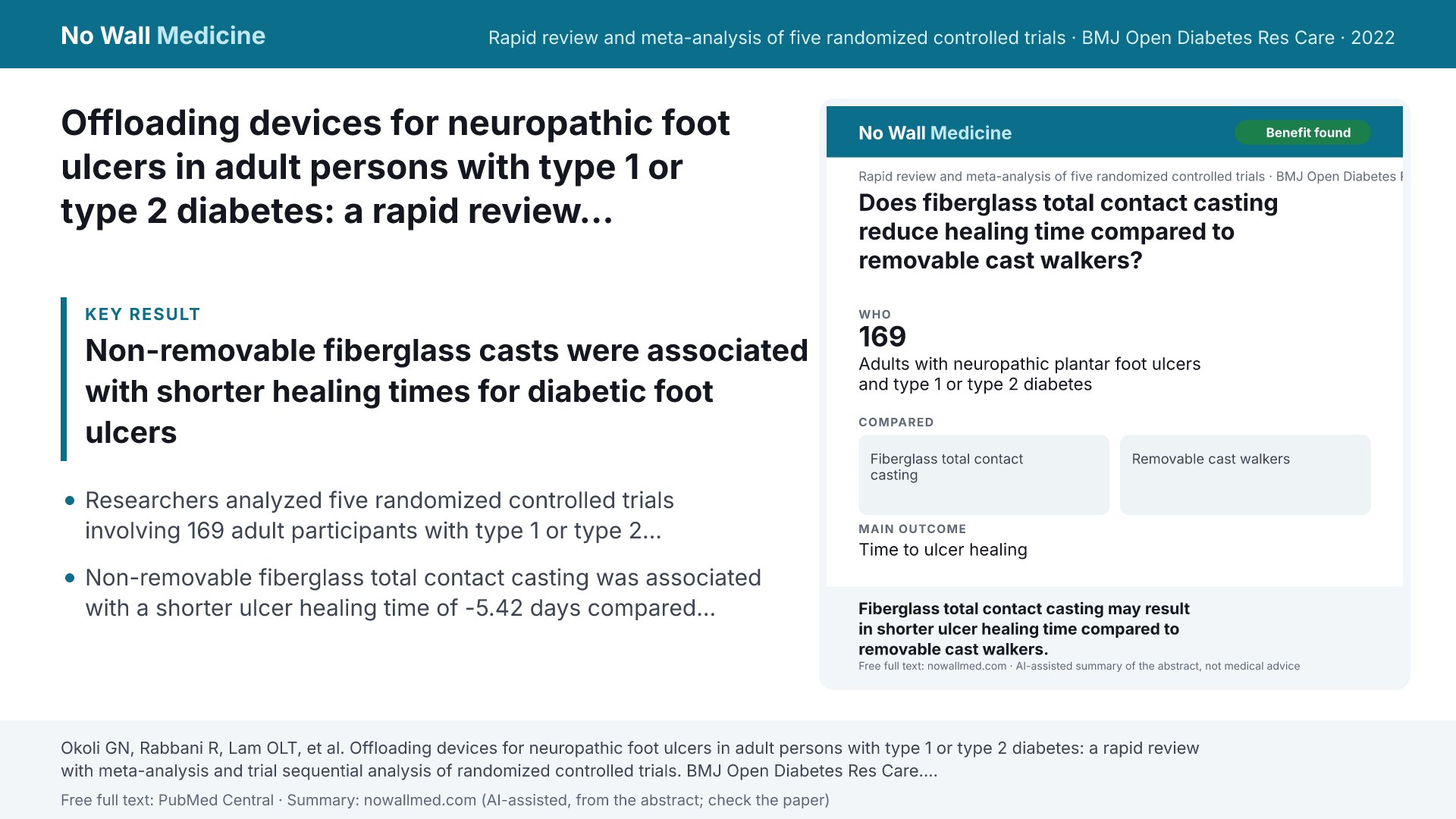
Non-removable fiberglass casts were associated with shorter healing times for diabetic foot ulcers
Offloading devices for neuropathic foot ulcers in adult persons with type 1 or type 2 diabetes: a rapid review with meta-analysis and trial sequential analysis of randomized controlled trials
Rapid review and meta-analysis of five randomized controlled trialsBenefit found
Does fiberglass total contact casting reduce healing time compared to removable cast walkers?
Who
169
Adults with neuropathic plantar foot ulcers and type 1 or type 2 diabetes
Compared
Fiberglass total contact casting
Removable cast walkers
Main outcome
Time to ulcer healing
Result: -5.42 days, 95% CI -9.66 days to -1.17 days
Bottom line: Fiberglass total contact casting may result in shorter ulcer healing time compared to removable cast walkers.
Limitation: Limited evidence from randomized controlled trials and highly variable participant inclusion criteria.
BMJ Open Diabetes Res Care · 2022-05-13Download image
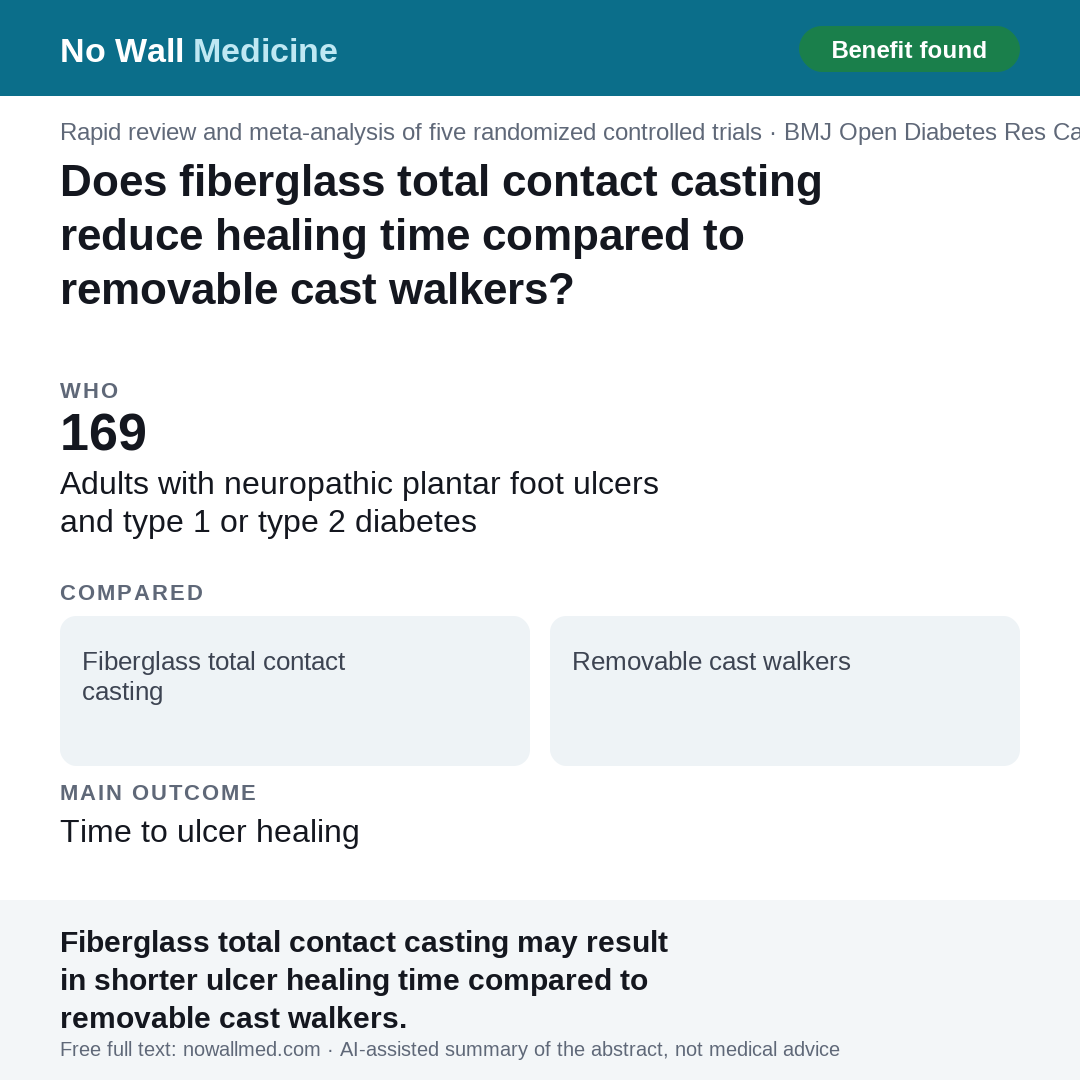
Clinical question: Does fiberglass total contact casting reduce healing time compared to removable cast walkers?
Why it matters: It was unclear whether non-removable fiberglass total contact casting or removable cast walkers are more effective at reducing healing time for diabetic foot ulcers.
Key points
- Researchers analyzed five randomized controlled trials involving 169 adult participants with type 1 or type 2 diabetes and neuropathic foot ulcers.
- Non-removable fiberglass total contact casting was associated with a shorter ulcer healing time of -5.42 days compared to removable cast walkers.
- The findings were supported by a trial sequential analysis, which is a method used to determine if enough data exists for a robust conclusion.
Limitation the authors note: The evidence base is limited due to high variability in ulcer stages and peripheral neuropathy among the included studies.
Headline and key points written with AI from the paper’s abstract, with every number checked against it. Read the paper before relying on them.
Was this summary helpful?
Abstract
Introduction
Healing time for neuropathic planter foot ulcers (NPFUs) in persons with diabetes may be reduced through use of non-removable fiberglass total contact casting (F-TCC) compared with removable cast walkers (RCWs), although the evidence base is still growing. Research design and methods
We conducted a rapid review and systematically searched for, and critically assessed, randomized controlled trials (RCTs) that compared the efficacy of F-TCC versus RCW, focusing on the time to ulcer healing in adult persons (18+ years) with NPFUs and type 1 or type 2 diabetes. We meta-analysed the mean differences and associated 95% CIs using an inverse variance, random-effects model. We also conducted a trial sequential analysis (TSA) to assess if the available evidence is up to the required information size for a robust conclusion. We assessed and quantified statistical heterogeneity between the included studies using the I2 statistic. Results
Out of 102 retrieved citations, five RCTs met the eligibility criteria. Participants' inclusion in relation to stage of ulcer was highly variable as was peripheral neuropathy complicating comparisons. F-TCC appeared to present a shorter ulcer healing time (-5.42 days, 95% CI -9.66 days to -1.17 days; I2 9.9%; 5 RCTs; 169 participants) compared with RCW. This finding was supported by the TSA. Conclusions
There is limited evidence from RCTs to suggest that F-TCC has a shorter ulcer healing time compared with RCW among adults with diabetic NPFUs. Properly designed and conducted RCTs are still required for a stronger evidence base.
Abstract reproduced under the article’s CC BY NC licence.
Subject terms
Cite this article
Okoli GN, Rabbani R, Lam OLT, Askin N, Horsley T, Bayliss L. Offloading devices for neuropathic foot ulcers in adult persons with type 1 or type 2 diabetes: a rapid review with meta-analysis and trial sequential analysis of randomized controlled trials. BMJ Open Diabetes Res Care. 2022. doi:10.1136/bmjdrc-2022-002822
Spotted a mistake? Suggest a correction
Top studies every Monday
The week’s key trials and guidelines in your specialties, plus any topics you follow. By email, free.
Get the weekly digest