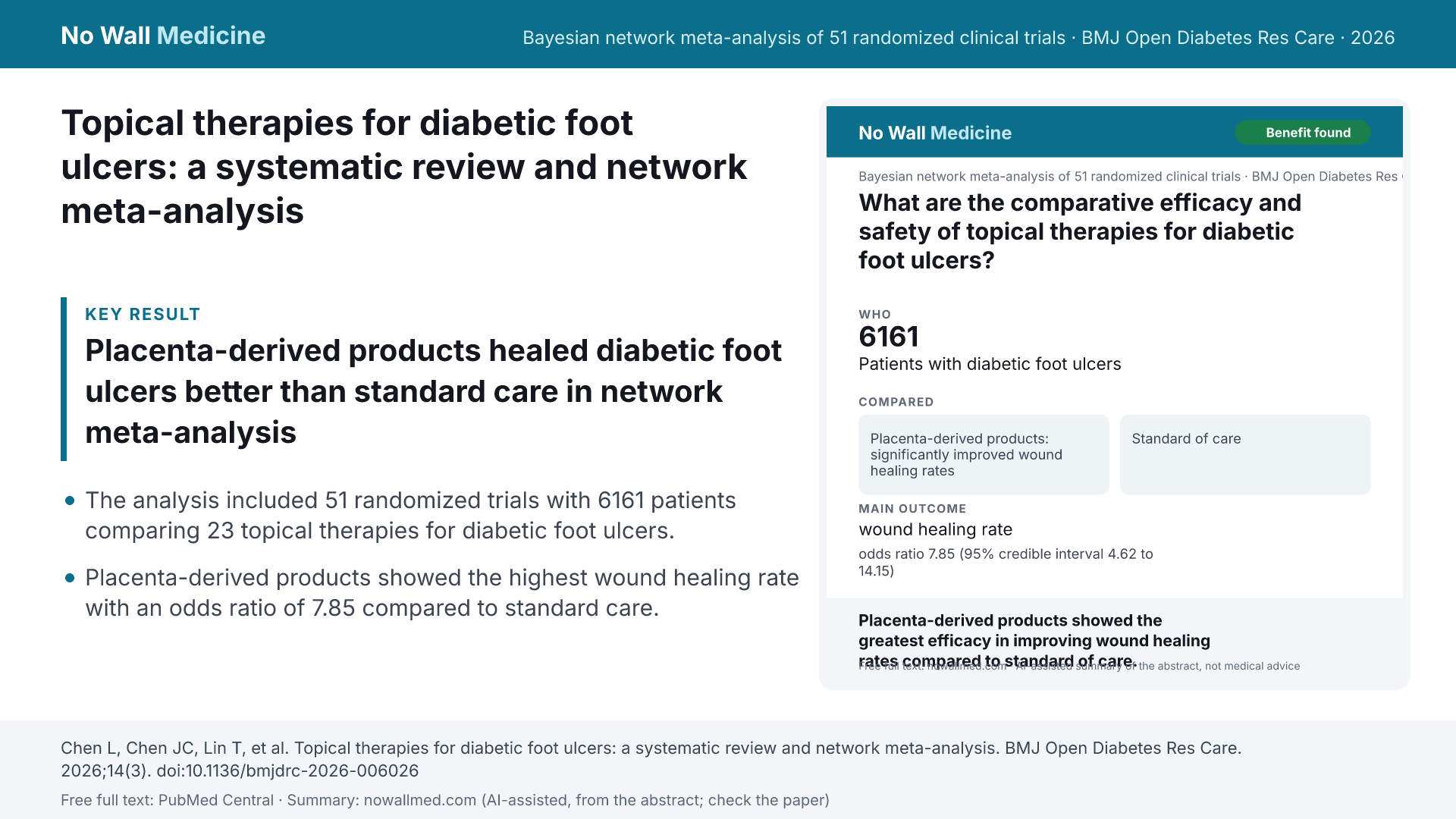
Placenta-derived products healed diabetic foot ulcers better than standard care in network meta-analysis
Topical therapies for diabetic foot ulcers: a systematic review and network meta-analysis
Bayesian network meta-analysis of 51 randomized clinical trialsBenefit found
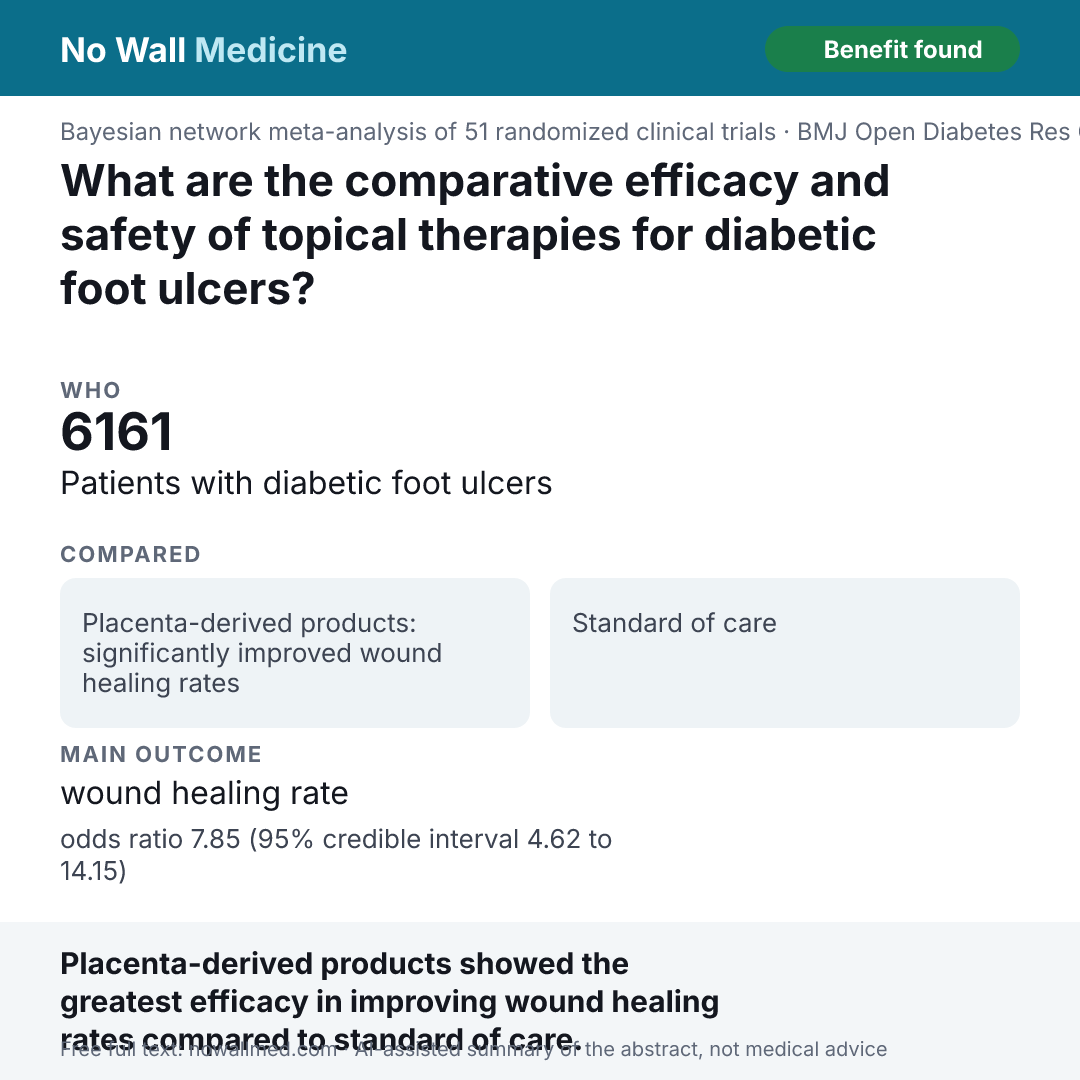
What are the comparative efficacy and safety of topical therapies for diabetic foot ulcers?
Who
6161
Patients with diabetic foot ulcers
Compared
Placenta-derived products: significantly improved wound healing rates
Standard of care
Main outcome
wound healing rate
Result: odds ratio 7.85 (95% credible interval 4.62 to 14.15)
Bottom line: Placenta-derived products showed the greatest efficacy in improving wound healing rates compared to standard of care.
Limitation: the certainty of evidence for most comparisons remains in the low-to-moderate range
BMJ Open Diabetes Res Care · 2026-05-21
Why it matters: Comparative efficacy and safety of numerous topical therapies for diabetic foot ulcers remained unclear despite high amputation rates.
Headline and visual abstract written with AI from the paper’s abstract, with every number checked against it. Read the paper before relying on them.
Was this summary helpful?
Abstract
Objective
Diabetic foot ulcer (DFU) is a life-threatening complication associated with high amputation and mortality rates. While numerous topical therapies exist, their comparative efficacy and safety remain unclear. We aimed to compare the efficacy and safety of topical therapies for DFUs to identify optimal treatment strategies. Research design and methods
We searched PubMed, Embase, and CENTRAL from inception to February 1, 2025, for randomized clinical trials (RCTs) evaluating topical therapies for DFUs. We excluded non-topical interventions to ensure clinically relevant comparisons. A Bayesian network meta-analysis was performed. The primary outcome was wound healing rate. Results
We included 51 RCTs involving 6161 patients and 23 interventions. 12 topical therapies, including placenta-derived products, platelet-related products, ON101, epidermal growth factor, and tissue-engineered skin substitutes, significantly improved wound healing rates vs standard of care (SOC). Placenta-derived products showed the greatest efficacy (OR 7.85 (95% credible interval (CrI) 4.62 to 14.15)) and were the only intervention to significantly reduce adverse events vs SOC (0.25 (95% CrI 0.10 to 0.60)). No interventions differed significantly from SOC in time to wound healing, serious adverse events, or infections. Conclusions
Placenta-derived products and other biological or advanced topical therapies may demonstrate greater efficacy than the SOC in facilitating the healing of DFUs. Nevertheless, the certainty of evidence for most comparisons remains in the low-to-moderate range. These findings suggest potential benefits in integrating these therapies into the management of DFUs. However, high-quality RCTs are necessary to verify long-term outcomes.
Abstract reproduced under the article’s CC BY NC licence.
Subject terms
Cite this article
Chen L, Chen JC, Lin T, et al. Topical therapies for diabetic foot ulcers: a systematic review and network meta-analysis. BMJ Open Diabetes Res Care. 2026;14(3). doi:10.1136/bmjdrc-2026-006026
Spotted a mistake? Suggest a correction