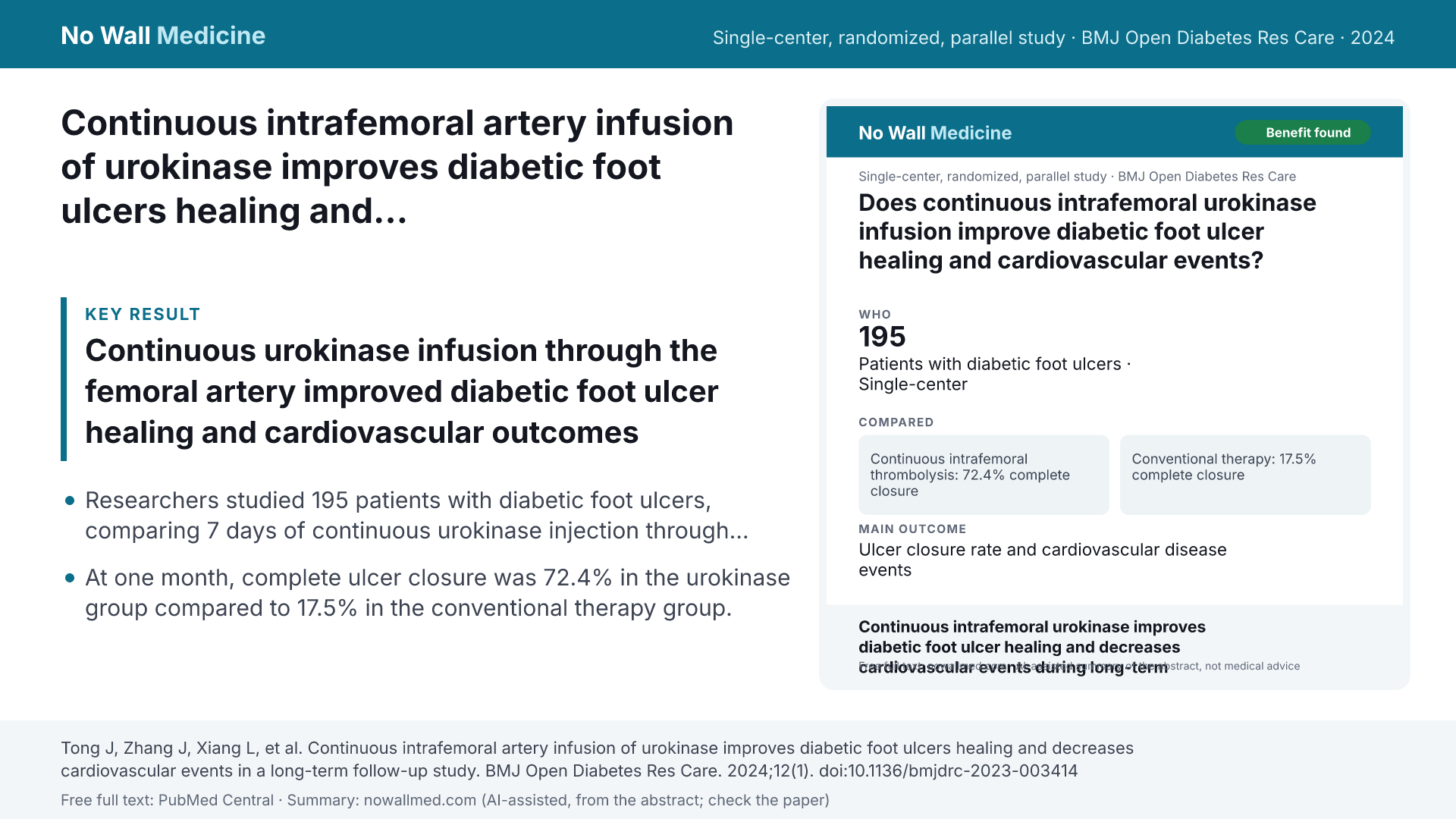
Continuous urokinase infusion through the femoral artery improved diabetic foot ulcer healing and cardiovascular outcomes
Continuous intrafemoral artery infusion of urokinase improves diabetic foot ulcers healing and decreases cardiovascular events in a long-term follow-up study
Single-center, randomized, parallel studyBenefit found
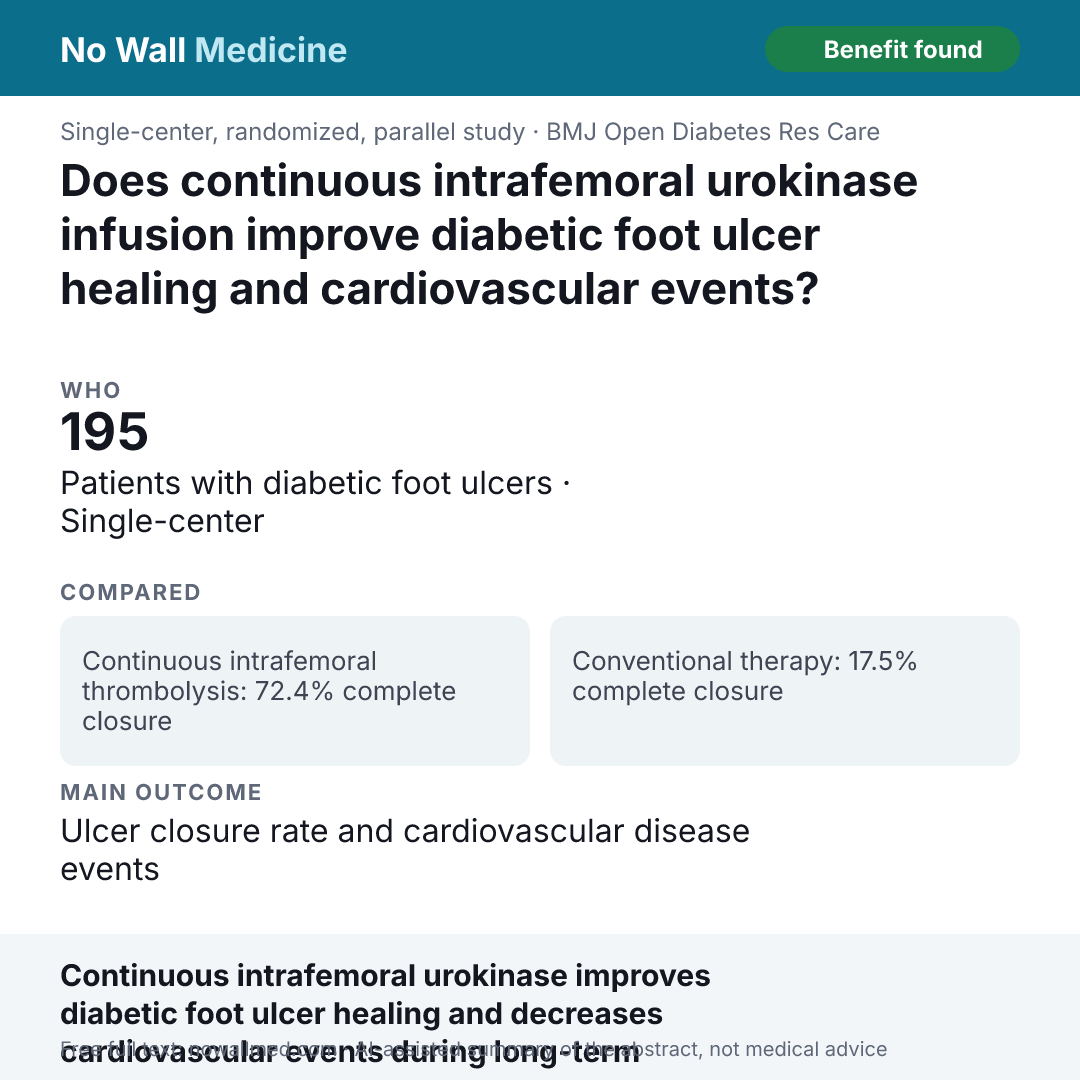
Does continuous intrafemoral urokinase infusion improve diabetic foot ulcer healing and cardiovascular events?
Who
195
Patients with diabetic foot ulcers · Single-center
Compared
Continuous intrafemoral thrombolysis: 72.4% complete closure
Conventional therapy: 17.5% complete closure
Main outcome
Ulcer closure rate and cardiovascular disease events
Result: hazard ratio 3.42 (95% CI 2.35 to 4.98)
Bottom line: Continuous intrafemoral urokinase improves diabetic foot ulcer healing and decreases cardiovascular events during long-term follow-up.
BMJ Open Diabetes Res Care · 2024-01-12 · Save PNG
Clinical question: Does continuous intrafemoral urokinase infusion improve diabetic foot ulcer healing and cardiovascular events?
In absolute numbers
Continuous intrafemoral thrombolysis: 72.4% · Conventional therapy: 17.5% → a difference of 54.9 percentage points, so about 2 people would need the treatment for 1 more to benefit (number needed to treat) over the trial’s follow-up.
Worked out by us from the two group results above, not reported by the authors. Check the paper for the exact outcome and timing.
Key points
- Researchers studied 195 patients with diabetic foot ulcers, comparing 7 days of continuous urokinase injection through the femoral artery to conventional wound care.
- At one month, complete ulcer closure was 72.4% in the urokinase group compared to 17.5% in the conventional therapy group.
- During a 6.5-year follow-up, the urokinase group had a lower incidence of cardiovascular events and cardiovascular death.
Limitation the authors note: This was a single-center study.
Headline and key points written with AI from the paper’s abstract, with every number checked against it. Read the paper before relying on them.
Was this summary helpful?
Abstract
Introduction
Diabetic foot ulcer (DFU) is a disabling complication of diabetes mellitus. Here, we attempted to assess whether long-term intrafemoral artery infusion of low-dose urokinase therapy improved DFUs and decreased cardiovascular events in patients with DFUs. Research design and methods
This trial was a single-center, randomized, parallel study. A total of 195 patients with DFU were randomized to continuous intrafemoral thrombolysis or conventional therapy groups. The continuous intrafemoral thrombolysis group received continuous intrafemoral urokinase injection for 7 days, and conventional therapy just received wound debridement and dressing change. Then, a follow-up of average 6.5 years was performed. Results
Compared with conventional therapy, at the first 1 month of intervention stage, the ulcers achieved a significant improvement in continuous intrafemoral thrombolysis group including a complete closure (72.4% vs 17.5%), an improved ulcer (27.6% vs 25.8%), unchanged or impaired ulcer (0% vs 56.7%). During the 6.5-year follow-up, for the primary outcome of ulcer closure rate, continuous intrafemoral thrombolysis therapy obtained a better complete healing rate (HR 3.42 (95% CI 2.35 to 4.98, p<0.0001)). For the secondary outcome of cardiovascular disease events, continuous intrafemoral thrombolysis therapy had a lower incidence of cardiovascular events (HR 0.50 (95% CI 0.34 to 0.74, p<0.0001)). Importantly, intrafemoral thrombolysis therapy decreased the incidence of cardiovascular death (HR 0.42 (95%CI 0.20 to 0.89, p=0.0241)). Additionally, continuous intrafemoral thrombolysis therapy improved local skin oxygenation and peripheral neuropathy as well as glycolipid metabolic profiles when compared with conventional therapy group (p<0.05). Conclusions
Continuous intrafemoral thrombolysis therapy has a better therapeutic efficacy to improve DFUs and decrease cardiovascular events. Trial registration number
NCT01108120.
Abstract reproduced under the article’s CC BY NC licence.
Subject terms
Headline, design, result, key points, caveat and citation as plain text.
Cite this article
Tong J, Zhang J, Xiang L, et al. Continuous intrafemoral artery infusion of urokinase improves diabetic foot ulcers healing and decreases cardiovascular events in a long-term follow-up study. BMJ Open Diabetes Res Care. 2024;12(1). doi:10.1136/bmjdrc-2023-003414
Spotted a mistake? Suggest a correction