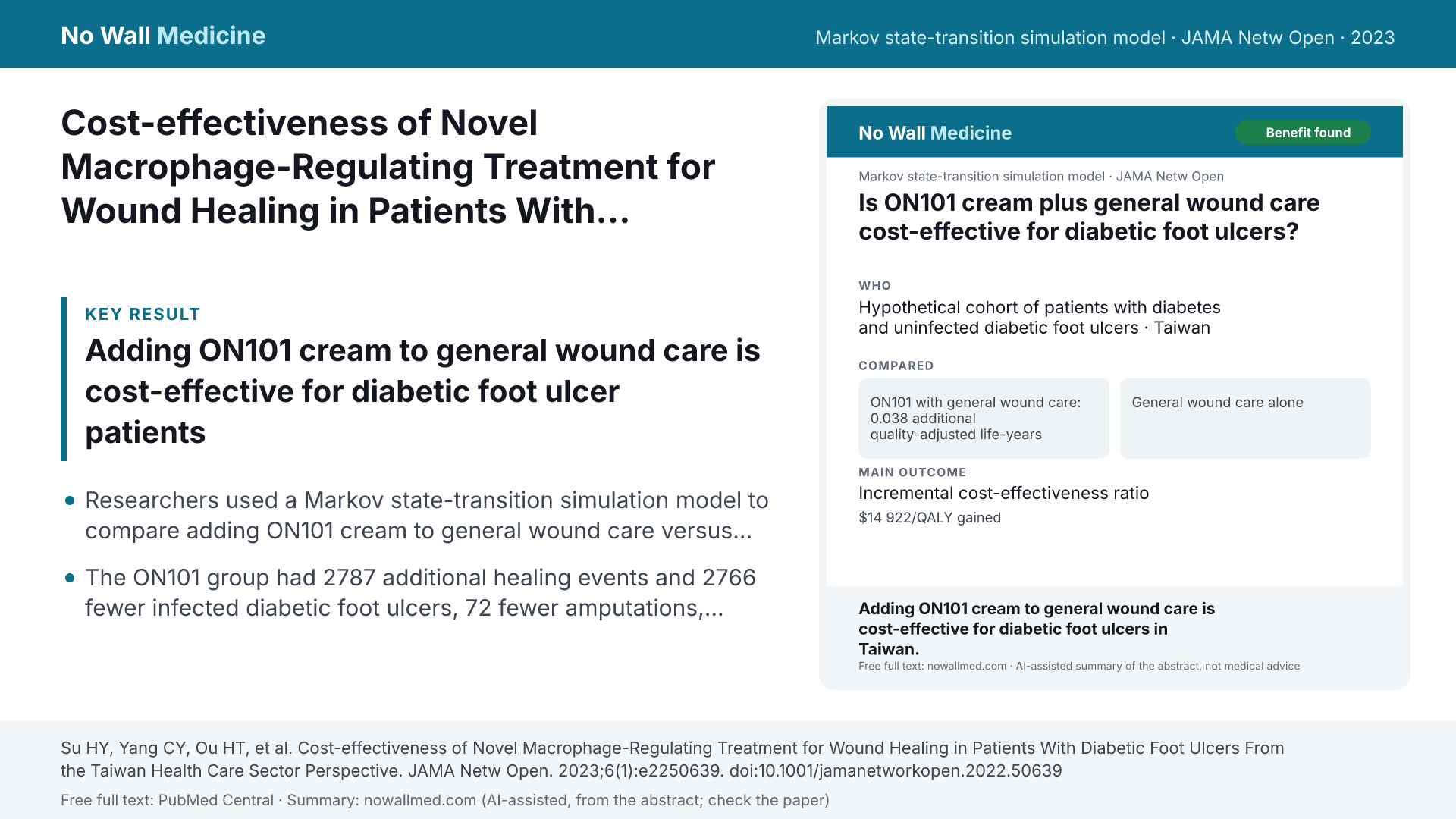
Adding ON101 cream to general wound care is cost-effective for diabetic foot ulcer patients
Cost-effectiveness of Novel Macrophage-Regulating Treatment for Wound Healing in Patients With Diabetic Foot Ulcers From the Taiwan Health Care Sector Perspective
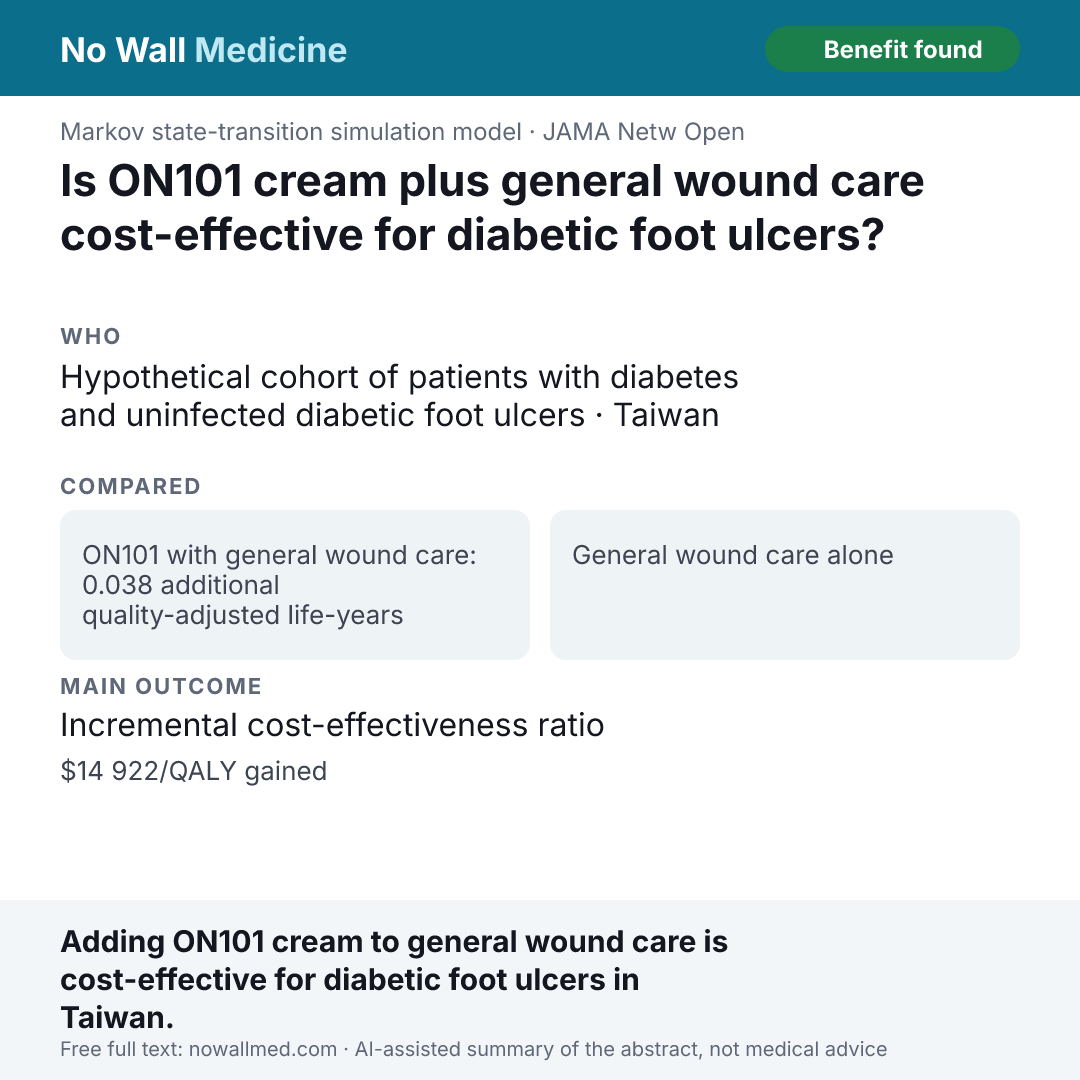
Markov state-transition simulation modelBenefit found
Is ON101 cream plus general wound care cost-effective for diabetic foot ulcers?
Who
Hypothetical cohort of patients with diabetes and uninfected diabetic foot ulcers · Taiwan health care sector perspective
Compared
ON101 with general wound care: 0.038 additional quality-adjusted life-years
General wound care alone
Main outcome
Incremental cost-effectiveness ratio
Result: $14 922/QALY gained
Bottom line: Adding ON101 cream to general wound care is cost-effective for diabetic foot ulcers in Taiwan.
Limitation: Economic results were most sensitive to healing efficacy, drug cost, and health utility.
JAMA Netw Open · 2023-01-03 · Save PNG
Clinical question: Is ON101 cream plus general wound care cost-effective for diabetic foot ulcers?
Key points
- Researchers used a Markov state-transition simulation model to compare adding ON101 cream to general wound care versus general wound care alone for a hypothetical cohort of patients.
- The ON101 group had 2787 additional healing events and 2766 fewer infected diabetic foot ulcers, 72 fewer amputations, and 7 fewer gangrene events over 5 years.
- Adding ON101 yielded 0.038 additional quality-adjusted life-years at an incremental cost of $571, resulting in $14,922 per quality-adjusted life-year gained.
Limitation the authors note: This economic evaluation used a hypothetical cohort of patients and a simulation model rather than real-world patient data.
Headline and key points written with AI from the paper’s abstract, with every number checked against it. Read the paper before relying on them.
Was this summary helpful?
Subject terms
Headline, design, result, key points, caveat and citation as plain text.
Cite this article
Su HY, Yang CY, Ou HT, et al. Cost-effectiveness of Novel Macrophage-Regulating Treatment for Wound Healing in Patients With Diabetic Foot Ulcers From the Taiwan Health Care Sector Perspective. JAMA Netw Open. 2023;6(1):e2250639. doi:10.1001/jamanetworkopen.2022.50639
Spotted a mistake? Suggest a correction