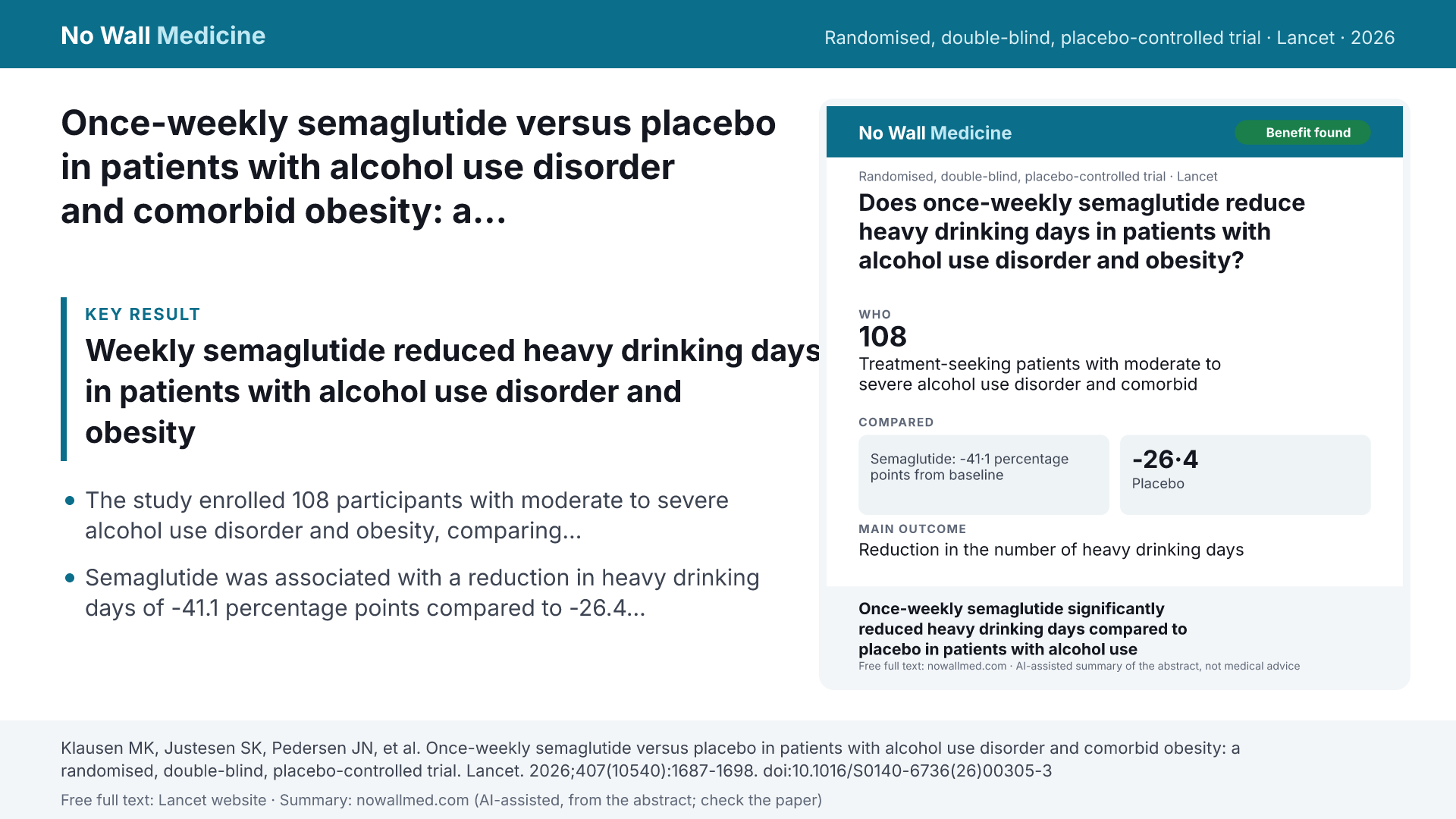
Weekly semaglutide reduced heavy drinking days in patients with alcohol use disorder and obesity
Once-weekly semaglutide versus placebo in patients with alcohol use disorder and comorbid obesity: a randomised, double-blind, placebo-controlled trial
Randomised, double-blind, placebo-controlled trialBenefit found
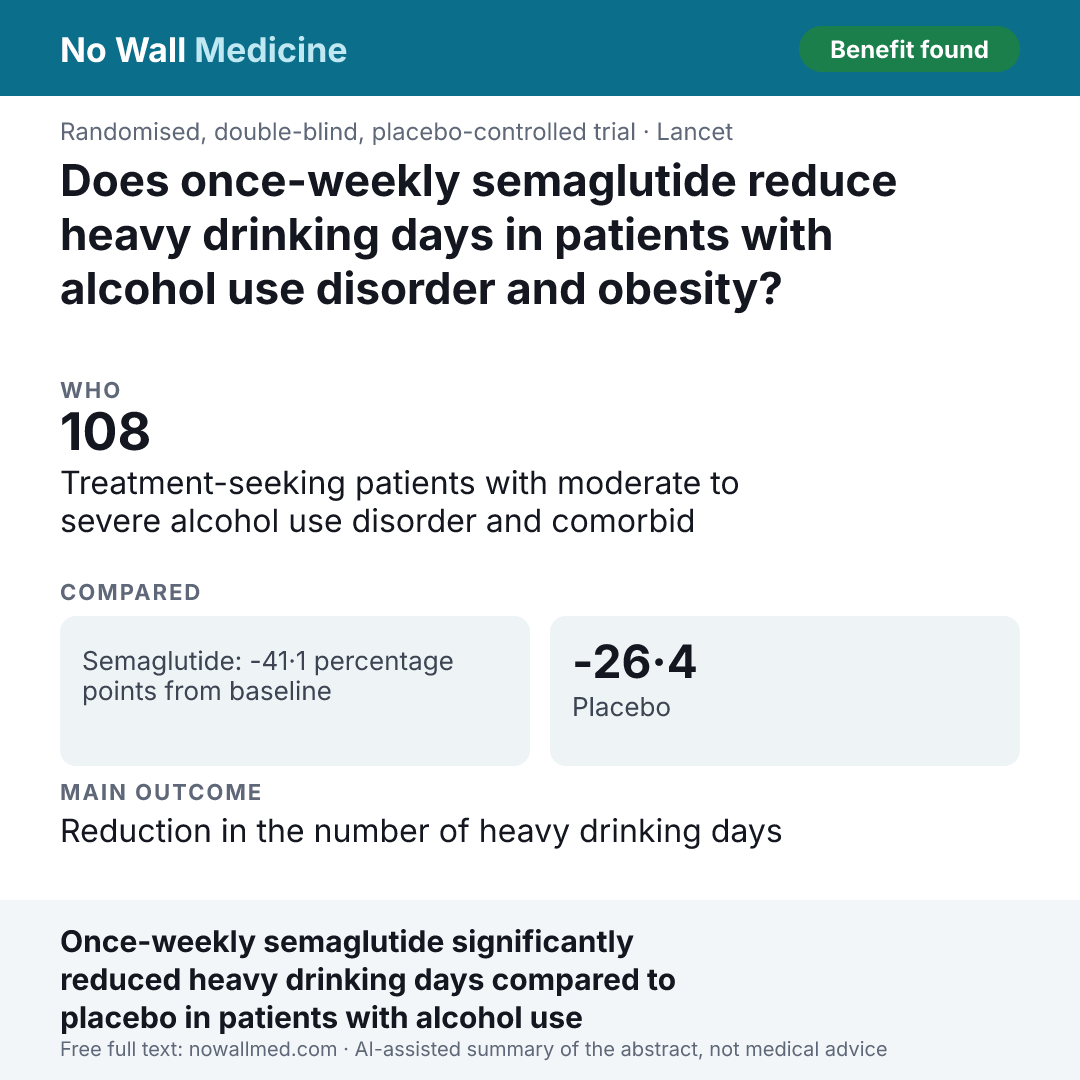
Does once-weekly semaglutide reduce heavy drinking days in patients with alcohol use disorder and obesity?
Who
108
Treatment-seeking patients with moderate to severe alcohol use disorder and comorbid obesity · Single-centre
Compared
Semaglutide: -41·1 percentage points from baseline
-26·4Placebo
Main outcome
Reduction in the number of heavy drinking days
Result: estimated treatment difference -13·7 percentage points, -22·0 to -5·4
Bottom line: Once-weekly semaglutide significantly reduced heavy drinking days compared to placebo in patients with alcohol use disorder and obesity.
Funded by: The Research Foundation, Mental Health Services, Novo Nordisk Foundation, and others
Lancet · 2026-05-04 · Save PNG
Clinical question: Does once-weekly semaglutide reduce heavy drinking days in patients with alcohol use disorder and obesity?
Why it matters: There is an urgent need for new therapeutic interventions for alcohol use disorder, which accounts for 5% of deaths worldwide annually.
Key points
- The study enrolled 108 participants with moderate to severe alcohol use disorder and obesity, comparing once-weekly semaglutide to a placebo alongside cognitive behavioural therapy.
- Semaglutide was associated with a reduction in heavy drinking days of -41.1 percentage points compared to -26.4 percentage points for the placebo group.
- Adverse events were generally mild to moderate gastrointestinal effects and occurred more frequently in the semaglutide group.
Limitation the authors note: The study was a single-centre trial.
Headline and key points written with AI from the paper’s abstract, with every number checked against it. Read the paper before relying on them.
Was this summary helpful?
Abstract
Background
Alcohol use disorder accounts for 5% of deaths worldwide annually, and there is an urgent need for new therapeutic interventions. Preclinical and initial human studies indicate that the GLP-1 receptor agonist semaglutide might reduce alcohol drinking. This study evaluated the efficacy of semaglutide once-weekly in treatment-seeking patients with alcohol use disorder and comorbid obesity. Methods
In a 26-week, single-centre, randomised, double-blinded, placebo-controlled trial, treatment-seeking participants with moderate to severe alcohol use disorder and comorbid obesity were assigned (1:1) to receive once-weekly semaglutide (2·4 mg subcutaneously) or placebo (saline subcutaneously), in addition to standard cognitive behavioural therapy. The primary endpoint was a reduction in the number of heavy drinking days assessed after 26 weeks of intervention, analysed with an ANCOVA model. Analysis adhered to the intention-to-treat principle, and missing outcome data were addressed using multiple imputations. Safety was assessed in all treated patients. The trial is registered at ClinicalTrials.govNCT05895643, and is complete. Findings
From June 10, 2023, to Feb 4, 2025, 108 participants (53 women and 55 men) were enrolled, with 54 participants in each of the semaglutide and placebo treatment groups, and all were included in the data analysis. Overall, 88 participants (81%) completed the full intervention. Semaglutide was associated with a reduction in heavy drinking days (-41·1 percentage points from baseline, 95% CI -48·7 to -33·5) compared with placebo (-26·4, -34·1 to -18·6; estimated treatment difference -13·7 percentage points, -22·0 to -5·4; p=0·0015), and had substantial effects on multiple secondary alcohol-related and somatic outcomes. Adverse events were transient, generally mild to moderate gastrointestinal effects, and occurred more frequently in the semaglutide group. Interpretation
Semaglutide showed robust therapeutic effects in treatment-seeking participants with obesity and alcohol use disorder and this trial supports previous preclinical and clinical findings suggesting GLP-1 receptor agonists as a potential novel treatment target for alcohol use disorder. Funding
The Research Foundation, Mental Health Services (Capital Region of Denmark), the Novo Nordisk Foundation, the Novavi Foundation, the Hartmann Foundation, and the Augustinus Foundation.
Abstract reproduced under the article’s CC BY licence.
Subject terms
Headline, design, result, key points, caveat and citation as plain text.
Cite this article
Klausen MK, Justesen SK, Pedersen JN, et al. Once-weekly semaglutide versus placebo in patients with alcohol use disorder and comorbid obesity: a randomised, double-blind, placebo-controlled trial. Lancet. 2026;407(10540):1687-1698. doi:10.1016/S0140-6736(26)00305-3
Spotted a mistake? Suggest a correction