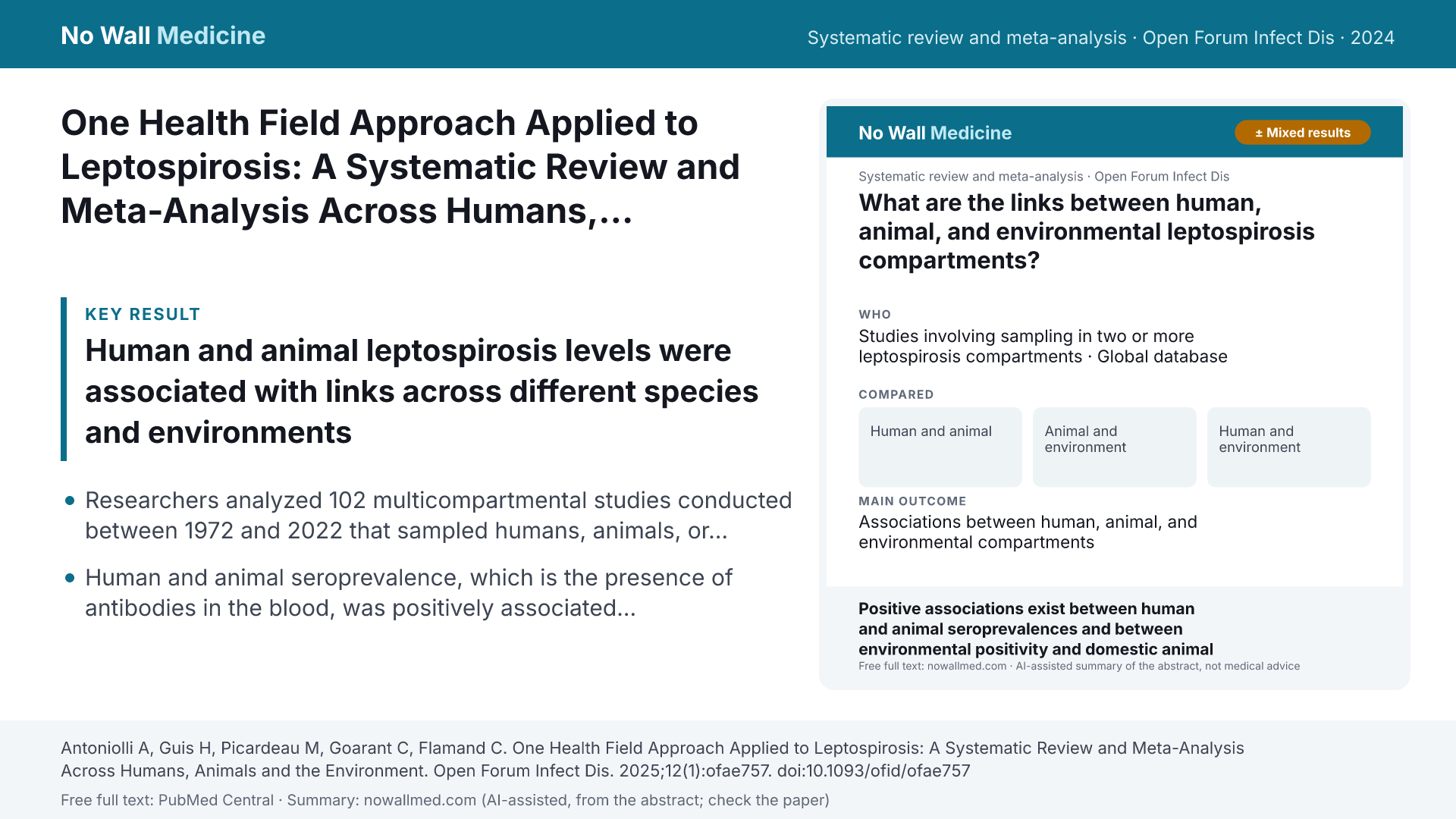
Human and animal leptospirosis levels were associated with links across different species and environments
One Health Field Approach Applied to Leptospirosis: A Systematic Review and Meta-Analysis Across Humans, Animals and the Environment
Systematic review and meta-analysisMixed results
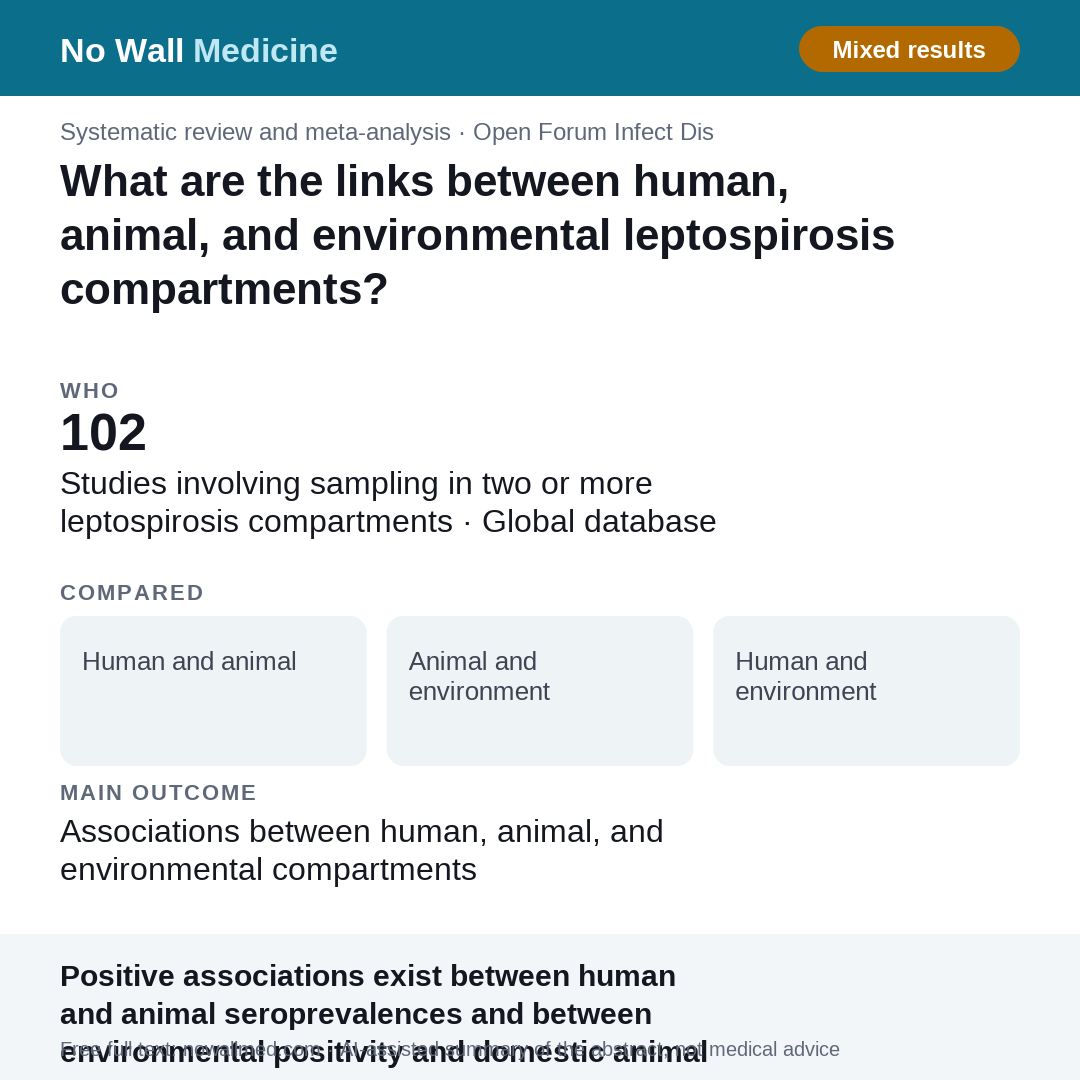
What are the links between human, animal, and environmental leptospirosis compartments?
Who
102
Studies involving sampling in two or more leptospirosis compartments · Global database search
Compared
Human and animal
Animal and environment
Human and environment
Main outcome
Associations between human, animal, and environmental compartments
Bottom line: Positive associations exist between human and animal seroprevalences and between environmental positivity and domestic animal seroprevalence.
Limitation: Limited number of studies included and quality of protocols.
Open Forum Infect Dis · 2024-12-30Download image
Clinical question: What are the links between human, animal, and environmental leptospirosis compartments?
Why it matters: The transmission dynamics and risk factors of leptospirosis, a disease spread through urine, remain unclear due to a lack of robust One Health research.
Key points
- Researchers analyzed 102 multicompartmental studies conducted between 1972 and 2022 that sampled humans, animals, or the environment.
- Human and animal seroprevalence, which is the presence of antibodies in the blood, was positively associated with livestock and wild nonrodent animals.
- The environmental positivity rate was linked to the seroprevalence of domestic animals.
Limitation the authors note: The analysis was constrained by the limited number of studies included and by the quality of protocols.
Headline and key points written with AI from the paper’s abstract, with every number checked against it. Read the paper before relying on them.
Was this summary helpful?
Cite this article
Antoniolli A, Guis H, Picardeau M, Goarant C, Flamand C. One Health Field Approach Applied to Leptospirosis: A Systematic Review and Meta-Analysis Across Humans, Animals and the Environment. Open Forum Infect Dis. 2024. doi:10.1093/ofid/ofae757
Spotted a mistake? Suggest a correction