One-stage surgery showed similar success rates to two-stage surgery for treating joint infections
One-Stage Versus Two-Stage Exchange Arthroplasty for Periprosthetic Joint Infection: A Prospective Randomized Trial
Prospective, multicenter, randomized trialBenefit found
Is one-stage or two-stage exchange arthroplasty better for periprosthetic joint infection?
Who
323
Patients with chronic periprosthetic joint infection after primary hip or knee arthroplasty · multicenter
Compared
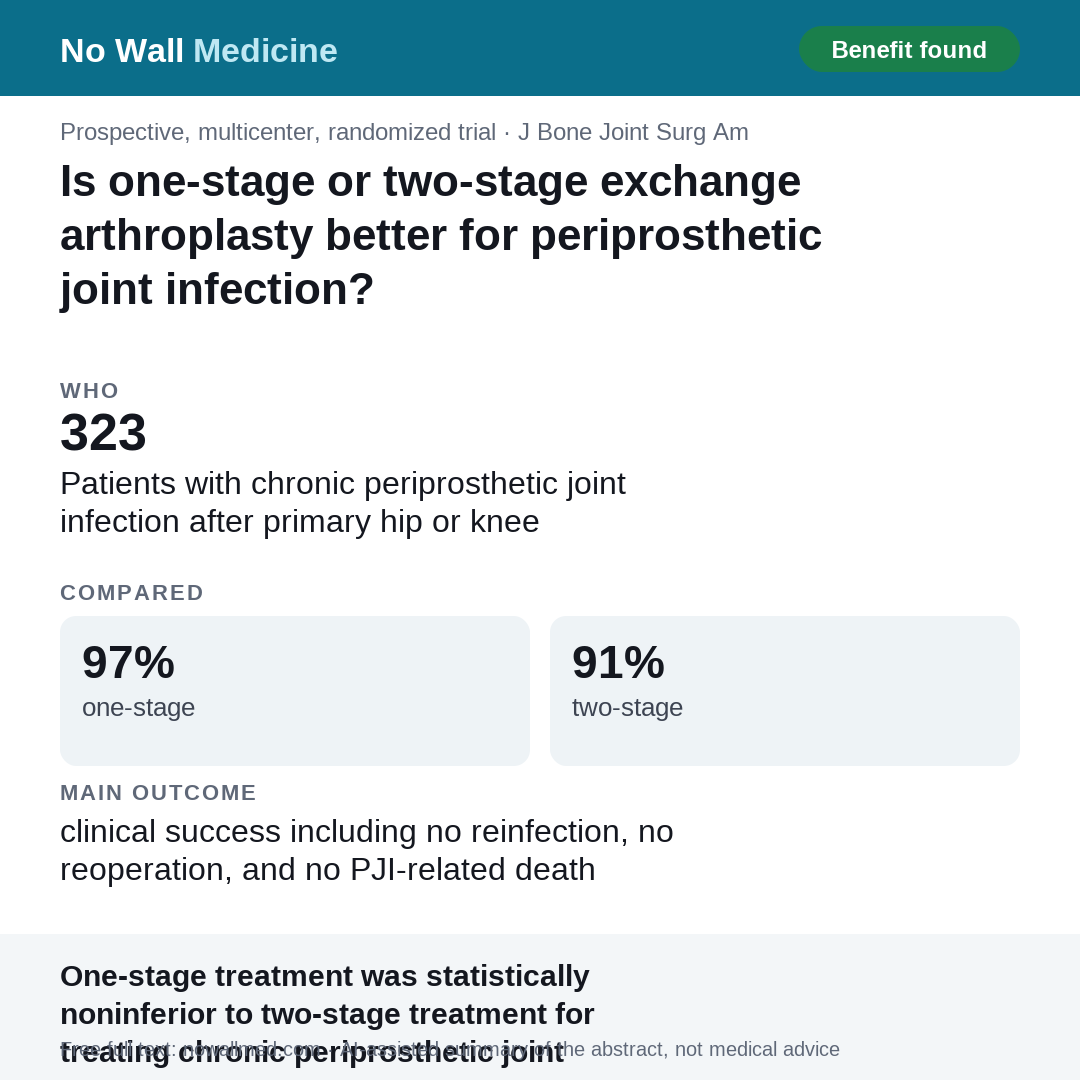
97%one-stage (131 of 135)
91%two-stage (112 of 123)
Main outcome
clinical success including no reinfection, no reoperation, and no PJI-related death
Result: unadjusted odds ratio = 3.22 (95% confidence interval = 1.0 to 10.38)
Bottom line: One-stage treatment was statistically noninferior to two-stage treatment for treating chronic periprosthetic joint infection at 2-year follow-up.
J Bone Joint Surg Am · 2026-04-01Download image
Clinical question: Is one-stage or two-stage exchange arthroplasty better for periprosthetic joint infection?
Why it matters: The two-stage approach is most commonly used for joint infections, but it is associated with high morbidity and expense.
Key points
- Researchers studied 323 patients with chronic periprosthetic joint infection, comparing one-stage versus two-stage surgical replacement of hip or knee implants.
- At two-year follow-up, the one-stage treatment success rate was 97% (131 of 135) compared to 91% (112 of 123) for two-stage treatment.
- The one-stage group had 3-times the odds of overall success compared to the two-stage group in regression analysis.
Headline and key points written with AI from the paper’s abstract, with every number checked against it. Read the paper before relying on them.
Topics
Cite this article
Fehring TK, Otero JE, Fehring KA, Curtin BM, Springer BD, Della Valle CJ. One-Stage Versus Two-Stage Exchange Arthroplasty for Periprosthetic Joint Infection: A Prospective Randomized Trial. J Bone Joint Surg Am. 2026. doi:10.2106/JBJS.25.00713
Spotted a mistake? Suggest a correction