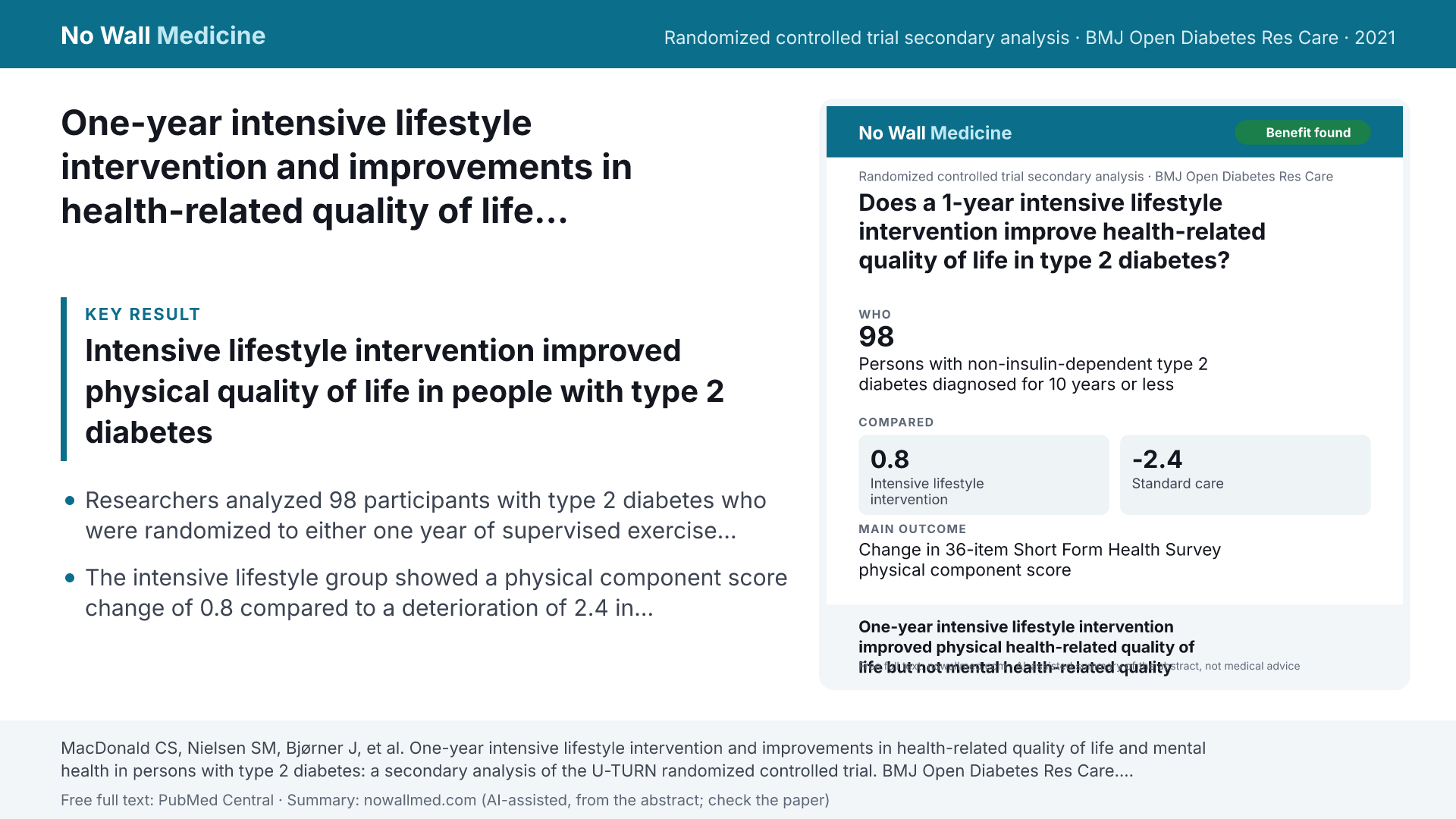
Intensive lifestyle intervention improved physical quality of life in people with type 2 diabetes
One-year intensive lifestyle intervention and improvements in health-related quality of life and mental health in persons with type 2 diabetes: a secondary analysis of the U-TURN randomized controlled trial
Randomized controlled trial secondary analysisBenefit found
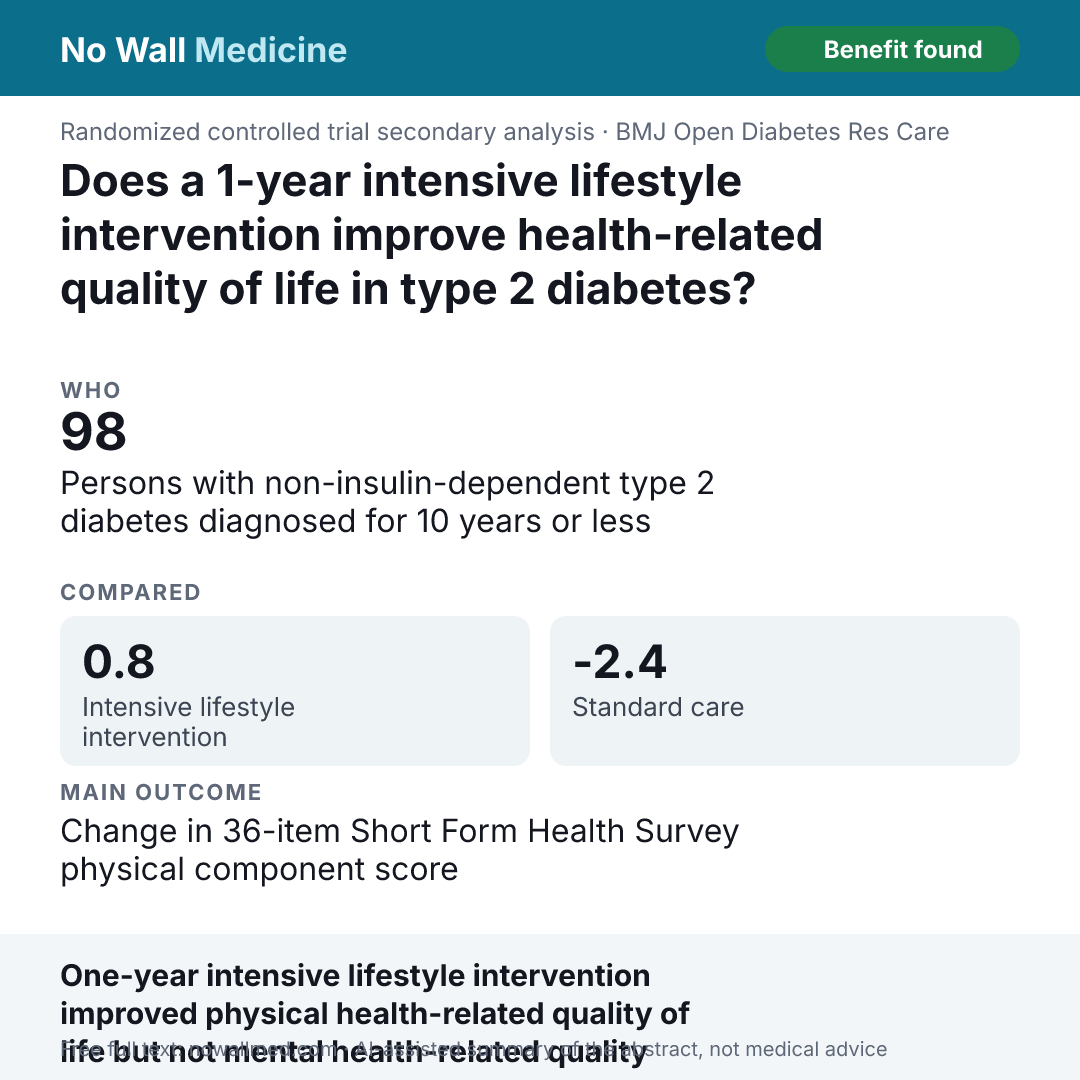
Does a 1-year intensive lifestyle intervention improve health-related quality of life in type 2 diabetes?
Who
98
Persons with non-insulin-dependent type 2 diabetes diagnosed for 10 years or less
Compared
0.8Intensive lifestyle intervention (95% CI -0.7 to 2.3)
-2.4Standard care (95% CI -4.6 to -0.1)
Main outcome
Change in 36-item Short Form Health Survey physical component score
Result: difference of 3.2, 95% CI 0.5 to 5.9
Bottom line: One-year intensive lifestyle intervention improved physical health-related quality of life but not mental health-related quality of life.
BMJ Open Diabetes Res Care · 2021-01-14 · NCT02417012
Why it matters: The effects of lifestyle interventions on health-related quality of life and subjective well-being are ambiguous in people with type 2 diabetes.
Headline and visual abstract written with AI from the paper’s abstract, with every number checked against it. Read the paper before relying on them.
Was this summary helpful?
Abstract
Introduction
The effects of lifestyle interventions in persons with type 2 diabetes (T2D) on health-related quality of life (HRQoL) and subjective well-being are ambiguous, and no studies have explored the effect of exercise interventions that meet or exceed current recommended exercise levels. We investigated whether a 1-year intensive lifestyle intervention is superior in improving HRQoL compared with standard care in T2D persons. Research design and methods
We performed secondary analyses of a previously conducted randomized controlled trial (April 2015 to August 2016). Persons with non-insulin-dependent T2D (duration ≤10 years) were randomized to 1-year supervised exercise and individualized dietary counseling (ie, 'U-TURN'), or standard care. The primary HRQoL outcome was change in the 36-item Short Form Health Survey (SF-36) physical component score (PCS) from baseline to 12 months of follow-up, and a key secondary outcome was changes in the SF-36 mental component score (MCS). Results
We included 98 participants (U-TURN group=64, standard care group=34) with a mean age of 54.6 years (SD 8.9). Between-group analyses at 12-month follow-up showed SF-36 PCS change of 0.8 (95% CI -0.7 to 2.3) in the U-TURN group and deterioration of 2.4 (95% CI -4.6 to -0.1) in the standard care group (difference of 3.2, 95% CI 0.5 to 5.9, p=0.02) while no changes were detected in SF-36 MCS. At 12 months, 19 participants (30%) in the U-TURN group and 6 participants (18%) in the standard care group achieved clinically significant improvement in SF-36 PCS score (adjusted risk ratio 2.6, 95% CI 1.0 to 4.5 corresponding to number needed to treat of 4, 95% CI 1.6 to infinite). Conclusion
In persons with T2D diagnosed for less than 10 years, intensive lifestyle intervention improved the physical component of HRQoL, but not the mental component of HRQoL after 1 year, compared with standard care. Trial registration number
NCT02417012.
Abstract reproduced under the article’s CC BY NC licence.
Subject terms
Cite this article
MacDonald CS, Nielsen SM, Bjørner J, et al. One-year intensive lifestyle intervention and improvements in health-related quality of life and mental health in persons with type 2 diabetes: a secondary analysis of the U-TURN randomized controlled trial. BMJ Open Diabetes Res Care. 2021;9(1). doi:10.1136/bmjdrc-2020-001840
Spotted a mistake? Suggest a correction