Robot-assisted bladder removal surgery was associated with lower transfusion rates than open surgery
Open Radical Cystectomy versus Robot-Assisted Radical Cystectomy with Intracorporeal Urinary Diversion: Early Outcomes of a Single-Center Randomized Controlled Trial
Randomized controlled trialBenefit found
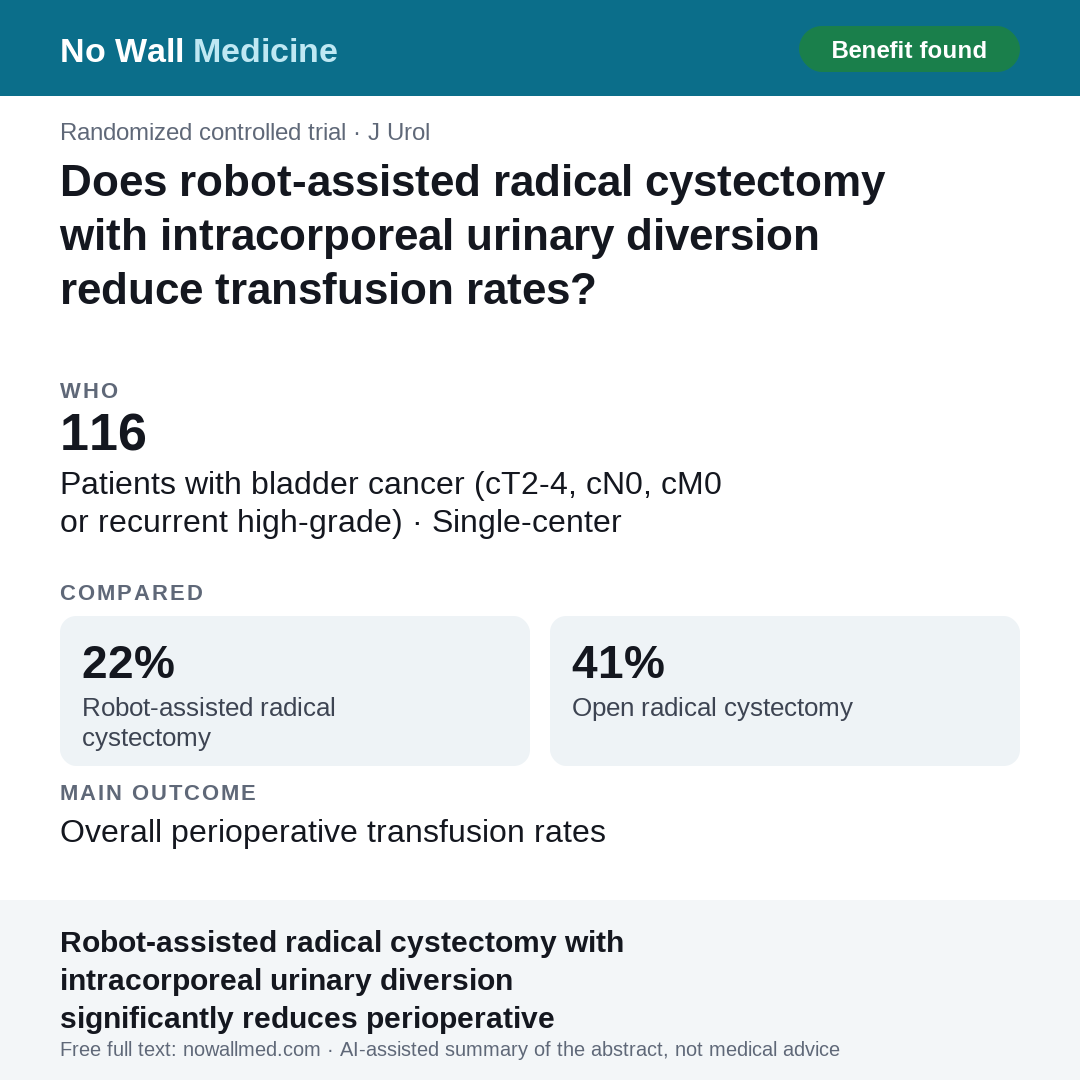
Does robot-assisted radical cystectomy with intracorporeal urinary diversion reduce transfusion rates?
Who
116
Patients with bladder cancer (cT2-4, cN0, cM0 or recurrent high-grade) · Single-center
Compared
22%Robot-assisted radical cystectomy
41%Open radical cystectomy
Main outcome
Overall perioperative transfusion rates
Bottom line: Robot-assisted radical cystectomy with intracorporeal urinary diversion significantly reduces perioperative transfusion rates compared to open radical cystectomy.
Limitation: Oncologic and functional outcomes will be assessed at longer followup.
J Urol · 2022-02-02Download image
Clinical question: Does robot-assisted radical cystectomy with intracorporeal urinary diversion reduce transfusion rates?
Why it matters: It was unknown if a totally minimally invasive robot-assisted bladder removal surgery could reduce transfusion rates compared to the traditional open surgical approach.
Key points
- Researchers compared 116 patients undergoing either open radical cystectomy or robot-assisted radical cystectomy with intracorporeal urinary diversion, which is the reconstruction of the urinary tract entirely inside the body.
- The perioperative transfusion rate was 22% in the robot-assisted group compared to 41% in the open surgery group.
- Perioperative complications, length of hospital stay, and 6-month health-related quality of life were largely comparable between the two surgical methods.
Headline and key points written with AI from the paper’s abstract, with every number checked against it. Read the paper before relying on them.
Was this summary helpful?
Subject terms
Cite this article
Mastroianni R, Ferriero M, Tuderti G, Anceschi U, Bove AM, Brassetti A. Open Radical Cystectomy versus Robot-Assisted Radical Cystectomy with Intracorporeal Urinary Diversion: Early Outcomes of a Single-Center Randomized Controlled Trial. J Urol. 2022. doi:10.1097/JU.0000000000002422
Spotted a mistake? Suggest a correction
Top studies every Monday
The week’s key trials and guidelines in your specialties, plus any topics you follow. By email, free.
Get the weekly digest