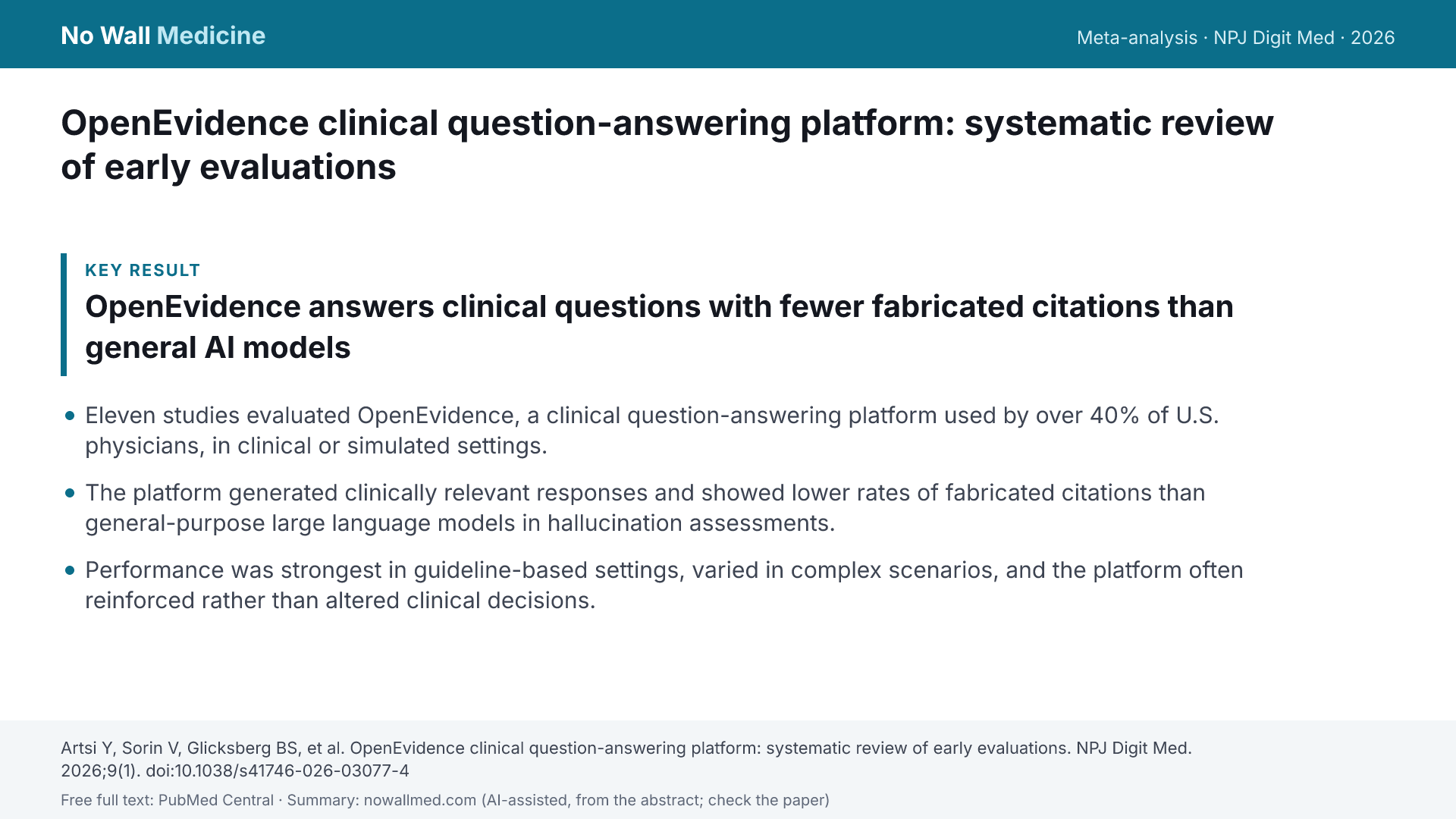
OpenEvidence clinical question-answering platform: systematic review of early evaluations
Key result: OpenEvidence answers clinical questions with fewer fabricated citations than general AI models
Key points
- Eleven studies evaluated OpenEvidence, a clinical question-answering platform used by over 40% of U.S. physicians, in clinical or simulated settings.
- The platform generated clinically relevant responses and showed lower rates of fabricated citations than general-purpose large language models in hallucination assessments.
- Performance was strongest in guideline-based settings, varied in complex scenarios, and the platform often reinforced rather than altered clinical decisions.
Why it matters: Applies to clinicians using AI for decision support; suggests OpenEvidence provides grounded answers but does not typically change existing clinical choices.
Limitation the authors note: The evidence base is limited by methodological heterogeneity, small sample sizes, and the platform's continuous evolution.
Discussion prompts
- Would these patients look like yours? Who was left out?
- Is the main outcome one that matters to patients?
- Is the difference large enough to change what you do?
Cite: Artsi Y, Sorin V, Glicksberg BS, et al. OpenEvidence clinical question-answering platform: systematic review of early evaluations. NPJ Digit Med. 2026;9(1). doi:10.1038/s41746-026-03077-4
Free full text: PubMed Central · Summary and visual abstract: nowallmed.com/a/openevidence-clinical-question-answering-platform-systematic-review-smaiw4/ (AI-assisted from the abstract; check the paper before relying on it).