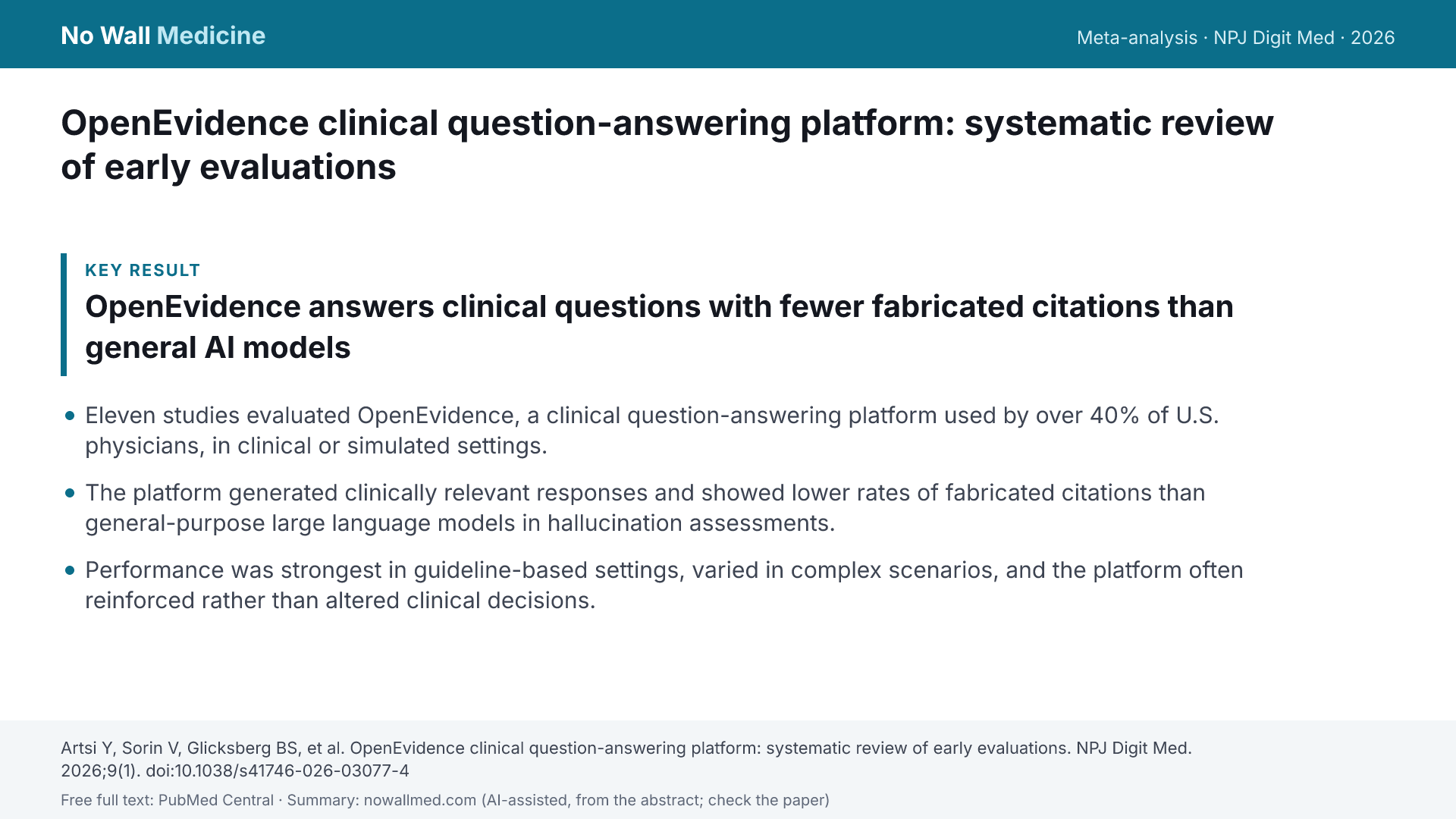
OpenEvidence answers clinical questions with fewer fabricated citations than general AI models
OpenEvidence clinical question-answering platform: systematic review of early evaluations
Why it matters: Applies to clinicians using AI for decision support; suggests OpenEvidence provides grounded answers but does not typically change existing clinical choices.
Key points
- Eleven studies evaluated OpenEvidence, a clinical question-answering platform used by over 40% of U.S. physicians, in clinical or simulated settings.
- The platform generated clinically relevant responses and showed lower rates of fabricated citations than general-purpose large language models in hallucination assessments.
- Performance was strongest in guideline-based settings, varied in complex scenarios, and the platform often reinforced rather than altered clinical decisions.
Limitation the authors note: The evidence base is limited by methodological heterogeneity, small sample sizes, and the platform's continuous evolution.
Headline and key points written with AI from the paper’s abstract, with every number checked against it. Read the paper before relying on them.
Was this summary helpful?
Cite this article
Artsi Y, Sorin V, Glicksberg BS, et al. OpenEvidence clinical question-answering platform: systematic review of early evaluations. NPJ Digit Med. 2026;9(1). doi:10.1038/s41746-026-03077-4
Spotted a mistake? Suggest a correction