Achieving stent optimization via optical coherence tomography was associated with better clinical outcomes in complex lesions
Optical coherence tomography-guided stent optimization for complex coronary lesions: the OCCUPI trial
Randomized trialBenefit found
Does stent optimization after optical coherence tomography guidance improve clinical outcomes in complex lesions?
Who
773
Patients undergoing optical coherence tomography guided percutaneous coronary intervention
Compared
2.9%Optical Coherence Tomography Optimization
9.4%Optical Coherence Tomography Sub-Optimization
Main outcome
Cardiac death, myocardial infarction, stent thrombosis, or ischemia-driven target vessel revascularization
Result: hazard ratio 0.30 (95% CI 0.16-0.58)
Bottom line: Achieving stent optimization via optical coherence tomography significantly reduces clinical events in complex coronary lesions.
Eur Heart J · 2025-11-19Download image
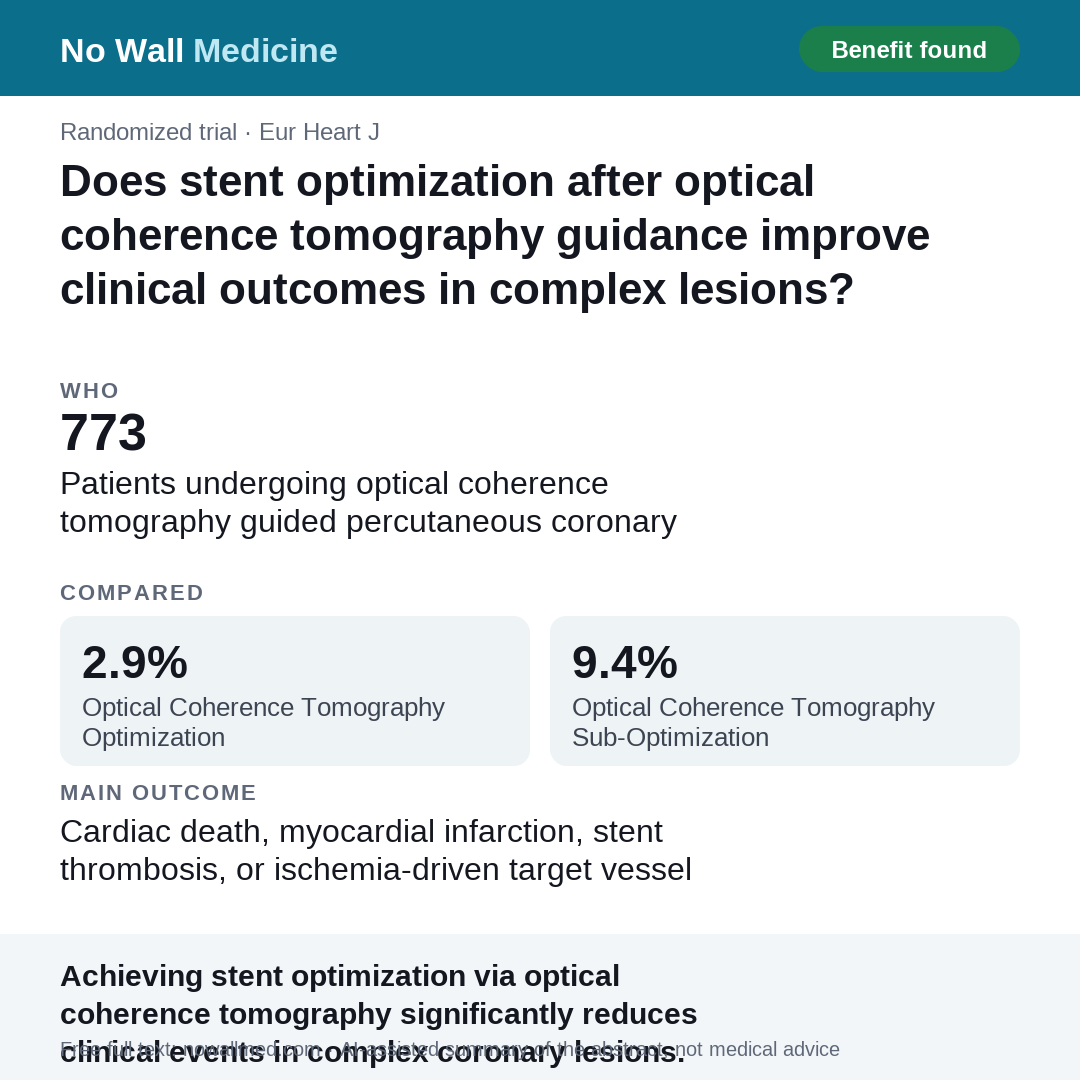
Clinical question: Does stent optimization after optical coherence tomography guidance improve clinical outcomes in complex lesions?
Why it matters: It is unclear how achieving specific stent optimization criteria through optical coherence tomography imaging affects clinical outcomes in patients with complex coronary lesions.
Key points
- Researchers studied 773 patients who underwent percutaneous coronary intervention, a procedure to open blocked heart arteries, using optical coherence tomography, an imaging technology.
- The primary endpoint of cardiac death, heart attack, stent thrombosis, or ischemia-driven target vessel revascularization occurred in 2.9% of the optimization group versus 9.4% in the sub-optimization group.
- Long lesions and small-vessel disease were identified as independent predictors of failing to meet the criteria for stent optimization.
Headline and key points written with AI from the paper’s abstract, with every number checked against it. Read the paper before relying on them.
Topics
Cite this article
Lee SJ, Lee SJ, Hong SJ, Cho DK, Kim JW, Kim SM. Optical coherence tomography-guided stent optimization for complex coronary lesions: the OCCUPI trial. Eur Heart J. 2025. doi:10.1093/eurheartj/ehaf884
Spotted a mistake? Suggest a correction