Optical coherence tomography guidance improved outcomes for patients with moderately or severely calcified coronary lesions
Optical coherence tomography- vs angiography-guided coronary stent implantation in calcified lesions: the ILUMIEN IV trial
Randomized trialBenefit found
Does optical coherence tomography guidance improve outcomes in calcified coronary lesions?
Who
2114
Patients with a single percutaneous coronary intervention target lesion
Compared
6.8%Optical coherence tomography guidance (moderate/severe calcification)
9.7%Angiography guidance (moderate/severe calcification)
Main outcome
2-year target-vessel failure
Result: adjusted hazard ratio 0.62 (95% CI 0.40-0.96)
Bottom line: Optical coherence tomography guidance reduces 2-year target-vessel failure in moderately or severely calcified lesions compared to angiography guidance.
Eur Heart J · 2025-06-05Download image
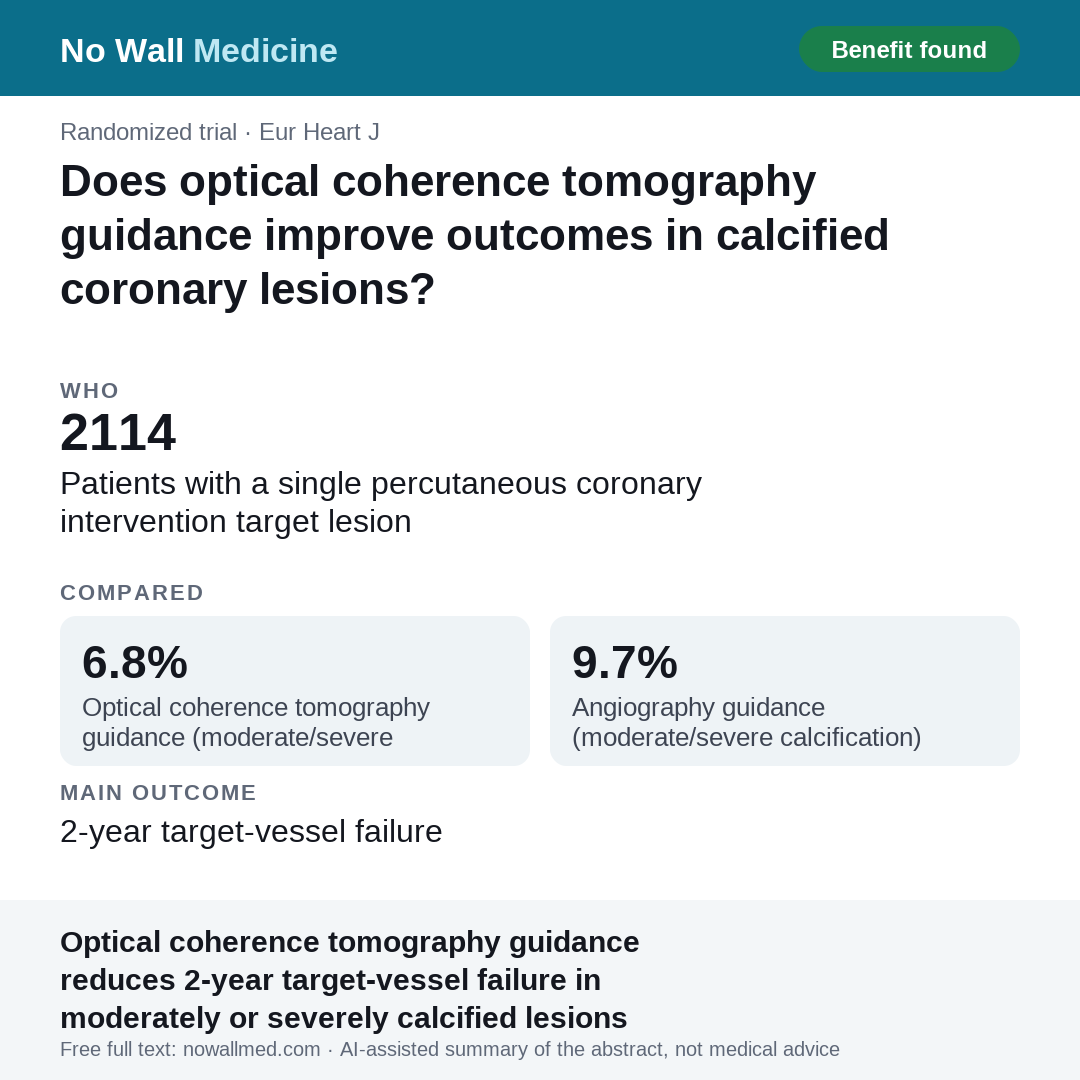
Clinical question: Does optical coherence tomography guidance improve outcomes in calcified coronary lesions?
Why it matters: It is unclear if using optical coherence tomography, an imaging tool, improves outcomes compared to standard angiography when treating calcified coronary artery lesions.
Key points
- Researchers studied 2114 patients undergoing percutaneous coronary intervention, comparing optical coherence tomography guidance to angiography guidance based on the level of calcium in the artery.
- In patients with moderate or severe calcification, optical coherence tomography guidance was associated with a 2-year target-vessel failure rate of 6.8% compared to 9.7% with angiography guidance.
- For those with moderate or severe calcification, optical coherence tomography guidance was associated with lower rates of serious major adverse cardiac events, heart attacks, and stent thrombosis.
Headline and key points written with AI from the paper’s abstract, with every number checked against it. Read the paper before relying on them.
Topics
Cite this article
Ali ZA, Shin D, Vijayvergiya R, Gawalkar AA, Shlofmitz RA, Alfonso F. Optical coherence tomography- vs angiography-guided coronary stent implantation in calcified lesions: the ILUMIEN IV trial. Eur Heart J. 2025. doi:10.1093/eurheartj/ehaf331
Spotted a mistake? Suggest a correction
Top studies every Monday
The week’s key trials and guidelines in your specialties, plus any topics you follow. By email, free.
Get the weekly digest