Virtual reality training was associated with higher compliance with new cardiopulmonary resuscitation quality criteria
Optimal Combination of Chest Compression Depth and Rate in Virtual Reality Resuscitation Training: A Post Hoc Analysis of the Randomized Lowlands Saves Lives Trial
Post hoc analysis of a randomized trialBenefit found
Does virtual reality training improve compliance with new cardiopulmonary resuscitation quality criteria?
Who
352
352 participants, age 26 years, 56% female
Compared
Virtual reality training: 52% compliance with new criteria
Current quality criteria: 23% compliance
Main outcome
Compliance with newly proposed cardiopulmonary resuscitation quality criteria
Bottom line: Virtual reality training may lead to cardiopulmonary resuscitation quality compliant with recently proposed new quality criteria.
J Am Heart Assoc · 2021-01-14Download image
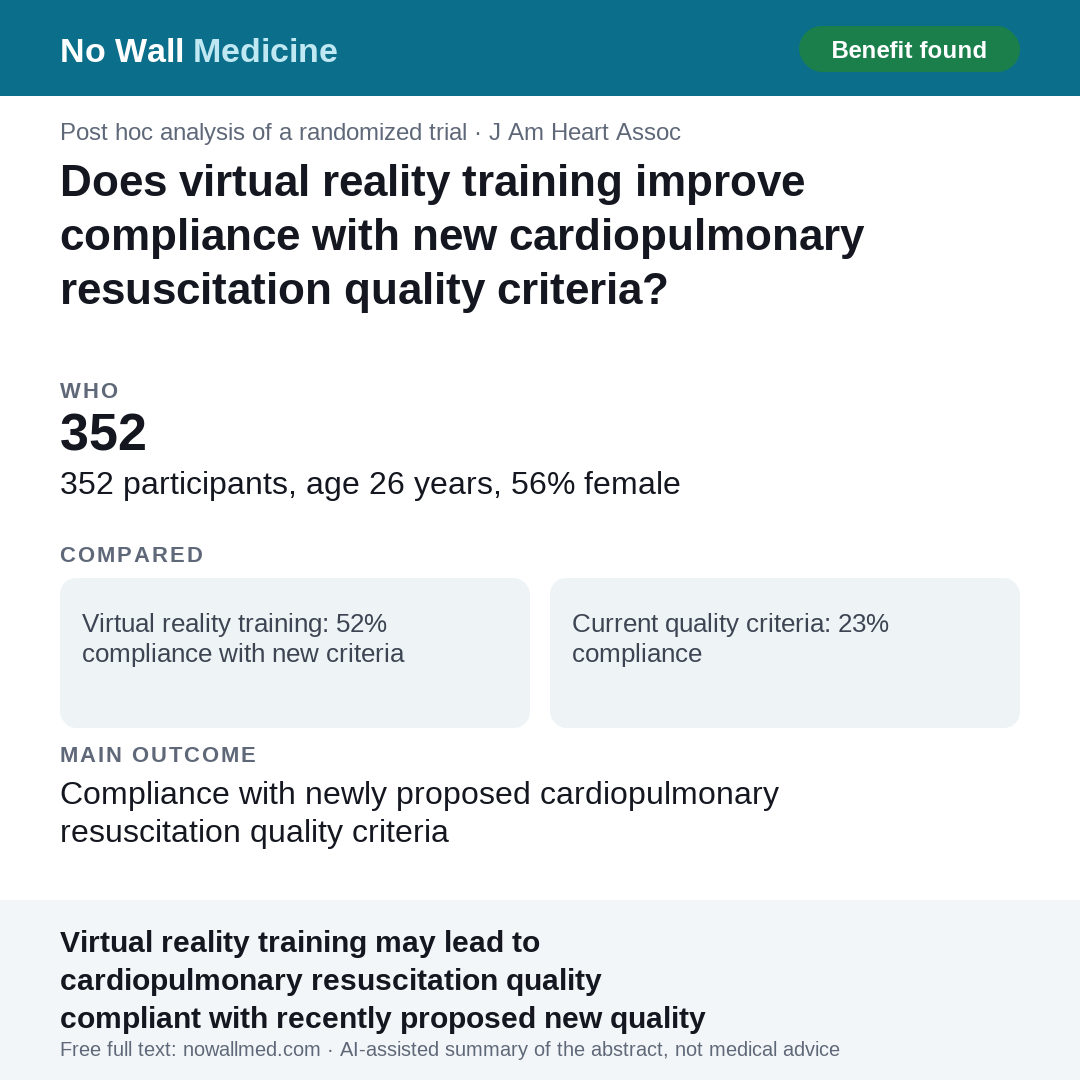
Clinical question: Does virtual reality training improve compliance with new cardiopulmonary resuscitation quality criteria?
Why it matters: It is unknown if virtual reality training can help learners meet newly proposed standards for the depth and speed of chest compressions during cardiopulmonary resuscitation.
Key points
- Researchers analyzed 352 participants, with a median age of 26 years, comparing face-to-face training to virtual reality training using a smartphone application.
- Among those using virtual reality, 52% met new quality criteria compared to 23% meeting current criteria, driven by a 96% compliance rate for compression speed.
- There was no statistically significant difference in meeting depth requirements between the new and current criteria, with 55% and 51% compliance respectively.
Headline and key points written with AI from the paper’s abstract, with every number checked against it. Read the paper before relying on them.
Was this summary helpful?
Subject terms
Cite this article
Nas J, Thannhauser J, van Geuns RM, van Royen N, Bonnes JL, Brouwer MA. Optimal Combination of Chest Compression Depth and Rate in Virtual Reality Resuscitation Training: A Post Hoc Analysis of the Randomized Lowlands Saves Lives Trial. J Am Heart Assoc. 2021. doi:10.1161/JAHA.120.017367
Spotted a mistake? Suggest a correction
Top studies every Monday
The week’s key trials and guidelines in your specialties, plus any topics you follow. By email, free.
Get the weekly digest