Comprehensive care and flow capacity-guided revascularization reduced death and heart attack risk in patients
Optimal medical care and coronary flow capacity-guided myocardial revascularization vs usual care for chronic coronary artery disease: the CENTURY trial
Randomized trialBenefit found
Does comprehensive care with coronary flow capacity-guided revascularization improve outcomes in chronic coronary artery disease?
Who
1028
Patients with chronic stable coronary artery disease
Compared
20.5%Comprehensive care
29.9%Standard care
Main outcome
Major adverse cardiac events
Bottom line: Comprehensive care with coronary flow capacity-guided revascularization reduced major adverse cardiac events and death.
Eur Heart J · 2025-05-29 · Save PNG
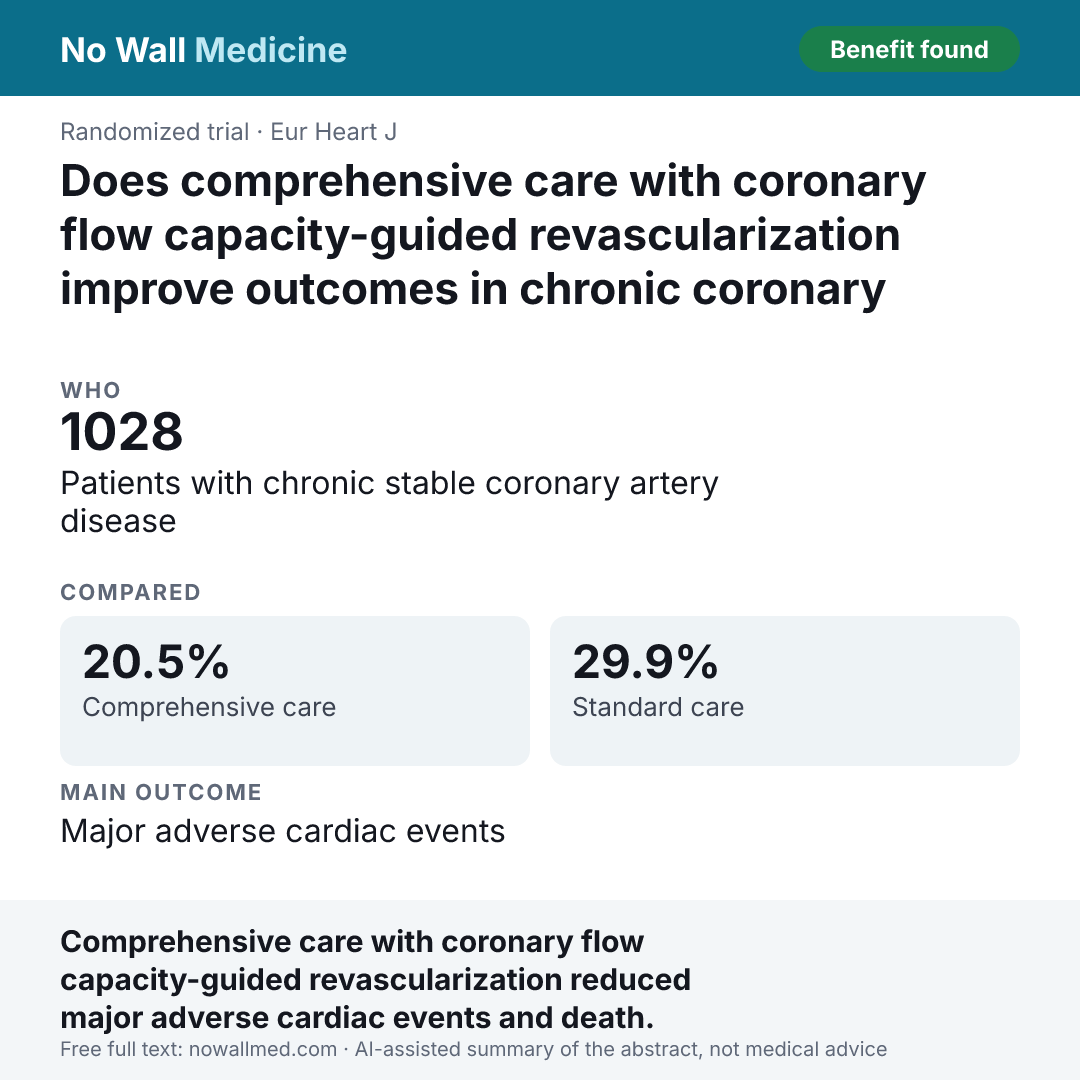
Clinical question: Does comprehensive care with coronary flow capacity-guided revascularization improve outcomes in chronic coronary artery disease?
In absolute numbers
Comprehensive care: 20.5% · Standard care: 29.9% → a difference of 9.4 percentage points, so about 11 people would need the treatment for 1 more to benefit (number needed to treat) over the trial’s follow-up.
Worked out by us from the two group results above, not reported by the authors. Check the paper for the exact outcome and timing.
Key points
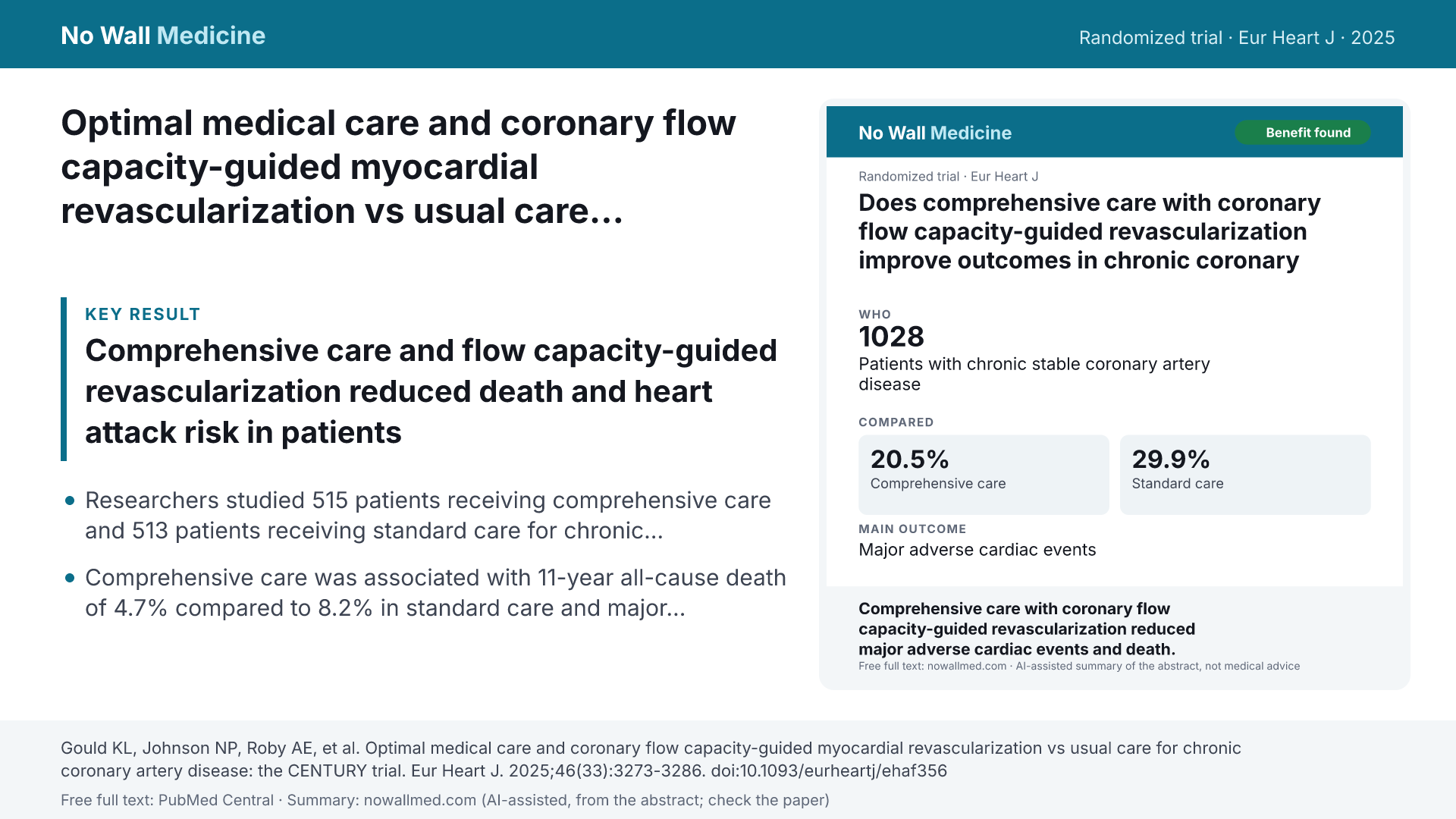
- Researchers studied 515 patients receiving comprehensive care and 513 patients receiving standard care for chronic stable coronary artery disease.
- Comprehensive care was associated with 11-year all-cause death of 4.7% compared to 8.2% in standard care and major adverse cardiac events of 20.5% versus 29.9%.
- The comprehensive care group had lower rates of death or myocardial infarction (7.0% vs 11.1%) and late revascularization (9.5% vs 14.8%).
Headline and key points written with AI from the paper’s abstract, with every number checked against it. Read the paper before relying on them.
Was this summary helpful?
Subject terms
Headline, design, result, key points, caveat and citation as plain text.
Cite this article
Gould KL, Johnson NP, Roby AE, et al. Optimal medical care and coronary flow capacity-guided myocardial revascularization vs usual care for chronic coronary artery disease: the CENTURY trial. Eur Heart J. 2025;46(33):3273-3286. doi:10.1093/eurheartj/ehaf356
Spotted a mistake? Suggest a correction