Strict phosphate target ranges were associated with slower coronary artery calcification progression in dialysis patients
Optimal Phosphate Control Related to Coronary Artery Calcification in Dialysis Patients
Randomized, open-label, multicenter, interventional trialBenefit found
Does phosphate target range or binder type affect coronary artery calcification progression?
Who
115
Adults on maintenance dialysis · multicenter
Compared
Strict phosphate target (3.5-4.5 mg/dl): median of 8.52 (interquartile range, -1.0-23.9)
Standard phosphate target (5.0-6.0 mg/dl): median of 21.8 (interquartile range, 10.0-36.1)
Sucroferric oxyhydroxide
Lanthanum carbonate
Main outcome
percentage change in coronary artery calcification scores
Bottom line: Strict phosphate control shows promise for delaying coronary artery calcification progression in patients undergoing maintenance hemodialysis.
Limitation: Further study with a larger sample size is needed
JASN · 2021-02-05Download image
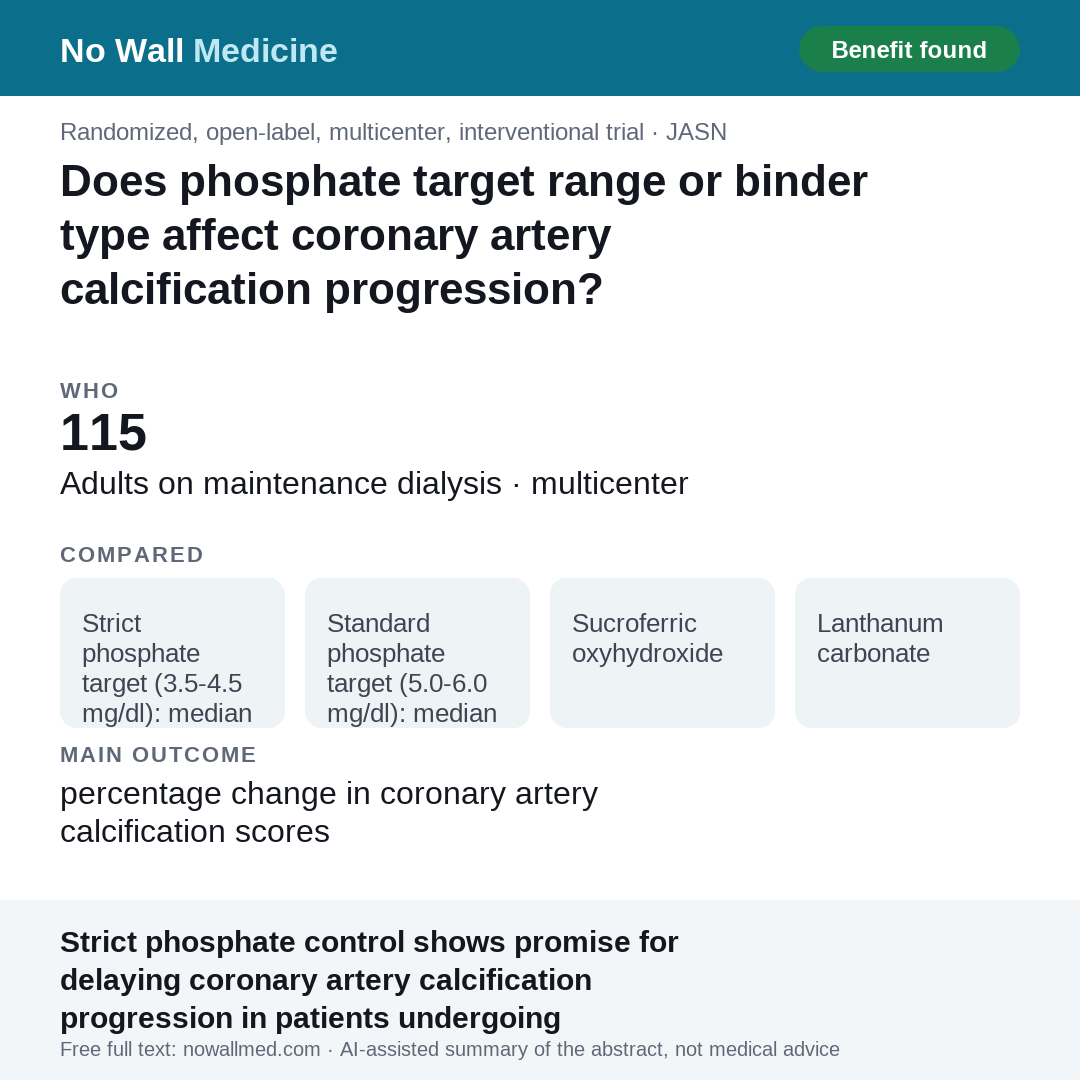
Clinical question: Does phosphate target range or binder type affect coronary artery calcification progression?
Why it matters: The optimal serum phosphate range for managing coronary artery calcification, which is the buildup of calcium in the heart arteries, remains unknown in patients on dialysis.
Key points
- Researchers studied 115 adults on maintenance dialysis to compare two noncalcium-based phosphate binders and two different phosphate target ranges over 12 months.
- The strict phosphate target group had a median percentage change in coronary artery calcification scores of 8.52 compared to 21.8 in the standard group.
- No significant difference in the percentage change of coronary artery calcification scores was observed between the sucroferric oxyhydroxide and lanthanum carbonate groups.
Headline and key points written with AI from the paper’s abstract, with every number checked against it. Read the paper before relying on them.
Was this summary helpful?
Subject terms
Cite this article
Isaka Y, Hamano T, Fujii H, Tsujimoto Y, Koiwa F, Sakaguchi Y. Optimal Phosphate Control Related to Coronary Artery Calcification in Dialysis Patients. JASN. 2021. doi:10.1681/ASN.2020050598
Spotted a mistake? Suggest a correction
Top studies every Monday
The week’s key trials and guidelines in your specialties, plus any topics you follow. By email, free.
Get the weekly digest